

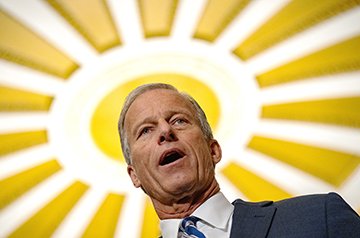
Senator John Thune (R–SD), a career politician who this week was elected majority leader of the U. S. Senate, will now have a bigger influence over U.S. research funding. And although Thune doesn’t have a deep background in science, he’s painfully familiar with the political down and dirty it often takes to realize a scientific megaproject, having once advocated for building a massive underground physics laboratory in his home state.
More than 2 decades ago, during his early years in Congress, Thune became a prominent player in a long and often contentious battle to convert the world’s deepest gold mine into a state-of-the-art underground research laboratory. Although parts of that vision are now coming to fruition with funding from the U.S. Department of Energy (DOE), backers of the original idea ultimately failed to persuade the National Science Foundation (NSF) to fund the grandest version of their dream. Surprisingly, however, the nerdy research project did become a hot talking point for conservative radio hosts and the subject of attack ads during a fierce election campaign. That experience may have helped prepare Thune for the tough job ahead: trying to unite the Senate’s fractious 53 Republicans, who now make up the majority of that chamber, behind President-elect Donald Trump’s agenda.
Thune’s close encounter with subterranean science began in late 2000, when a mining company announced plans to close the Homestake Gold Mine, a 125-year-old, 2500-meter-deep shaft in the scenic Black Hills of South Dakota, 80 kilometers north of Mount Rushmore. U.S. physicists had long desired a facility deep enough underground to shelter their sensitive particle detectors from cosmic rays, especially detectors designed to search for particles of mysterious dark matter or elusive particles called neutrinos. So, they leapt into action when they heard that Homestake’s deep chambers might be available, developing a $281 million request to NSF to create the nation’s deepest laboratory. “This is an unusual opportunity to create the best underground laboratory ever,” physicist John Bahcall told Science when the scientists unveiled the proposal in mid-2001.
Thune, who won a seat in the House of Representatives in 1996, saw the proposed lab as a promising way to save some of the mine’s jobs and economic benefits. “It all centers around something that up until a year ago I knew very little about, and that is neutrino research,” Thune explained on the House floor in late 2001. “We have the opportunity to take something that would be considered a liability and convert it into an asset.” The state’s two Democratic senators at the time, Tim Johnson and Tom Daschle, agreed.
The lab proposal, however, soon became entangled in a host of practical and political problems. One was the cost of running massive pumps to keep the mine’s sprawling tunnels from filling with water. The mine’s owners, meanwhile, refused to donate it for use as a lab unless they were assured they would face no legal or financial liability for future environmental cleanups or injuries. And many scientists and lawmakers were upset that lab proponents appeared to be trying to circumvent NSF’s usual process for approving big projects and jump ahead of other costly facilities awaiting funding.
Despite such concerns, South Dakota lawmakers were able to persuade Congress to provide some $10 million annually to keep the pumps going, and in late 2001, Daschle and Johnson won Senate approval for a bill that shifted mine liabilities to the federal government. But the project became a political punching bag. “Congress should not be in the business of legislating what is scientifically meritorious,” complained then-Senator Christopher Bond (R–MO). And environmental groups and conservative commentators, including the then-powerful radio host Rush Limbaugh, vociferously attacked the legislation, complaining that it amounted to an expensive taxpayer giveaway.
Thune, who was backing a similar liability bill in the House, scrambled to quiet the criticism by persuading his body to add provisions he said protected taxpayers. But to little avail: Congress shelved the bill after NSF officials warned it could set a dangerous precedent for the agency, and the mine owner said it wouldn’t make a deal if the House provisions remained.
South Dakotans were disappointed. And much to Thune’s chagrin, his effort to salvage the liability bill became an issue in his 2002 effort to win Johnson’s Senate seat. Johnson savaged Thune for wrecking the Homestake deal in a TV ad and public statements, a charge Thune doggedly denied. In the end, Thune lost that election by less than 600 votes. But in 2004 he tried again and shocked many observers by defeating Daschle—then the Senate’s majority leader —to claim his current seat. Thune would go on to rise through the Senate’s ranks, including serving as chair of the body’s science and commerce committee from 2015 to 2019.