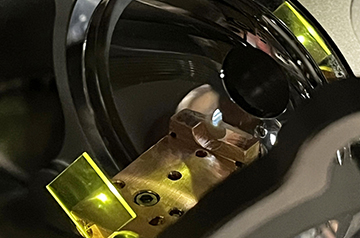
For a few precious minutes during a solar eclipse, the Moon blots out the disk of the Sun, revealing its wispy outer atmosphere, or corona. On 4 November, NASA plans to launch the Coronal Diagnostic Experiment (CODEX), an instrument that will create eclipses on demand with a Sun-blocking device called a coronagraph. Attached to the International Space Station (ISS), it will study the “middle corona,” the layer of the Sun’s atmosphere that generates the solar wind, the stream of charged particles—mostly electrons—that fan out from the Sun toward Earth.
By consistently measuring the solar wind’s temperature and speed in this region for the first time, CODEX scientists hope to improve their understanding of what accelerates and heats it up–and what sometimes causes highly energetic bursts of particles to crash into Earth in bouts of space weather.
CODEX will provide “a level of detail that we’ve never been able to have before,” says Nicholeen Viall, a heliophysicist at NASA’s Goddard Space Flight Center and the science lead on CODEX, a $30 million collaboration between NASA, the Korea Astronomy and Space Science Institute (KASI), and Italy’s National Institute for Astrophysics.
Around the world, a suite of instruments already study the Sun’s corona from the ground and space. Perhaps most notable is NASA’s Parker Solar Probe, which in 2021 became the first spacecraft to fly through the corona. But Parker samples the outermost parts of the corona at a distance of about 10 solar radii, whereas other solar telescopes zoom in on its innermost parts. CODEX will target the middle corona, between about 2.75 and 10 solar radii.
CODEX will observe the solar wind not just in a new place, but in new ways. Most coronagraphic instruments measure the overall brightness of the light reflected by electrons in the solar wind, which corresponds to the density of particles and the wind’s strength.
But CODEX’s coronagraph, which blocks the Sun with a disk as wide as a tennis ball, will also measure the speed and temperature of the electrons, using four filters that gather coronal light at specific wavelengths. Changes in particle temperature alter the shape of the corona’s spectrum—the intensity of the light at a given wavelength. With the filters sampling four points on this spectrum, CODEX researchers can estimate its shape and work backward to calculate the temperature of the particles.
To calculate speed, CODEX researchers will measure shifts in the four filtered wavelengths caused by electrons moving toward or away from Earth. The shifts occur because of the Doppler effect—the same reason ambulance sirens squeal higher on approach and shift down in pitch as they recede.
The measurements could help heliophysicists solve an enduring mystery: the mechanisms that heat the solar wind to more than 1 million degrees Celsius and speed it up to more than 1 million kilometers per hour. Those have been “key outstanding problems in solar physics for decades,” says Jeffrey Newmark, a heliophysicist at Goddard and principal investigator (PI) of CODEX. “We’re going to add pieces to the puzzle.”
There are two leading theories, both involving the conversion of the Sun’s magnetic energy into the thermal energy of the solar wind particles. One suggests that as tangled and looping magnetic fields reconnect near the Sun’s surface, they release bursts of energy into the corona that excite the solar wind particles until they overcome the Sun’s gravity. Another theory posits that the wiggling of Alfvén waves, oscillations in the Sun’s magnetic field that penetrate into the corona and turn back on themselves, can also inject energy into the solar wind. However, these theories aren’t mutually exclusive; both mechanisms likely occur, Viall says.
Most of the time, Earth’s magnetic field can rebuff and deflect the solar wind. But sometimes, bouts of intense magnetic activity on the Sun lead to coronal mass ejections—high-powered, bloblike bursts of solar wind. These space weather events can cause visually stunning aurorae when they crash into Earth’s magnetic field, but the energetic particles can harm astronauts, disrupt satellite operations, and interfere with utility power grids. Collecting more data should help heliophysicists inch closer to predicting space weather events much like meteorologists forecast hurricanes, Viall says.
However, CODEX’s location on the ISS means it can only catch space weather events when it happens to be oriented toward the Sun—roughly a bit more than half the time, says Yeon-Han Kim, a solar astronomer at KASI and PI of South Korea’s CODEX team.
Another payoff of missions like CODEX is their ability help heliophysicists understand other stars in the universe, says Christina Cohen, a space physicist at the California Institute of Technology who is not involved with CODEX. “People who study the Sun, like me, like to think of our Sun as special,” she says. But it’s actually a fairly common kind of star, and “anything we can really understand should apply to at least a certain category of stars,” she says.
In the coming year, NASA and the European Space Agency plan to launch more coronagraphic missions to study the Sun’s corona and solar wind, including PUNCH (Polarimeter to Unify the Corona and Heliosphere) and Proba-3. Cohen is pleased. “The more, the better,” she says.
More: https://www.science.org/content/article/nasa-instrument-study-mysterious-origins-solar-wind