


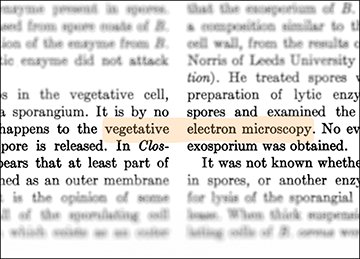
The phrase was so strange it would have stood out even to a non-scientist. Yet "egetative electron microscopy" had already made it past reviewers and editors at several journals when it was noticed the odd wording in a now-retracted paper in Springer Nature’s Environmental Science and Pollution Research. The ludicrous phrase is what sleuths call a "fingerprint": an offbeat characteristic found in one or more publications that suggests paper-mill involvement.
In one of his PubPeer comments, Alexander Magazinov, a software engineer in Kazakhstan, speculated the phrase could have originated through faulty digital processing of a two-column article from 1959 in which the word "vegetative" appeared in the left column directly opposite "electron microscopy" in the right. Perhaps an AI model had picked it up and spit it back into machine-generated text that was since plagiarized in other papers by the same Iranian network of fraudsters, Magazinov elaborated in an interview.
Searching for such clues is just one way to identify the hundreds of thousands of fake papers analysts say are polluting the scientific literature. And the tale of "vegetative electron microscopy" shows how nonsense phrases can enter the vocabulary of researchers and proliferate in the literature.
More: https://retractionwatch.com/2025/02/10/vegetative-electron-microscopy-fingerprint-paper-mill/
