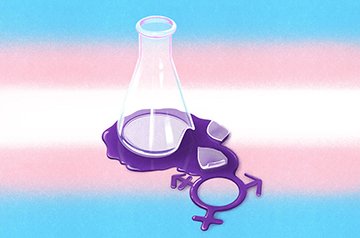
On 21 January, Chris Beyrer, an infectious disease epidemiologist at Duke University, was on a weekly call with about 20 fellow scientists who are running an HIV prevention trial funded by the U.S. National Institutes of Health (NIH).
The previous day, as one of his first actions in office, President Donald Trump signed an executive order declaring it “the policy of the United States to recognize two sexes, male and female.” It ordered the word “gender” to be replaced with “sex” throughout federal policies and documents and mandated that government agencies “ensure grant funds do not promote gender ideology.”
One scientist on the call declared that, executive order or not, they would keep honoring any colleague’s request to be addressed with they/them pronouns. After the call, Beyrer says, a different, junior scientist confided to him their worry that expressing support for nonbinary people in a group call could put the research project at risk. “They said to me, ‘I hope nobody says anything like that on a public call ever again.’ And I thought: ‘Wow, OK, this person is afraid.’”
Fear and uncertainty dominated conversations this week among those doing NIH-funded research involving people who are transgender, gender fluid, nonbinary, or otherwise gender minorities. The consequences of the order for research are still not clear, and Science has not learned of any project forced to halt work as a result of the order. But, “There is … very real concern,” about the fate of such studies, Beyrer says, “particularly among younger investigators [who] want to launch careers in this area.”
Matthew Mimiaga, an epidemiologist at the University of California, Los Angeles who is running a large trial of a phone app aimed at preventing HIV in young transgender women, says the order “could significantly limit the scope of research [in] critical areas in need of attention and continued funding.” Seven other scientists who are principal investigators involved with large, agency-funded projects declined to speak on the record or did not respond to interview requests. “The situation is too volatile and I don’t want to draw attention to our study,” one said.
The executive order attempts to define sex as binary and eliminate the concept of gender identity, stating that it “does not provide a meaningful basis for identification and cannot be recognized as a replacement for sex.” Scientists have criticized the order’s language for ignoring the existence of intersex people and failing to comprehend the biological distinctions and interactions between sex and gender. But what it will mean for science depends on “what falls under ‘promote gender ideology,’” says Carrie Wolinetz, a former NIH chief of staff who leads the health and bioscience policy practice at lobbying firm Lewis-Burke Associates. A broad interpretation, she says, “could impact any award involving transgender individuals or that differentiates gender identity from sex.”
One scientist at a major academic medical center, who doesn’t study gender minorities but has a grant with the word “gender” in its title, fears a broad interpretation could include his work, which focuses on how biological differences between the sexes affect Alzheimer’s disease in mice and humans. He asked not to be identified for fear of his grant becoming a target. “If they are going to cancel grants just using ‘gender’ without understanding what they’re about, that is going to be a huge problem,” he says.
NIH, which has a budget of more than $47 billion, is funding about 1600 active research and training projects, totaling just under $1 billion, that mention “gender” in their abstract, according to a review by Science of NIH data. There are 412 grants worth $235 million whose abstracts contain the terms “transgender,” “gender minority,” or “nonbinary.” The funding involves almost every NIH institute, but is concentrated in institutes focused on infectious diseases, mental health, alcoholism, and drug abuse, reflecting conditions for which transgender people are disproportionately at risk. Many projects focus on care for transgender teens, and nearly half involve HIV or AIDS.
“Most of these studies I don’t think a reasonable person could argue are ‘promoting’ an ideology,” says Douglas Diekema, a bioethicist and pediatrician at the University of Washington who chaired a federal advisory committee that recently issued recommendations for improving inclusion of lesbian, gay, transgender, and other sexual and gender minority people in clinical trials. “Most [of the studies] are looking at individuals who happen to be part of the LGBTQI [lesbian, gay, bisexual, transgender, queer, and intersex] community. And they have health conditions or disparities in their ability to obtain health care that may differ from other individuals or populations in the United States. That’s what people are studying,” he says.
It will be up to lawyers at individual agencies to interpret the executive order, Wolinetz says. But, given the political tone of the executive order, “I strongly suspect that the administration would support the broadest interpretation.” She notes that in 1997, when Congress began to specify in the U.S. Centers for Disease Control and Prevention’s annual funding bill that none of the agency’s money “may be used to advocate or promote gun control,” the agency stopped funding firearm research entirely until 2019, when Congress explicitly clarified that the amendment did not prohibit federal funding of research on gun violence.
Some fear the phrase “promote gender ideology” will extend to the identity of researchers. Jess McLaughlin, an evolutionary biologist and genomics researcher at the University of Alaska Anchorage, studies topics such as bird speciation, but they wonder whether their status as an openly trans scientist who emphasizes diversity, inclusion, and equity in their lab will hurt their ability to apply for federal funding in the future.
The executive order has already changed the environment for transgender scientists. Resource pages for LGBTQI individuals are being taken down across federal websites. At NIH, several relevant pages, including one devoted to distinguishing sex and gender in research, lead to “access denied” messages. And because the order also calls for changes to require government-issued identification documents “accurately reflect the holder’s sex,” researchers who travel internationally for fieldwork and conferences may run into issues if the gender marker “X” on their passport isn’t recognized as valid, McLaughlin adds.
Diekema, for his part, is waiting and watching for how the executive order plays out. “It’s extraordinarily difficult to predict with any degree of certainty anything this current administration might or might not do,” he says. But, he adds, “These aren’t ‘ideologies’ for most of us. These are people. Individuals with [health] needs as important as anybody else’s.”