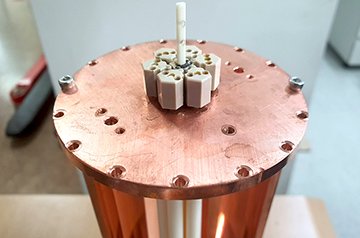
Physicists in South Korea have honed their detector for hypothetical dark matter particles called axions by borrowing concepts from unlikely sources: strange constructs called metamaterials, and kirigami, a form of origami in which paper can be both cut and folded. Their innovation, described in a paper in press at Physical Review Letters, could help axion hunters spot quarry that would elude current detectors.
“It’s a very clever idea and it looks like they did a nice job in implementing it,” says Aaron Chou, a quantum physicist at the Fermi National Accelerator Laboratory. “There’s a lot of papers of people saying you could build something like this,” Gray Rybka, a particle astrophysicist at the University of Washington (UW), says. “They built it.”
Axions are one possible solution to the cosmic mystery of dark matter, the invisible stuff that appears to provide most of the gravity needed to keep galaxies from whirling to pieces. Presumably it consists of some new type of particle, and for decades physicists have hunted in vain for the prime suspect, weakly interacting massive particles. A few have also pursued the axion, a nearly massless particle originally proposed to solve a different problem with the theory of the strong nuclear force.
If they exist, axions should interact with a magnetic field to turn into detectable photons. For example, UW’s Axion Dark Matter Experiment (ADMX) consists of a metal cylinder 30 centimeters wide and 1 meter long, chilled to near absolute zero and nestled in a magnet with a field of 8 Tesla, several times stronger than that of a commercial MRI machine. Axions passing through the field would turn into photons with a frequency proportional to the axion’s mass, somewhere in the radio range.
ADMX’s cylinder serves as an antenna to detect that signal. Depending on its dimensions, the cylinder will ring with radio waves of a specific frequency, just as a bottle will whistle with sound waves of a set pitch if you blow across its mouth. Physicists can adjust the cylinder’s resonant frequency, trying to match and amplify the tiny radio signal from any axions, by repositioning one or two off-center tuning rods. ADMX has scanned frequencies from 0.6 to 1.1 gigahertz and found nothing, ruling out axions with masses from 2.7 to 4.3 micro–electron volts (µeV) as the sole source of dark matter.
But recent theoretical works suggest the axion could be heavier than that. To reach higher frequencies and higher masses, physicists can make the chamber smaller. But doing so saps its sensitivity, as doubling a cylinder’s resonant frequency would require shrinking it to one-eighth its original volume. That’s why ADMX researchers plan to run four smaller chambers together in their rig, a task more formidable than it sounds.
Rather than shrink the device, SungWoo Youn, a physicist at South Korea’s Institute for Basic Science, and colleagues decided to use a higher frequency resonance, or mode, of the same cavity. Just as a bottle can sing at a higher pitch if blown into more directly, a metal cylinder can ring with radio waves of certain higher frequencies, too. “Using a higher order mode, basically you can increase the frequency quite naturally without losing any volume,” Youn says.
There’s a catch, however. In a cavity’s lowest mode, the radio waves’ electric field oscillates uniformly up and down along the cavity axis. In the next higher frequency mode, the electric fields in the cavity’s center and its outer region point in opposite directions and oscillate out of sync, which would dramatically curtail the conversion of the axions to photons.
To overcome this problem, Youn and colleagues placed rods of an insulating material in the center of their cavity. The rods would soak up most of the electric field there while allowing it to oscillate at full strength beyond the rods, restoring the conversion rate. Others had done similar things, Rybka notes, but earlier efforts made the higher mode resonator ring strongly at one frequency or made it tunable, not both.
Youn and colleagues got around that jam by borrowing an idea from metamaterials, assemblages of discrete parts that act like continuous materials and can have novel properties. When stretched in length, an ordinary material such as rubber contracts in width. A metamaterial can be designed so that, when stretched, it expands in all directions. In kirigami, a piece of paper can be patterned to expand the same way, as Youn learned from a colleague’s father over dinner.
Youn and colleagues arranged their seven insulating rods in a kirigami-inspired hexagonal array that, with the turn of a gear, would expand to change the frequency of the higher mode. Crucially, the array would expand symmetrically, ensuring the mode would resonate strongly. In a test at their Center for Axion and Precision Physics Research (CAPP), they searched for axions between 21.38 and 21.79 µeV, achieving record sensitivity in that range over 2 weeks and at a relatively high temperature. “He’s getting five [small] cavities’ worth of oomph out of one cavity,” Rybka says. “That makes a difference.”
Even so, the new resonator’s frequency can be tuned by only about 5%, Rybka notes. So, covering a broad range of frequencies and axion masses might still require a series of cavities. The researchers also have to show that, at the temperatures closer to absolute zero that maximize sensitivity, the gears in the tuning mechanism won’t create more heat than the cooling system can handle, Chou says. Still, he says, technology could become a useful tool for axion hunters. Youn and colleagues have already implemented it in one of CAPP’s four “production” rigs and are running with it now.
More: https://www.science.org/content/article/physicists-borrow-origami-extend-range-dark-matter-search