


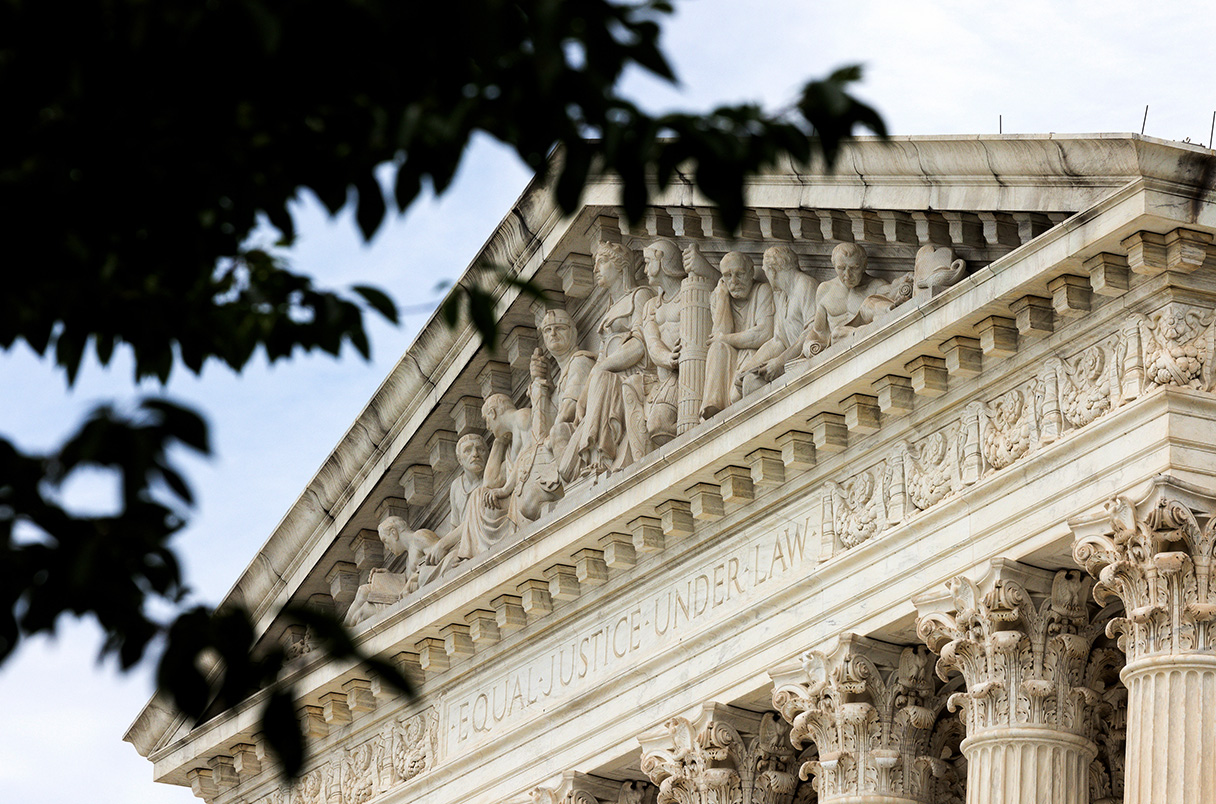
In a much-anticipated decision that many scientific groups had feared, the U.S. Supreme Court today overturned a 40-year-old doctrine that gave federal agencies considerable leeway in interpreting laws passed by Congress.
The 6-to-3 ruling means judges should no longer defer to the scientific expertise of those agencies on a vast range of technical questions and, instead, should make such decisions themselves. “Agencies have no special competence in resolving statutory ambiguities. Courts do,” Chief Justice John Roberts said in the majority opinion in Loper Bright Enterprises v. Raimondo, a case involving environmental regulations affecting herring boats.
Groups who urged the high court to retain the so-called Chevron doctrine are worried the nation’s courts may not be equipped to take on that job. The ruling “will thrust federal agencies’ decision-making into uncharted waters and fundamentally change the way scientific information is used in federal policymaking,” says Sudip Parikh, CEO of AAAS (which publishes Science), which filed an amicus brief on behalf of the government’s defense of the status quo.
The ruling also discounts the value of scientific expertise, says George Washington University law professor Emily Hammond. “The idea that generalist judges are now best situated to make those kinds of decisions as compared with the scientists, engineers, and technical experts at those agencies really flips on its head decades of expectations about the relative competencies of agencies versus judges,” she says.
But many conservatives, including leading Republicans in Congress, hailed the ruling. “Today’s decision fixes the decadeslong error of handing vague and broad powers to unelected and unaccountable bureaucrats,” said Representative Jim Jordan (OH), part of a group of Republicans in the House of Representatives who asked the justices to end the Chevron deference policy.
The doctrine was formulated in the high court’s 1984 ruling in Chevron U.S.A., Inc. v. Natural Resources Defense Council, a dispute over how the U.S. Environmental Protection Agency had interpreted a provision of the 1977 Clean Air Act regulating power plants. Although environmental groups lost their argument that then-President Ronald Reagan’s administration’s interpretation of the law favored industry, the court’s decision laid out a two-step process for deciding how federal courts should mediate such disputes.
Courts have no cause to intervene if Congress has been clear about its intent, the high court explained. But if there are ambiguities or gaps in a law, they added, courts should defer to the agency’s interpretation if the agency’s actions are reasonable and based on compelling evidence.
That approach has since been applied in thousands of cases involving government regulations affecting businesses, schools, and the general population. However, today’s ruling says it must be discarded because it conflicts with a 1946 law called the Administrative Procedure Act that makes the judiciary, not the executive branch, the final arbiter of nearly all disputes over federal statutes. Roberts also called the Chevron doctrine “fundamentally misguided” and “unworkable.”
But in a stinging dissent, Justice Elena Kagan said the ruling by the conservative majority is an example of “judicial hubris” and that the majority “grasps for power.”
Kagan gave several examples of technical questions that she feels judges are ill-equipped to answer. The Food and Drug Administration must decide what qualifies as a protein in regulating biological products, she notes. And the Fish and Wildlife Service is required to determine what constitutes “distinct population segments” of imperiled plants or animals to enforce the Endangered Species Act.
“That is what a typical Chevron question looks like,” she wrote, and scientists at those agencies have the knowledge and experience to answer them. “It is a role this Court has now claimed for itself, as well as for other judges,” she asserted.
Today’s ruling still leaves room for judges to tap into outside expertise, legal experts say. But some see that as a poor substitute. “The court assumes they can get technical expertise to some degree from agencies, and also from amicus briefs,” says Michael Showalter of ArentFox Schiff, referring to the petitions filed by outside groups to weigh in on a case. “But it’s pretty tough for me to see how that works in practice.”
Showalter says the majority opinion also assumes Congress will enact “more and better written statutes” that will result in less ambiguity to be adjudicated by the courts, especially with respect to environmental regulations. But that’s a pipe dream in today’s ultrapartisan political climate, he and other legal experts say. “Congress just hasn’t done a very good job of modernizing those laws,” Showalter says.
Some legislation is intentionally ambiguous so that it can be updated to fit with new scientific findings, Hammond adds. And she’s dubious that judges will be able to keep up with the literature in the same way agency scientists do as part of their jobs.
“There are places where deference is very appropriate,” Hammond says. “And it’s really disappointing to see that this court has decided that they’re just as adept as agencies to make those kinds of decisions.”
