From dumping iron into the ocean to launching mirrors into space, proposals to cool the planet through “geoengineering” tend to be controversial—and sometimes fantastical. A new idea isn’t any less far-out, but it may avoid some of the usual pitfalls of strategies to fill the atmosphere with tiny, reflective particles.
In a modeling study published this month in Geophysical Research Letters, scientists report that shooting 5 million tons of diamond dust into the stratosphere each year could cool the planet by 1.6ºC—enough to stave off the worst consequences of global warming. The scheme wouldn’t be cheap, however: experts estimate it would cost nearly $200 trillion over the remainder of this century—far more than traditional proposals to use sulfur particles.
Studies like this that weigh the pros and cons of different geoengineering materials are “really valuable,” says Shuchi Talati, executive director of the Alliance for Just Deliberation on Solar Geoengineering. “You need to understand the early-stage physics of potential particles to then have the conversations about broader impacts.”
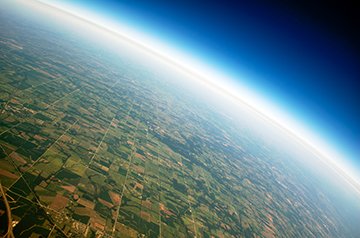
The new research is concerned with a form of geoengineering known as stratospheric aerosol injection. The idea takes its inspiration from a natural process: volcanism. Throughout history, eruptions have vaulted millions of tons of sulfur dioxide into the stratosphere. There, the gas reacts with water vapor and other gases to form sulfate aerosols–suspended particles that reflect sunlight back into space. The effect can be substantial: the 1991 eruption of Mount Pinatubo cooled the planet by as much as 0.5º C for several years, for example.
But artificial sulfur injections would also pose numerous climate risks. Sulfate aerosols include tiny sulfuric acid droplets, one of the primary components of acid rain. The aerosols can also deplete the ozone layer and fuel bouts of stratospheric warming that can disrupt weather and climate patterns lower in the atmosphere.
Sandro Vattioni, a climate scientist and postdoctoral researcher at ETH Zürich, and his colleagues wanted to see whether alternative particles carried less baggage.
They built a 3D climate model that incorporates the chemistry of aerosols, how they are transported around the atmosphere, and how they absorb or reflect heat. The model also accounted for two less studied microphysical properties of aerosols: sedimentation (how they settle out of the atmosphere over time) and coagulation (how they clump together). Ideal particles for solar geoengineering would settle slowly out of the atmosphere, providing longer-lasting cooling. They should also avoid clumping, as clumps tend to trap heat whereas individual, more spherical particles bounce it back to space.
The researchers modeled the effects of seven compounds, including sulfur dioxide, as well as particles of diamond, aluminum, and calcite, the primary ingredient in limestone. They evaluated the effects of each particle across 45 years in the model, where each trial took more than a week in real-time on a supercomputer. The results showed diamond particles were best at reflecting radiation while also staying aloft and avoiding clumping. Diamond is also thought to be chemically inert, meaning it would not react to form acid rain, like sulfur. To achieve 1.6ºC of cooling, Vattioni says, 5 million tons of diamond particles would need to be injected into the stratosphere each year. Such a large quantity would require a huge ramp up in synthetic diamond production before high-altitude aircraft could sprinkle the ground-up gems across the stratosphere.
Sulfur was the second-worst of the evaluated particles due to its tendency to absorb light at some wavelengths and trap heat. Such stratospheric warming not only offsets some of the desired cooling but can also perturb climate patterns at Earth’s surface, such as El Niño. Previous studies have underestimated this important side effect of sulfur, Vattioni says.
However, diamond dust isn’t ideal either, says Douglas MacMartin, an engineer at Cornell University who studies climate science. For one, the cost would be enormous. At roughly $500,000 per ton, synthetic diamond dust would be 2400 times more expensive than sulfur and cost $175 trillion if deployed from 2035 to 2100, one study estimates.
Sulfur is so widely available and so cheap, MacMartin says, that the material costs are “basically free.” Because it’s a gas, sulfur dioxide can also be pumped in large quantities and dispersed quickly through the stratosphere with a few aircraft, whereas solid particles such as diamond would need to be gradually delivered over many flights to prevent them from clumping. Additionally, sulfates are the only aerosols scientists can study in large, outdoor settings without much pushback, MacMartin says, because volcanic eruptions test the process for us.
“I do think that it’s interesting to explore these other materials,” MacMartin says. “But if you ask me today what’s going to get deployed, it’s gonna be sulfate.”
Some scientists remain opposed to conducting geoengineering research at all, because they worry about the unforeseen consequences of large-scale implementation and think it siphons researchers and funding away from reducing carbon emissions and climate impacts. Someone “might think that they’re making a recommendation here of one particle type over the others,” says Daniel Cziczo, an atmospheric scientist at Purdue University who opposes geoengineering research. But with all the outstanding uncertainties, he says, that conclusion is “very misleading.”
However, Vattioni contends that not doing any solar geoengineering research is “neglecting the scope of the problem we’re dealing with.”
Talati, who works to include climate-vulnerable nations and people in geoengineering research and governance discussions, sees research as a necessary step. Solar geoengineering “is not going to go away just because we’re not talking about it,” she says. “Engaging with it is an opportunity to shape it.”
More: https://route.ee/en/news/3501-ai-can-help-warring-political-camps-find-common-ground