


When debating high-stakes, politically and emotionally charged topics like climate change or minimum wage, it can be hard for people on opposite sides to find common ground. Artificial intelligence (AI) may be able to help, researchers report today in Science.
People rate consensus statements written by AI as clearer, more informative, and less biased than those produced by a human, the authors report. These AI mediators, they suggest, could help people to change their beliefs on divisive subjects, break political stalemates, and even result in progress on new policies and legislation. But other experts say the technology isn’t quite ready to be deployed in real-world settings.
“I think it’s very inventive,” says James Fishkin, a political scientist at Stanford University who studies deliberative democracy—the idea that through thoughtful and informed discussion, randomly selected members of the public can be trusted with important political decisions. Deliberative bodies like the Irish Citizens’ Assembly have led to major policy resolutions, such as Ireland’s legalization of abortion, and Fishkin has run more than 150 “deliberative polls” that have seen people shift their opinions on subjects such as illegal immigration and climate action. “I can see potential uses for what they’ve done,” Fishkin says, “but it’s not a freestanding alternative to what we’re trying to do.”
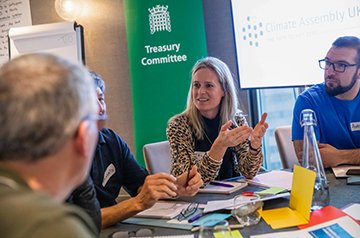
Although real-life deliberative bodies such as Climate Assembly UK generally bring together dozens of people, an AI mediator could help hundreds of people speaking multiple languages develop consensus statements, says senior author Christopher Summerfield, research director at the U.K. AI Safety Institute. In a pilot test, Summerfield and his colleagues recruited people online in the United Kingdom to participate in a mock deliberation, then divided them into 75 groups of six. In each group, one person was given brief training on how to write a consensus statement based on the group’s views. Then, the other members of the group wrote about their opinions on a hot-button subject, such as whether the U.K. should offer free universal childcare.
Those opinions were fed into a large language model (LLM), which generated a draft consensus statement. Participants repeatedly critiqued the draft until they reached a final version. They then compared the AI-guided consensus statement with the one written by the human. The researchers found participants preferred the AI-written statements 56% of the time. A separate group of 155 participants recruited online rated the AI statements as clearer and more informative.
Next, the researchers put their findings to the test in a mock citizen’s assembly. They recruited 200 volunteers who were representative of the U.K.’s demographic makeup. In virtual sessions, these participants responded to questions about divisive subjects such as Brexit, criminal justice, and the national retirement age. Once again, the AI took their answers and turned them into consensus statements, using multiple rounds of feedback from the participants.
On some of the questions, participants shifted their opinions substantially—for instance, before the task, 68% of participants agreed that “we should be trying to reduce the number of people in prison”; afterward, this increased to 78%. But on the question of whether the U.K. should apply to rejoin the European Union, there was no shift at all, which may be a result of these opinions being more entrenched, the researchers suggest.
The model is “ready to go” in the real world, Summerfield says. He argues the technology could generate statements summarizing participants’ beliefs in mass citizens’ assemblies and political polls, improving on the information that can be gathered in standard opinion polls. “People have sophisticated, nuanced views about complex political issues, and our instruments for measuring them are incredibly blunt.”
Alice Siu, a political scientist at Stanford University, says the work is “very cool” but she doesn’t think it’s ready for deployment yet. For some people, an AI mediator may allow them to feel less judged in expressing their views, but others may be suspicious of the technology or struggle to use it. Also, not all deliberative bodies try to aim for consensus, she adds.
Stephen Elstub, a political scientist at the Newcastle University, agrees, noting the system is missing some ingredients essential to deliberative democracy, such as participants listening to expert policy advisers who bring them up to speed on the facts and then deliberating together in carefully moderated group sessions. AI mediation has the potential to be “really valuable,” Elstub says, but he sees it as a tool for facilitators rather than as a replacement for them.
Fishkin adds that without the essential steps of expert information and group deliberation, there’s a risk that ill-informed and harmful views could creep into the process and work their way into group statements—a risk the authors acknowledge. In a well-constructed deliberative body, participants hear about the pros and cons of an idea, relate to each other, and “sometimes depart from their tribalism in very dramatic ways,” he says. “I believe in the magic of dialogue under the right design. But there’s not really much dialogue here.”
More: https://www.science.org/content/article/ai-can-help-warring-political-camps-find-common-ground
