Last summer, while the Northern Hemisphere endured record-breaking heat, a paper in Environmental Health Perspectives (EHP) generated a stir among scientists who study heat’s risks to health. The paper pointed out a startling disconnect between two camps of researchers on whether humidity makes hot weather more deadly.
Physiologists have found strong evidence that humidity matters: at a given temperature, more humidity makes it harder for the body to maintain a safe core temperature and ward off heat stroke. Epidemiologists, by contrast, have concluded that temperature alone accurately predicts heat-related death rates; adding humidity does little to improve their predictions.
Before the EHP paper, “No one had directly said: ‘Look, these two fields are going along in parallel with entirely different conclusions,’” says its first author, climate scientist Jane Baldwin of the University of California, Irvine, who highlighted the conundrum at a Columbia University workshop on extreme heat last month. “And if this continues, this could be a real problem for projecting impacts of climate change.”
“The humidity debate is a very live debate,” adds Chris Callahan, an earth systems scientist at Stanford University. “We don’t actually know what the role of humidity in shaping mortality is.”
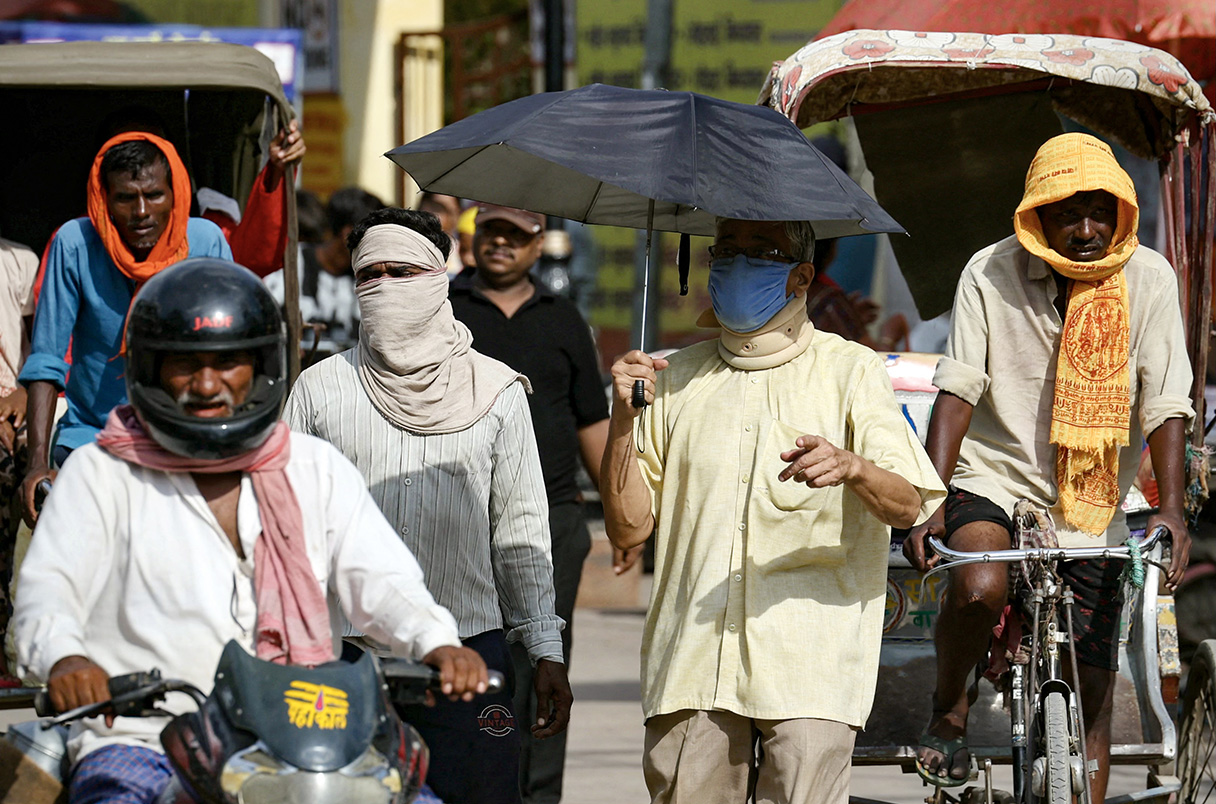
The stakes in figuring it out are high. Rising global temperatures are putting ever more people at risk of heat-related death, and many of the hottest parts of the world—South and Southeast Asia and the Persian Gulf, for example—also experience suffocating humidity. As a result, scientists’ conclusions about the role of humidity could influence everything from thresholds for government heat advisories to the kind of cooling methods recommended.
Humid heat feels more oppressive than dry heat, and it stands to reason that it would be more be deadly: Once air temperatures exceed about 35˚C, the only way the body can effectively cool itself is through the evaporation of sweat. The more water the air holds, the less sweat can be vaporized, blunting its effectiveness as a cooling mechanism.
Yet a 2019 study that analyzed an enormous data set of weather and mortality rates from 445 cities in 24 countries, many with decades of data, found virtually no association between humidity and mortality after adjusting for temperature. “We should do more research to clarify why,” says first author Ben Armstrong, an epidemiological statistician at the London School of Hygiene and Tropical Medicine.
A second large study, published in 2023, reached a similar conclusion: Metrics of heat stress that incorporate humidity did no better than temperature alone at estimating warm-season mortality across 604 locations in 39 countries. Based on the data used in the study, omitting humidity “would not give you a biased [mortality] outcome,” says the study’s senior author, environmental epidemiologist Ana Vicedo-Cabrera of the University of Bern.
Yet other research has argued that humidity compounds the effect of heat, and that humans have a physiological limit above which they can’t tolerate the combination of the two. A seminal 2010 paper used principles of biophysics to theorize that humans’ survivability limit—above which core temperature begins to rise uncontrollably, effectively cooking the internal organs—sets in at a wet bulb temperature (WBT) of 35°C. (WBT incorporates both heat and humidity and is measured using a thermometer with its bulb wrapped in a wet cloth. The higher the humidity, the less the bulb is cooled by evaporating all the water out of the cloth.)
In 2022, biometeorologist Dan Vecellio, now at the University of Nebraska at Omaha, and colleagues at Pennsylvania State University tested the proposed threshold empirically by studying young, healthy people in a climate chamber. By monitoring the volunteers while gradually raising either the heat or humidity in the chamber, the researchers pushed them to an inflection point at which their core temperature began to climb toward what would have ultimately been a deadly summit if the experiments hadn’t been stopped. The team concluded that for young, healthy people doing light physical activity, the survivable threshold in hot, humid environments was lower than previously theorized: 31°WBT, which might feel like 40°C to 50°C depending on humidity levels.
In a follow-up analysis, Vecellio and colleagues used climate models to predict the amount of warming at which global “hot spots” could become unsurvivable during hot, humid weather: from 1.5°C of warming in parts of the Indus River Valley and the Middle East to 3°C of warming in the U.S. Midwest.
One possible reason why epidemiologists have not seen an influence from humidity is that their data sets are skewed heavily toward the cooler, drier Global North. That could make it harder to see the deadly impact of humidity in countries of the Global South, where accurate mortality data are harder to come by. (The data set used in the 2019 and 2023 analyses, for instance, includes just one African country and omits India, Pakistan, and Bangladesh, among other populous, humid Asian countries.) Some researchers also suggest sedentary lifestyles in the Global North could mean extraordinarily high temperatures and humidity levels are needed for humidity to reveal its dangers.
Another issue is that weather station temperature and humidity data typically used by epidemiologists don’t capture the conditions people are exposed to if they stay in their homes, says Ollie Jay, a physiologist at the University of Sydney who was a co-author on the recent EHP paper. “That may be one of the reasons that we actually don’t see a particularly strong association [of mortality] with humidity.”
The demographics of those who die in heat waves could also be masking harmful effects of humidity. Elderly people, who today account for most heat-related deaths in the developed world, have reduced sweating capacity, which means humidity may not make as much difference to their ability to keep cool as it does in young, healthy people who have full sweating capacity.
Given the limitations of the data, “absence of evidence is not evidence of absence” when it comes to increased risks from humidity, Vicedo-Cabrera acknowledges. She is currently launching a study in the Republic of the Gambia that will closely monitor 60 people as they go about their lives to see whether and how physiological signs of heat stress vary with humidity levels.
Whatever the reasons for the disconnect, findings from both physiology and epidemiology can still aid public health efforts, says Amruta Nori-Sarma, an environmental health scientist at the Boston University’s School of Public Health who has studied the impact of heat waves on mortality in northwest India. “The individual perspective” provided by physiologists’ findings, for instance, argues for emphasizing extra water consumption to replace fluid lost to sweating. On the other hand, “the epidemiologic analysis could potentially facilitate larger scale interventions,” she says, such as temperature-triggered openings of air-conditioned cooling centers to prevent the surges in mortality that are well documented in epidemiological studies.
Vecellio says scientists and governments shouldn’t wait for the puzzle to be solved to act. “People are already dying in the heat,” he says. “We need to find ways to protect people during extreme heat events now.”
More: https://www.science.org/content/article/does-humidity-make-heat-more-deadly-scientists-are-divided