


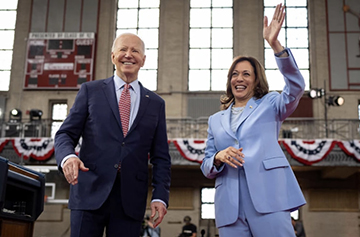
After US President Joe Biden ended his re-election campaign on Sunday, he and other senior Democratic politicians threw their support behind current vice-president Kamala Harris. Although the situation could change between now and the official selection of the Democratic candidate for the presidency in August, she is widely expected to face off against former president Donald Trump in the election this November.
Here, Nature talks to policy analysts and researchers about what a potential Harris administration might mean for science, health and the environment.
Health and science have been a part of Harris’s life since an early age: her mother, Shyamala Gopalan, whom Harris cites as a major influence, was a leading breast-cancer researcher who died of cancer.
Much of Harris’s career has centred on criminal justice — she served as the district attorney for San Francisco in California from 2004 to 2011 and state attorney general for six years until 2017. She then became a US senator for California.
As senator, Harris co-sponsored efforts to improve the diversity of the science, technology, engineering and medicine (STEM) workforce. She introduced legislation to aid students from under-represented populations in obtaining jobs and work experience in STEM fields. And in the race for the Democratic nomination for the 2020 presidential election, she proposed a plan to invest US$60 billion to fund historically Black universities and to bolster Black-owned businesses.
As vice-president, Harris has been chair of the National Space Council, which advises the president on US space policy and strategy. Under her leadership, the body has focused on international cooperation — for example, with the Artemis mission, which aims to send astronauts to the Moon.
It is unclear whom Harris will choose to be her running mate if she receives the party nomination. One contender is Mark Kelly, a Democratic US senator for Arizona and former astronaut with decades of experience in science and engineering.
During the 2020 Democratic primary race, Harris was to Biden’s left on health-care policy. For one, she endorsed a universal single-payer national health insurance system, although she left room for a role for private insurance companies. Biden preferred tweaking the existing system, which he had helped to engineer through the 2010 Affordable Care Act as vice-president under Barack Obama.
It is still unknown whether she will embrace similar progressive health policies or choose a path that might be more appealing to independent and centrist voters, says Alina Salganicoff, director for women’s health policy at the health-policy research organization KFF, based in San Francisco, California. “I anticipate she’s going to be a staunch defender of maintaining and supporting the Affordable Care Act, which has also been a priority for the Biden campaign,” she says.
The Biden–Harris administration has made drug pricing a key priority by creating a cap for the price of insulin and by endorsing the use of ‘march-in rights’, in which the government could intervene to increase market competition over innovations created using public funds, and thus lower prices. In 2019, as senator, Harris co-sponsored legislation that would have created an independent agency to determine appropriate drug prices.
Peter Maybarduk, director of the access-to-medicines programme at the advocacy organization Public Citizen, based in Washington DC, praises these actions, and hopes they would continue under a potential Harris administration. “The Biden–Harris administration has been by far the strongest yet in challenging outrageous drug prices and starting the country down a long road toward medicine affordability,” he says.
Harris has been more vocal than Biden on abortion rights, especially since they were dramatically curtailed by the Supreme Court’s decision in Dobbs v. Jackson Women’s Health Organization in 2022. Last December, she launched a nationwide ‘reproductive freedoms’ speaking tour, and in March she became the first US vice-president to make an official visit to an abortion provider.
Abortion rights have been a major issue for US voters, with 63% of the population saying that abortion should be legal in all or most cases according to an April poll by the Pew Research Center in Washington DC. Support for abortion rights is thought to have fuelled important Democratic wins in the past year. “The fact that she’s willing to talk about this is going to be enormous, because that’s a winning issue for Democrats,” says Melissa Murray, a legal scholar specializing in reproductive rights at New York University in New York City. “It’s a major point of differentiation between the two parties and the person who can make that case most clearly to the American public, I think will be in a stronger position.”
Harris’s approach to reproductive justice is not limited to access to contraception and abortion, Murray notes. The vice-president has advocated for maternal-health issues more broadly, highlighting the need to combat implicit bias against Black women in health care. This approach “takes seriously the needs of women of colour, who are perhaps more deeply affected by assaults on reproductive freedom, as we’ve seen in the two years since Dobbs”, Murray says.
Harris has long promoted action on climate as well as environmental justice, says Leah Stokes, a climate-policy researcher at the University of California, Santa Barbara. As San Francisco district attorney and California attorney general, Harris became a champion for communities on the front lines of fossil-fuel pollution, Stokes says, and she followed a similar path with work on public health and the environment as a senator from 2017 to 2021.
If she is voted in as president in November, Harris is expected to maintain both the momentum and the unprecedented investments that Biden has injected into the climate movement in the United States. This includes upwards of US$1 trillion in funding for clean energy and climate change over a decade, a legislative accomplishment that many energy experts say could sharply reduce US greenhouse-gas emissions over the coming decades.
“Harris and Biden are in lockstep on climate, and that’s exactly what we need,” says Stokes. “Our 2030 goals are right around the corner, and we can’t afford to roll back progress for four more years.”
