Samuel Pierre, a research physician at the major Haitian HIV/AIDS treatment and study center GHESKIO, flew to Denver on 2 March, excited for what he expected to be a short work trip to a conference. Three days later, after presenting a poster describing his team’s successful trial of an HIV drug regimen, he learned that heavily armed gangs had attacked Haiti’s international airport. It soon shut down and remains closed to commercial traffic.
Undeterred, Pierre is managing his staff while perched with family in New York City and he’s eager to resume his research on site. “I am intending to go back as soon as the airport is open,” he says. “This is the kind of risk you need to take if you want to keep moving forward providing care, conducting research.”
Pierre is one of a determined set of health researchers who are still running studies in Haiti, despite mounting chaos. The turmoil surged on 29 February, when a coalition of gangs launched a new wave of violence aimed at toppling the government while then–Prime Minister Ariel Henry was out of the country. It has not subsided: According to an Associated Press report, gangs on 11 May attacked the police station and the community in the coastal city of Gressier, an area that historically has been a site of medical research.
“There is this heroic network of physicians and scientists that have figured out ways to keep aspects of science and medicine happening,” says Eric Nelson, a pediatrician and cholera researcher at the Emerging Pathogens Institute at the University of Florida (UF), which runs a research facility in rural Haiti. “And this may be the darkest hour of that challenge.”
Medical research in Haiti has long had to contend with the country’s instability. Before February, gangs already controlled an estimated 80% of Port-au-Prince, the capital and largest city. The violence has forced 60% of GHESKIO’s staff to leave since 2021; the son of its director, Jean William “Bill” Pape, was kidnapped in November 2023, held for 3.5 months, and released only after five ransom payments were made.
But in recent months, the situation got worse after one notorious gang leader united other gangs against the government. Since then, they have stormed prisons, releasing thousands of inmates, burned police stations, and strangled the main port, putting more than 1 million people at risk of famine. Henry resigned in late April, and a divided “transitional council” narrowly voted to appoint a new prime minister, Fritz Bélizaire. The next day, 1 May, gangs launched a new round of attacks in Port-au-Prince, burning homes and sending terrified residents fleeing.
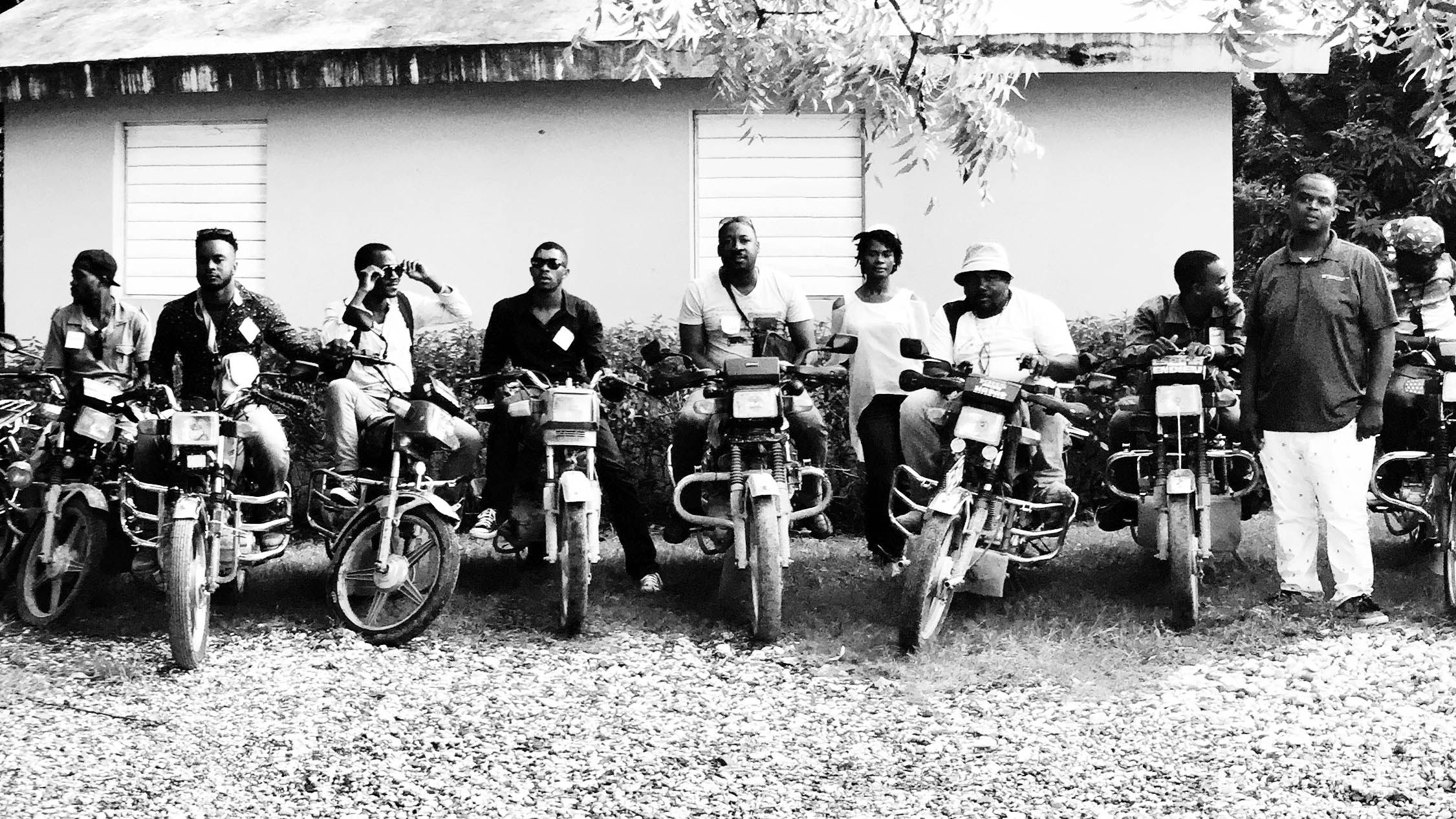
“We’re not going to stop just because it’s difficult,” says UF research coordinator Molly Klarman, Nelson’s co-investigator on a U.S. National Institutes of Health (NIH)-funded study aiming to digitize a pediatric service called MotoMeds. It operates at night to serve sick children in regions that include the site of the new attack in Gressier. Nurses fielding calls from parents triage cases and dispatch motorcycle drivers with medicines and sometimes nurses. So far, they have relied on pen and paper for the triage calls, but the study will test whether training nurses on an app will reduce call and delivery times without negatively impacting outcomes. If it does, the researchers hope to take MotoMeds national.
With the country’s ambulance network effectively shut down, road travel often dangerous, and many health facilities shuttered, demand for the MotoMeds service has increased, from two calls per night last fall to three per night in April. Parents “are just more uneasy about leaving their home, so they like the [MotoMeds] idea,” says nurse practitioner Youseline Cajusma, who oversees the call center and is training the nurses in the study.
Nelson adds: “Early access to low-cost, proven, effective medications is becoming all that families can do.”
Disease surveillance efforts are also hobbling through the crisis. In 2019, after violence made it perilous to travel the 31 kilometers between Port-au-Prince and UF’s infectious disease research lab in Gressier, the university relocated its research to a new high-end lab in a rural area near the border with the Dominican Republic. In Gressier, researchers led by Glenn Morris, director of UF’s Emerging Pathogens Institute, had churned out paper after paper, identifying coronaviruses that leapt from pigs to children, turning up rare viruses previously thought to be confined to South America, and revealing aquatic reservoirs of cholera during an epidemic that began in 2010, resurged in 2022, and has sickened more than 800,000 Haitians.
“Having the surveillance in Haiti has allowed us to get a much better feel for the movement of viruses really across the entire Caribbean and South America,” Morris says. But the violence is now hampering the rural lab, too. To avoid dangerous areas, some employees were recently driving 5 hours from their homes to reach work, where they would stay for several weeks. That proved unsustainable, and today, just one employee is on site, ensuring the freezers are running. The output of papers has slowed to a crawl.
“We have difficulties to get supplies, difficulties to ship samples. To get dry ice is a nightmare,” says Valery Madsen Beau De Rochars, a Haitian epidemiologist at UF who once supervised the rural research operation but has not been able to travel to the lab himself since 2022.
“[UF] used to send students and faculty in Haiti to train our staff,” adds Rigan Louis, a Haitian nurse practitioner earning a Ph.D. at UF who managed the rural lab more recently. The end of those visits since 2020 “has significantly affected our ability to continue doing research.”
The many obstacles are reflected in the number of proposals for human subject research submitted to Haiti’s national institutional review board, says Gerald Lerebours, president of that board, which evaluates and approves such studies before they can start. Before 2020, Lerebours says, the group was asked to review 40 to 60 protocols annually; during the 12 months that ended in September 2023, it received 20.
Funding work in Haiti has also become harder, some researchers say. Gene Kwan, a cardiologist and global health researcher based at Boston University, last year applied for NIH funding to run a study assessing whether artificial intelligence could give nonspecialist physicians an edge as they use portable ultrasound scanners to diagnose and rate the severity of congestive heart failure—a major problem in Haiti. But reviewers were “very critical of the [study’s] feasibility … given everything that is going on,” Kwan says. He didn’t win the grant.
Morris’s own NIH grant, to study whether previous coronavirus exposure blunted COVID-19’s impact in Haitians, has entered an “unfunded continuation phase” because he couldn’t complete the work required to move to the next stage, he says. He is waiting on a renewal decision for another NIH grant that allowed his team to track cholera. “There may be a massive cholera epidemic occurring right now,” he says. “There’s no data.”
Another long-standing NIH grant, now focused on approaches to controlling cholera with vaccination and water treatment, is up for renewal next year. The project’s co–lead investigator, infectious disease physician and researcher Louise Ivers of Massachusetts General Hospital, is hesitant about applying. “We have exciting [new] questions,” Ivers says, but “the sociopolitical context might mean that we can’t do new work. We haven’t completely come to that decision. But we may have to, depending on how things go in the next 6 months.”
Yet the commitment of her Haitian colleagues is heavy on her mind. In December 2023, she visited Haiti’s National Laboratory of Public Health and met with her collaborator, center Director Jacques Boncy, who was back at work after being kidnapped and injured several months earlier.
“People were going into work. The lab was functioning. They were showing me their beautiful biobank,” Ivers recalls. “If we try to renew our grant, it’s going to be to honor these people’s dedication.”