


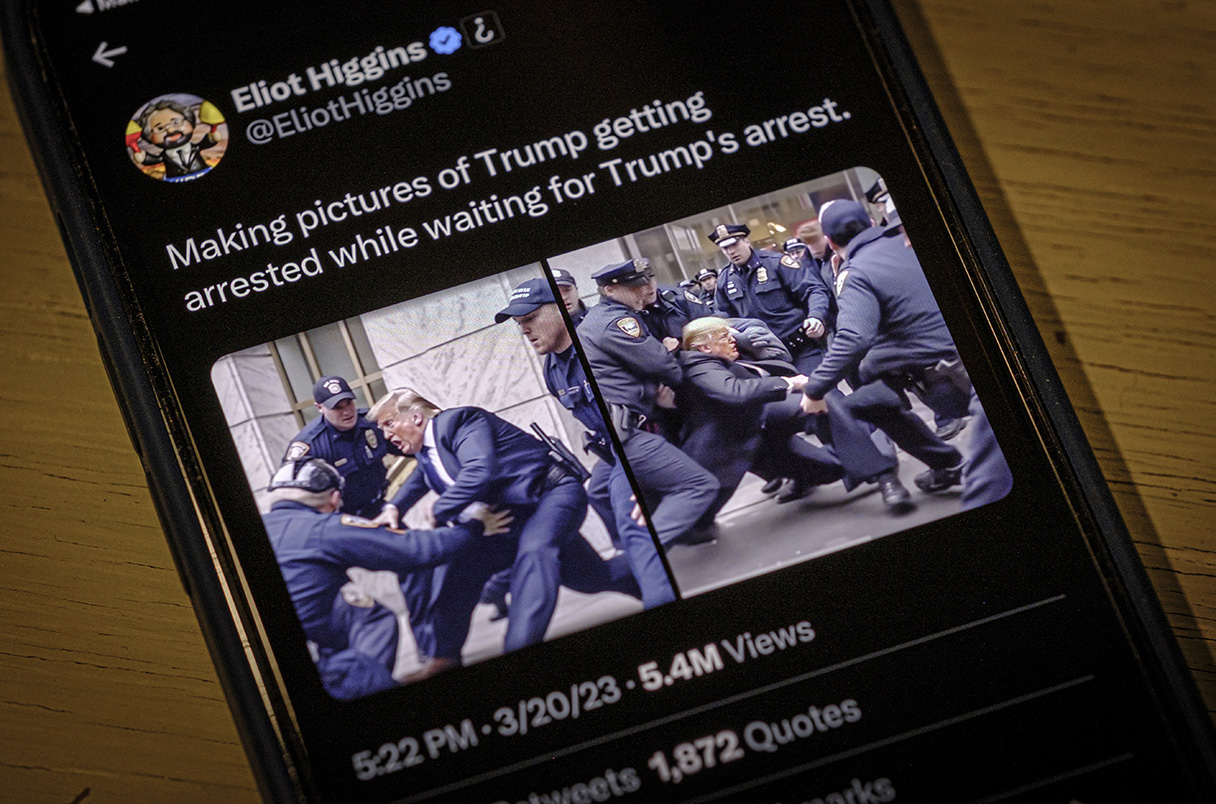
As the U.S. gears up for the upcoming presidential election, a new and potent threat emerges in the form of AI-generated deepfakes—fake video and audio clips that could potentially sway voters. Last week, a deepfake robocall in New Hampshire impersonated President Joe Biden, urging voters to abstain from participating in the election. The incident underscores the increasing danger of deepfakes, created through generative AI that learns from existing clips to mimic a person's face or voice convincingly.
Experts express alarm at the potential impact of deepfakes, combining disinformation, AI-generated voices, impersonation of public figures, and even attempts to discourage voting—a potentially illegal activity. The ease and cost-effectiveness of producing deepfakes make them a looming threat during the election season.
Despite the prevalence of fake news on social media, deepfakes present unique challenges. Images and videos tend to have a lasting impact on memory, making deepfakes, even if briefly convincing, more widely shared and believed. Additionally, deepfakes can sow uncertainty, as people may struggle to differentiate between real and manipulated content, leading to a potential erosion of trust in authentic media.
Recognizing the limitations of public awareness and detection abilities, experts point out that deepfakes are not easily distinguishable from genuine content. Studies reveal that people's confidence in spotting deepfakes often exceeds their actual ability to do so. Even in audio deepfakes, such as the robocall incident, individuals struggle to correctly identify manipulated speech.
While technology advancements have addressed signature giveaways in AI-generated images, subtle inconsistencies persist. Deepfakes tend to be overly perfect, lacking unusual features present in real-life individuals. Software designed to detect deepfakes is in development, but the evolving nature of AI technology poses challenges to keeping pace with new advancements.
Efforts to counter deepfake threats involve updating rules on election campaign fraud and raising awareness about the existence and identification of deepfakes. However, experts acknowledge that this is an ongoing battle, with the likelihood of the problem worsening as AI algorithms improve. As the arms race continues, educating diverse groups becomes crucial, emphasizing the need for vigilance, even when faced with convincing AI-generated content.
In conclusion, the deepfake dilemma prompts a call for increased public awareness, education, and vigilance to mitigate the potential impact on political processes and public perception.
More: https://www.science.org/content/article/how-spot-deepfake-and-prevent-it-causing-political-chaos
