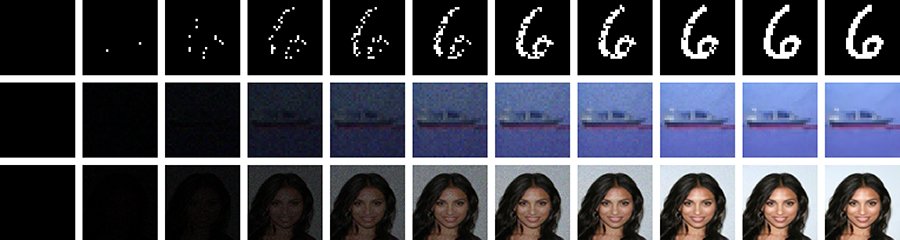
In a groundbreaking development, a cutting-edge artificial intelligence framework known as "Blackout Diffusion" has emerged, showcasing the potential to transform the landscape of generative modeling. Unlike traditional diffusion models, this revolutionary technology has the ability to generate images from a completely blank canvas without the need for a "random seed" initiation. Recently unveiled at the International Conference on Machine Learning, Blackout Diffusion produces samples comparable to current models like DALL-E and Midjourney but with significantly reduced computational demands.
Javier Santos, an AI researcher at Los Alamos National Laboratory and co-author of Blackout Diffusion, highlighted the significance of generative modeling, stating, "Generative modeling is ushering in the next industrial revolution with its capacity to aid various tasks, including the generation of software code, legal documents, and even art." The research team believes that generative modeling could play a pivotal role in scientific discoveries, presenting foundational algorithms applicable to non-continuous scientific problems.
Unlike conventional models that necessitate input noise to initiate image generation, Blackout Diffusion showcases similar sample quality while operating within a smaller computational space. Yen Ting Lin, the leading physicist at Los Alamos behind the collaboration, emphasized the model's unique working space. Existing generative diffusion models operate in continuous spaces, limiting their potential for scientific applications. In contrast, Blackout Diffusion operates in discrete spaces, offering new possibilities for diverse applications, including text and scientific endeavors.
The team extensively tested Blackout Diffusion on standardized datasets, demonstrating its proficiency on the Modified National Institute of Standards and Technology database, CIFAR-10 dataset, and the CelebFaces Attributes Dataset. Beyond image generation, the discrete nature of Blackout Diffusion clarified misconceptions about internal workings of diffusion models, providing crucial insights into generative diffusion modeling.
By operating in discrete spaces, Blackout Diffusion paves the way for accelerated scientific simulations on supercomputers. This has the potential to significantly enhance scientific progress while concurrently reducing the carbon footprint of computational science. Applications range from subsurface reservoir dynamics to chemical models for drug discovery, as well as single-molecule and single-cell gene expression studies, offering a promising avenue for understanding biochemical mechanisms in living organisms. The team's findings establish a foundational study on discrete-state diffusion modeling, opening avenues for future scientific applications with discrete data.