


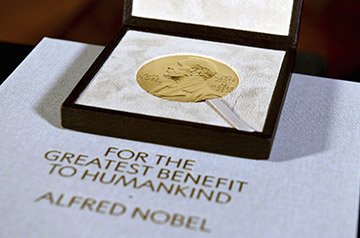
For many scientists, there’s no greater achievement than winning a Nobel Prize. Since its creation in 1901, the medal has recognized breakthroughs that have broadened our understanding of reality and changed the world. It also might be a productivity killer. According to a working paper recently published by the National Bureau of Economic Research, scientists’ output tends to fall off a cliff after they’ve won the prize.
Researchers behind the study analyzed data on Nobel Prize winners in physiology and medicine between 1950 and 2010, charting how three factors changed after their awards: the number of papers they published; the impact of those papers, based on how often they were cited; and how novel their ideas were. The authors quantified novelty by using a computer program to identify each separate, distinct scientific idea in the papers, then assigning each idea an age based on when it first appears in the U.S. National Library of Medicine’s Unified Medical Language System. Papers with “younger” ideas relative to their publication dates were given higher novelty scores.
Because the prize is often given to scientists late in their careers, as productivity typically declines, the researchers compared the Nobel winners with age-matched winners of another prestigious medical prize, the Lasker Award. “The matching strategy is sound,” says Kirk Doran, a social scientist at the University of Notre Dame who was not involved in the work. “Overall, the results are quite convincing.”
Before winning the prize, future Nobel laureates published more frequently than their colleagues who eventually won the Lasker Award, and they also published more-novel papers and garnered more citations. After winning a Nobel, however, the trend flipped: Nobel winners, on average, saw declines in productivity, novelty, and citations, dropping to even with the Lasker winners, or sometimes below them. In terms of raw numbers, future Nobel winners published about one study more per year than future Lasker winners in the 10 years leading up to the prize. In the 10 years after winning, however, the Lasker group published about one more study annually than did their Nobel laureate peers. Whereas the Lasker winners showed their own small decrease in productivity after winning, the inversion of the two groups’ productivity was driven almost entirely by declines in the Nobel group.
“I was actually surprised by the shift in novelty,” says the working paper’s first author, Jayanta Bhattacharya, a health economist and epidemiologist at Stanford University. “I expected the shifts in productivity because of the [new] demands on their time, but the shift towards less novel work is a little bit of a surprise to me.”
Doran, who has studied the career effects of winning a Fields Medal—the Nobel’s equivalent in math—says the results gel with his own findings, which have shown that mathematicians also appear to suffer decreases in productivity following a win.
Although Bhattacharya and colleagues stress that their analysis does not show a causal link between winning the Nobel and a drop in productivity, Doran notes that winning such a prestigious award is a life-changing event for most scientists. They may be flooded with opportunities for speaking engagements, media interviews, or book deals, all of which eat into the time and energy available to do original science. The Lasker, although prestigious within the field, does not carry the household recognition that catapults Nobel laureates into the realm of minor celebrity.
“There’s just a big change in the patterns that you see after the Nobel Prize, that indicates a pretty fundamental shift in their lives,” Bhattacharya says. “They’re not just scientists anymore, but public intellectuals.”
Given that, do the prize’s benefits outweigh the potential for lost research? That’s a hard question to answer, the authors say. Bhattacharya doesn’t want to scrap the Nobel Prize, but suggests it may be a good idea to save the recognition for scientists later in their career, to prevent interrupting our most brilliant minds in their prime. “Awarding Nobels as career achievement awards would still achieve a lot of the benefits of the Nobel while eliminating some of the harms,” he says.
