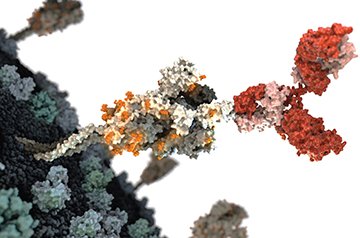
In 2020, as the COVID-19 pandemic raged and other effective drugs were elusive, monoclonal antibodies (mAbs) emerged as a lifesaving treatment. But now, 3 years later, all the approvals for COVID-19–fighting antibodies have been rescinded in the United States, as mutations of the SARS-CoV-2 virus have left the drugs—which target parts of the original virus—ineffective.
Researchers around the globe are now trying to revive antibody treatments by redesigning them to take aim at targets that are less prone to mutation. “There are new approaches that present a much more challenging task for the virus to evade,” says Paul Bieniasz, a virologist at Rockefeller University. Just this week, for example, researchers in Canada reported that they’ve created antibodylike compounds able to grab dozens of sites on viral proteins at the same time, acting as a sort of molecular Velcro to restrain the virus even if some of the sites have mutated to elude the drug candidate. Other researchers have taken less radical approaches to producing mutation-resistant antibodies.
All, however, worry that the work may be slow to reach the clinic. With the pandemic emergency declared over in the U.S. and other countries, governments and industry may have less incentive to develop promising new COVID-19 treatments. “There is no business model for this anymore,” says Michael Osterholm, a public health expert at the University of Minnesota.
The antibodies that initially saved lives all glommed on to the tip of spike, the protein SARS-CoV-2 uses to attach to angiotensin-converting enzyme 2 (ACE2), a receptor on the surface of human cells. For the first 2 years of the pandemic, spike changed modestly enough for the mAbs to continue to work. But as the virus encountered more people with antibodies from previous infections and vaccination, new variants emerged with extensive mutations in the ACE2-binding region, known as the receptor-binding domain (RBD). The variants dodged treatment and left pharma companies scrambling. “By the time you’ve isolated a good [mAb] the virus has moved on,” says Laura Walker, who heads infectious disease biotherapeutics discovery and engineering for Moderna.
Now, researchers are seeking antibodies targeting segments of spike that the virus can’t mutate without losing its ability to infect cells. “People are fishing for that hidden gem that targets something so conserved that the virus cannot mutate away from it,” says Jean-Philippe Julien, an immunologist at the University of Toronto.
In March, for example, an international team led by researchers at the University of Italian Switzerland reported that it had isolated several human antibodies aimed at conserved targets on spike, unchanged across multiple viral variants. One binds to a site known as the fusion peptide, preventing the virus from merging with human cells. In cell-based assays, the antibody bound to four separate families of coronaviruses, including SARS-CoV-2. Another antibody, which targets a spike site known as the stem helix, blocked all SARS-CoV-2 variants from fusing with human cell membranes. The group, reporting in the 10 March issue of Science Immunology, also found that a “bispecific” antibody that binds to both the RBD and a separate region called subdomain 1 (SD1) that’s involved in cell fusion protected mice against ancestral and Omicron SARS-CoV-2 variants.
Other groups are pursuing the same strategy. Researchers at the Fred Hutchinson Cancer Center (FHCC) reported in a March bioRxiv preprint that they, too, have isolated an SD1-targeting antibody that protects mice against all the recent variants of concern. And in January, a group led by antibody biologist Joshua Tan at the National Institute of Allergy and Infectious Diseases reported in Cell Host & Microbe that other fusion peptide and helix-binding antibodies can neutralize a broad array of SARS-CoV-2 variants in animals. “There are more and more antibodies that act more broadly because they are targeting spike in different areas,” says Julie Overbaugh, a virologist at FHCC who led the SD1 work.
A separate approach takes aim at the human protein, ACE2, that SARS-CoV-2 and its relatives bind to on the cell surface. Last week, Bieniasz and his colleagues reported encouraging results in Nature Microbiology. They injected mice with copies of a soluble version of the human ACE2 receptor. Thirty-five days later, they screened the animals’ blood serum for antibodies that targeted ACE2 and blocked SARS-CoV-2 from binding to it. They selected the most potent and injected it into mice that had been infected with a SARS-CoV-2 variant or a variety of other sarbecovirusus, the group of human and animal viruses that includes SARS-CoV-2. The antibody “was equally effective against all of them,” Bieniasz says.
“This looks quite promising,” Overbaugh says. But she and others are concerned that targeting human proteins could prompt side effects. They worry about interfering with ACE2’s normal function, as it helps regulate blood pressure among other duties. Recent reports have added to the concern by suggesting that people with Long Covid may be producing antibodies against their own proteins, including ACE2. Bieniasz agrees that more animal and human trials of the strategy will be needed, but he notes that in the initial cell culture studies, his group’s antibody does not seem to keep ACE2 from working properly.
A third strategy looks to modify the structure of antibodies themselves in hopes of making them more potent. Antibodies are usually Y-shaped, with two arms that can attach to two separate targets. Julien and his colleagues have designed a family of spherical “multibodies,” each with 24 attachment sites. In its most recent study, published this week in Science Translational Medicine, the Toronto team designed two different multibodies, one in which all 24 binding sites targeted the same site on SARS-CoV-2’s spike protein, the other that targeted three different sites. When they injected their multibodies into infected mice, they found that both designs neutralized the virus at doses well below those needed for conventional antibodies. The three-target multibody also neutralized all recent subvariants and a wide array of viruses more distantly related to SARS-CoV-2.
Walker, who was impressed by these results, cautions that because the multibody strategy is new, it faces a longer road to the clinic. Researchers must verify that the multibodies remain in circulation for days—if not months—after infusion, and developers must show that the drugs can be manufactured reliably and cheaply. “It’s not enough to have [mAbs] that will work, but [it’s also] whether they will be available,” Osterholm says.
But the momentum needed to turn the new antibodies into approved drugs may be waning. In March, President Joe Biden’s administration launched Project Next Gen to help commercialize vaccines, mAbs, and other therapeutics. But the $5 billion for the effort could soon evaporate, a likely victim of ongoing negotiations between the administration and Congress over the U.S. debt ceiling. With little government help, pharma companies may be loath to pour hundreds of millions of dollars into commercializing new treatments. “It’s going to take long-term investment,” Osterholm says. “That is something we are missing.”
At the same time, Tan notes, “There are at least some companies that remain interested.” At least one sizable market remains—people who are immunocompromised, some 3% of the U.S. population. Still, pushing for new treatments is “definitely more challenging than it was a year or two ago,” he says.