


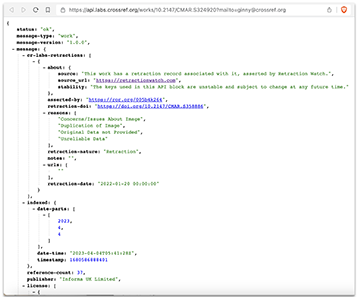
An agreement between the two organisations will allow Retraction Watch to keep the data populated on an ongoing basis and always open, alongside publishers registering their retraction notices directly with Crossref.
Both organisations have a shared mission to make it easier to assess the trustworthiness of scholarly outputs. Retractions are an important part of science and scholarship regulating themselves and are a sign that academic publishing is doing its job. But there are more journals and papers than ever, so identifying and tracking retracted papers has become much harder for publishers and readers. That, in turn, makes it difficult for readers and authors to know whether they are reading or citing work that has been retracted. Combining efforts to create the largest single open-source database of retractions reduces duplication, making it more efficient, transparent, and accessible for all.
