


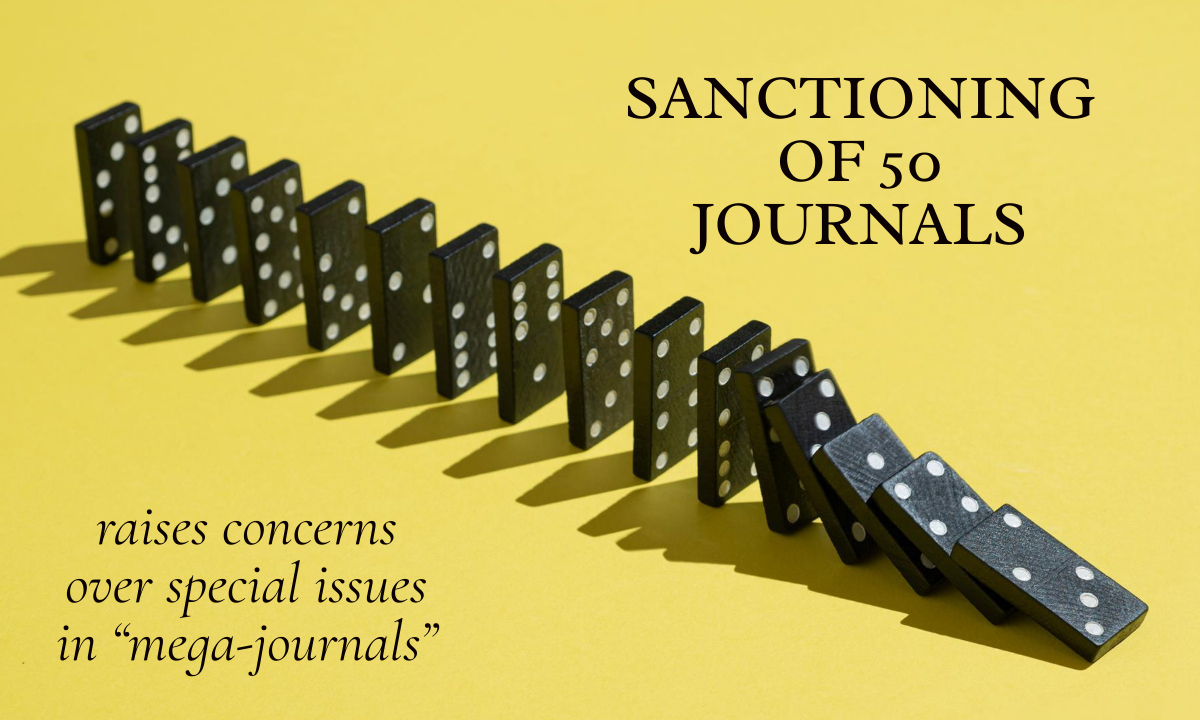
In a recent development, Web of Science has delisted more than 50 journals for failing to meet quality selection criteria, raising questions about the integrity of special issues within mega-journals. Clarivate, the owner of Web of Science, attributed the improved selection process to advanced technology, enabling the identification of journals requiring scrutiny.
The impact of this sanctioning means that Clarivate will no longer index, cite, or assign an impact factor to the affected journals. Among them, scientific publisher Hindawi, responsible for 19 delisted journals spanning health, science, and engineering, faces scrutiny. The nature of the concerns prompting delisting remains undisclosed by Clarivate.
One noteworthy journal affected is the International Journal of Environmental Research and Public Health (IJERPH), a mega-journal publishing over 17,000 papers in 2022 with an impact factor of 4.6. MDPI, the publisher, confirmed the delisting of two journals by Clarivate, citing content relevance criteria.
Wiley, having acquired Hindawi in January 2021, uncovered a paper mill issue at some Hindawi titles, impacting revenue by $9 million. The problem extends beyond paper mills, exposing vulnerabilities in special issues. Wiley's investigation revealed instances where special issues were manipulated by bad actors impersonating academics.
The fallout from this revelation prompted a meeting at the Frankfurt Book Fair, where Wiley disclosed the issues and outlined corrective actions, including AI-based screening and a manual review of compromised articles. Other major publishers, including Elsevier and Springer Nature, also experienced delisting of some journals.
Norway's response to such challenges includes establishing a national registry of approved journals, inviting the research community to share experiences. MDPI and Hindawi have drawn particular attention, with frequent reports leading to removals from Norway's green list.
The complex issue of paper mills, driven by economic motives and exploiting academic reward systems, remains a concern for publishers. Critics argue that drastic actions like delisting create disincentives for transparency, hindering efforts to address paper mills and retractions openly.
As the industry grapples with these challenges, questions linger about the reliability of special issues, with calls for journals to demonstrate rigorous peer review practices to maintain credibility in the academic community.
Source: https://www.chemistryworld.com/news/sanctioning-of-50-journals-raises-concerns-over-special-issues-in-mega-journals/4017315.article