


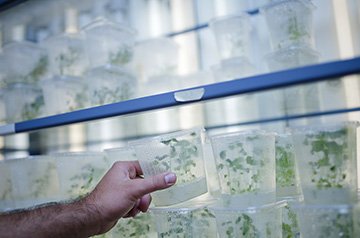
The European Commission has proposed making gene-edited plants much easier to study and commercialize. Scientists welcomed this week’s draft proposal, which aims to accelerate research boosting the resilience of crops to climate change, pests, and diseases, and to develop plants that require fewer fertilizers. But it could take several years for it to be approved by the European Parliament and Council.
"It's a big step; I'm quite happy," says Agnès Ricroch, a plant geneticist at AgroParisTech. It has been difficult to get money to carry out research using genetically modified organisms (GMOs) and permission for field trials, she says. "I think this is going to change."
GMOs have historically faced stiff opposition in Europe. The draft law would enable the release of new crop varieties, such as disease-resistant potatoes that would require far less fungicide, says Matin Qaim, an agricultural economist at the University of Bonn. Gene editing allows researchers to make targeted changes to DNA and modify a plant much more quickly than with conventional breeding. "Many exciting technologies would come to the market within the next few years."
Critics of the proposal include the seed conservation organization Arche Noah, which opposes GMOs. "New genetic engineering is first and foremost a tool for corporations to squeeze their competitors out of the market and expand further their control over our food system," said Magdalena Prieler, the group's seed policy adviser, in a statement.
The proposal to deregulate what the Commission calls New Genomic Techniques, including gene-editing CRISPR/Cas, is part of a larger legal package promoting the sustainable use of natural resources. It also includes provisions on monitoring soil health and reducing food waste.
The Commission's proposal would address two issues that GMO proponents say are problematic under existing legislation governing GMOs. One is the length of time and cost needed to evaluate genetically modified crops. "It is almost impossible to get something approved for cultivation," says René Custers, regulatory affairs manager for VIB, a biotech research institute. A second issue relates to how regulators handle small genetic changes in crop plants, given that can be extremely difficult to know whether these changes came from conventional breeding or were the product of gene editing.
Scientists had once hoped that Europe would regulate gene editing more lightly than traditional genetic engineering techniques. But in 2018 the Court of Justice of the European Union ruled that gene editing falls under the law covering transgenic plants. The next year the European Council asked the Commission to study the issue. Its 2021 report concluded that the existing GMO legislation was not appropriate for gene editing and was holding back the development of innovative crops.
The draft law would exempt gene-edited plants from the current GMO law if they are equivalent to what could be accomplished with conventional plant breeding. "This would be a much, much better way of going ahead," says Richard Visser, a plant geneticist at Wageningen University & Research. These gene-edited plants would not require lengthy risk assessments, which would allow developers to bring them to market much sooner and without doing studies of potential harm to human health or the environment. Instead, researchers or companies would only need to demonstrate that the gene-edited plants are the same as conventional plants.
Plants would be exempt if no more than 20 nucleotides were added or replaced during the gene editing. This number comes from a 2011 study of the model plant Arabidopsis in which detectable natural genetic variations among individual plants were limited to this size. (Subsequent studies have found that natural variation within species can be much larger.) The limit of 20 nucleotides could restrict what scientists would be able to achieve through gene editing. They could improve disease resistance, for example, but perhaps not enhance traits that are under the control of many genes, such as yield.
The draft also allows researchers to use gene editing to add or move genes, as long as the genes already exist within what is called the breeder's gene pool. That flexibility is appealing because moving genes can lead to much more sophisticated effects, such as changing expression patterns, than simply knocking out a gene with a mutation, says plant geneticist Detlef Weigel of the Max Planck Institute for Biology Tübingen.
Plants with new traits not found in conventionally bred crops, such as herbicide resistance acquired by DNA from other species, would continue to be regulated under the existing law.
The draft law still prohibits gene-edited plants in organic agriculture and requires gene-edited seeds to be labeled. And companies or other developers must register the crops and their traits in a public database. Herbicide resistance is also excluded from the relaxed regulation, notes plant molecular biologist Holger Puchta of the Karlsruhe Institute of Technology. “The commission took into account the concerns of the NGOs [nongovernmental organizations] that want to have a drastic reduction of herbicide use in Europe," he says. Puchta hopes these prohibitions will win opponents of gene editing.
The first session to work on the legislation is scheduled for 25 July, but Ricroch warns that major action may be delayed until after parliamentary elections next year.
