


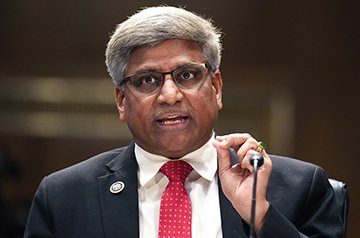
The director of the National Science Foundation (NSF) announced his resignation today, 16 months before his 6-year term ends, in a letter to staff obtained by Science.
“I believe that I have done all I can to advance the mission of the agency and feel that it is time to pass the baton to new leadership,” writes Sethuraman Panchanathan, a computer scientist who was nominated to lead NSF by then-President Donald Trump in December 2019 and was confirmed by the Senate in August 2020. “I am deeply grateful to the presidents for the opportunity to serve our nation.”
Although Panchanathan, known as Panch, didn’t give a reason for his sudden departure, orders from the White House to accept a 55% cut to the agency’s $9 billion budget next year and fire half its 1700-person staff may have been the final straws in a series of directives Panchanathan felt he could no longer obey.
“He was trying so hard to present the agency in a positive light,” says one knowledgeable source who asked to remain anonymous because of the sensitivity of their position. “But at the same time, Panch knew that he was alienating himself from the scientific community by being tone deaf to their growing concerns about the fate of the agency we all love.”
On 14 April, staffers from billionaire Elon Musk’s Department of Government Efficiency (DOGE) set up shop for the first time at NSF and triggered a series of events that appear to have culminated in Panchanathan’s resignation. Two days later, NSF announced it was halting any new awards for grants that had been recommended for funding by program officers and were in the final stages of approval by agency officials. And NSF said pending proposals that appeared to violate any of Trump’s executive orders—in particular those banning efforts to increase diversity in the scientific workforce, foster environmental justice, and study the spread of misinformation on social media sites—would be returned for “mitigation.”
On 18 April, NSF announced it was terminating what could be more than $1 billion in grants already awarded because they clashed with those directives and “were no longer priorities” for the agency.
That most recent disruption to NSF’s well-regarded grantmaking system was done on orders from DOGE, a knowledgeable source tells Science. The same day, DOGE told Panchanathan to prepare a plan for massive layoffs across the agency. Earlier in the month, the White House Office of Management and Budget had told him the president would be requesting only $4 billion for the agency in his upcoming spending request to Congress for the 2026 fiscal year that begins on 1 October.
Panchanathan refers obliquely to that draconian reduction in his resignation letter. “While NSF has always been an efficient agency,” he writes, “we still took [on] the challenge of identifying other possible efficiencies and reducing our commitments to serve the scientific community even better.”
Before leading NSF, Panchanathan spent 20 years as a faculty member and then senior research administrator at Arizona State University. When nominated he was also a member of the National Science Board, NSF’s presidentially appointed oversight body.
It’s not immediately clear who will be named acting director before Trump names a replacement. Mathematician Karen Marrongelle, the agency’s chief scientific officer and former head of its education directorate, this month was named president of Montana Technological University and starts there in August. The agency’s chief management officer, Micah Cheatham, is an applied economist who has been at the agency for less than a year after working on the business side of various government agencies.
Here is the text of today’s letter from Panchanathan:
Dear Colleagues,
It has been an honor and privilege to serve as the director of the National Science Foundation for the last 5 years.
As a faculty member and researcher, I have long admired the mission and impact of NSF.
It was an honor to be nominated to the National Science Board by President Obama in 2014, through which I had the opportunity to help shape the national strategy for science, technology, and innovation as well as the advancement of NSF.
I am grateful to President Trump for nominating me as the 15th director of NSF and for the unanimous support of the Senate resulting in my confirmation. I would also like to thank Dr. Kelvin Droegemeier for recommending my candidacy to President Trump and to OSTP Director Michael Kratsios for his support.
I came to NSF inspired by its mission, with a desire to serve the scientific community alongside the exceptional people of the agency. This has motivated me every day over the past 5 years.
I have always believed that innovation and opportunities must be unleashed everywhere at speed and scale, thereby nurturing talent in every corner of our great nation. This will ensure that we remain competitive and innovative on a global scale.
NSF always has been the agency that nurtures latent talent while advancing fundamental discoveries and translational solutions. These directly result in our economic and national security, including prosperity for all Americans.
The invisible hand of NSF propels the discovery engine of our nation evidenced by the numerous Nobel laureates, new technologies, industries of the future, and entrepreneurs of tomorrow. Every current technology has the imprint of NSF investments over the past decades. NSF is truly the envy of the world.
Our work over the last five years has resulted in (i) advancing numerous discoveries, (ii) launching impactful programs like the 27 AI institutes spanning the nation through strong public-private partnerships, (iii) seeding regional innovation engines across all parts of our
country, enabled by the new Technology, Innovation, and Partnership (TIP) Directorate, (iv) enabling the success of all institutions through the GRANTED program, and (v) unleashing solutions to grand challenges by partnering with like-minded nations through the Global Centers program.
It has been a privilege to work with the amazing leadership team during my tenure at NSF. Despite the many challenges over the past five years, including COVID, return to site, CUI and SAPHR, the incredible staff of NSF have always risen to the occasion. I am extremely grateful to all of you.
While NSF has always been an efficient agency, we still took the challenge of identifying other possible efficiencies and reducing our commitments to serve the scientific community even better.
This is a pivotal moment for our nation in terms of global competitiveness. NSF is an extremely important investment to make US scientific dominance a reality. We must not lose our competitive edge. A thoughtful approach to efficiencies and investments is incredibly important.
I believe that I have done all I can to advance the mission of the agency and feel that it is time for me to pass the baton to new leadership.
I am deeply grateful to the Presidents for the opportunity to serve our nation. I am also thankful for the strong bipartisan support of Congress.
I wish the very best for the agency and to all of you. I will always look proudly at the accomplishments and impact.
