BOSTON—By the time biologist Emma Courtney met bioinformatician J. P. Flores in person here last week at the annual conference of AAAS (publisher of Science), they’d already bonded virtually over their concerns about the impact that U.S. President Donald Trump’s executive orders on spending and other issues might have on science. And the two Ph.D. students, from Cold Spring Harbor Laboratory and the University of North Carolina at Chapel Hill, respectively, had decided to “make something out of it,” Flores says.
The result: Courtney and Flores, together with three other scientists, are now organizing events, called Stand Up for Science, on 7 March in Washington, D.C., and state capitals. Using social media, they have so far attracted more than 100 volunteers from some 30 states who are hoping to rally support for research as a public good. Now, Courtney says, organizers are rushing to acquire the needed permits and raise money to rent equipment, such as portable toilets.
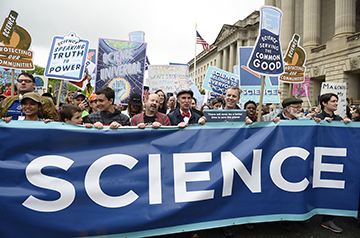
Stand Up for Science draws inspiration from the global March for Science held in 2017. Then, scientists gathered to express their concerns about a range of issues, including proposed cuts to research funding and other policies of the first Trump administration as well as climate change. Thousands of researchers were involved in organizing the marches, which attracted millions of people.
This year, however, Flores didn’t see scientists making the same kind of effort after Trump’s orders began to disrupt research efforts in the United States and around the world. “I really wanted something to happen,” he recalls, so he reached out to Jonathan Berman, an organizer of the original March for Science. Berman gave Flores the rundown on what it took to organize that event, including what he wished they’d done better 8 years ago.
The March for Science tried “to be all things to all people,” but “a protest doesn’t need to be that complicated,” Berman says. He suggested, for example, that Flores make sure Stand Up for Science organizers agreed on a basic mission statement before announcing the protest. So far, “they’re off to a good start,” Berman adds: They’re keeping it simple by just stating a time and place for the events.
At the AAAS meeting, some scientists welcomed Stand Up for Science’s plan. “It’s really encouraging to hear that there is something like this,” said Miles Arnett, a bioengineering student at the University of Pennsylvania. He hopes the marches will send “a message to the people in power that this is something we all really care about.”
Stand Up for Science won’t be the first opportunity for scientists to demonstrate. On Wednesday, for example, researchers affected by funding cuts and firings at the Department of Health and Human Services plan to rally outside the agency’s headquarters in Washington, D.C., and elsewhere.
At the meeting, computer scientist Bryce Johnson, a Ph.D. student at the University of Wisconsin–Madison, said he wasn’t sure whether he will attend a Stand Up for Science event. But he said he had already staged his own protest in Madison. He walked around the city with his dog, wearing a sign made from old carpeting that protested the National Institutes of Health’s plan to limit overhead costs to research institutions. “It was super satisfying that I got to express myself in a way that I usually don’t,” Johnson said.
The meeting’s exhibition hall also offered a way for researchers to express themselves. On four neon “trees,” attendees were invited to attach paper “leaves of encouragement” for researchers affected by recent events. “Students are with you!” one note said. “I’m scared, too. We’ll keep going,” another said. A third, in blue marker on orange paper, vowed: “We will STAND UP for science!”