


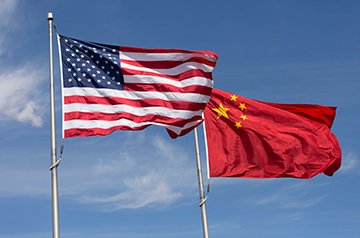
The U.S. and Chinese governments today signed an extension of a 45-year-old agreement that recognizes both nations can benefit from scientific collaborations. But the new version modifies the terms to account for the increased tensions between the two countries.
Many scientists are pleased. “The new agreement is a very positive step,” says Deborah Seligsohn, a political scientist at Villanova University who tracks U.S.-Chinese policy, of the pact known as the Science and Technology Agreement (STA). “It’s a signal to U.S. scientists that their government still values a bilateral relationship with China, even one with more guardrails.”
Li Tang, a science policy specialist at Fudan University, calls the latest version “a win-win-win for the U.S., China, and other nations that benefit from not having to take sides” in the growing economic and political competition between the two superpowers.
Signed in 1979 as China was making its debut on the global science stage, the agreement only applies to collaborations between government entities in each country on a host of topics, from clean energy research to reducing birth defects. But it has also served for decades as a template for Chinese officials to ink partnerships with U.S. universities as well as nongovernmental organizations (NGOs), fostering student and scholar exchanges and lab-to-lab interactions.
Those ties have become fraught, concedes a senior Department of State official who spoke yesterday on background at a media briefing. “We went into this process very realistic about the challenges that are associated with [China’s] national strategies related to science and technology, most notably the military-civilian fusion,” the official said. “We were also concerned about … their overly broad national security laws, the arbitrary application of their regulatory framework and … the complete lack of transparency that is often associated with their work.”
Those obstacles should have been enough to torpedo any agreement, its critics say. “The Chinese Communist Party has abused the openness of the American scientific community to steal American research and coopt it for its own malign purposes,” argued 10 Republican members of the U.S. House of Representatives last year in a letter urging President Joe Biden’s administration to let the agreement lapse. “The United States must stop fueling its own destruction.”
News of the renewed agreement has reignited that opposition. The chair of the House select committee on China complained last night to Secretary of State Anthony Blinken that he should have let President-elect Donald Trump’s incoming administration make the final decision, according to a report by Reuters. It cited a letter sent from Representative John Moolenaar (R–MI) asking Blinken to “immediately suspend efforts” to sign the deal.
But the State Department official says the benefits outweigh the risks. “We understood that failure to extend the STA could also have chilling effects in the areas of scientific cooperation that do benefit the United States,” the official said, citing ongoing collaborations in monitoring earthquakes, flu outbreaks, air quality, and agricultural pest management as examples of collaborations that benefit both countries. The Chinese government also wanted to extend the agreement, Seligsohn says. “China sees [the agreement] as critical for working with any U.S. academic institution or NGO.”
The extension contains new language on the need for reciprocity in data sharing and creates a process to discuss alleged violations of those provisions and terminate the treaty if concerns are not addressed. The U.S. side pushed for those measures, says a second State Department official involved in the negotiations who asked to remain anonymous because they are not authorized to speak for the agency. “All of the changes and amendments were ours,” the official notes, adding that “the new STA puts the burden on China to figure out how to navigate its data regulations.”
The new agreement also covers the safety of individual scientists, the official says. “We don’t want U.S. researchers involved in an innocuous project to be caught up in a situation where some overzealous official harasses them or detains them,” the second State Department official says. “We wanted to signal to Congress that we are aware of issues of arbitrary detention and exit bans in China.”
Chinese observers think the concern for researcher safety should cut both ways. “Ensuring fairness and safety for Chinese researchers abroad is essential to re-establishing a stable framework for scientific exchange and joint research,” Tang says, citing the harmful effect on Chinese scientists of a campaign launched by the Trump administration to thwart Chinese economic espionage.
As in the past, the White House must approve any proposed collaboration between a U.S. agency and its Chinese counterpart. The Biden administration failed to launch any new projects during its 4 years in office, Seligsohn notes, and many scientists worry Trump may take a dim view of any collaborations.
Still, she thinks perpetuating the agreement leaves the door open if relationships warm between the two countries. “Having to start over again would be much, much harder,” she says. “So, keeping this one alive is a big deal.”
Huiyao Wang, president of the Center for China and Globalization, a Beijing-based think tank that focuses on international relations, agrees. Reaching a new agreement, he says, “sends a strong signal that [politics] should be decoupled from science and technology cooperation.”
