


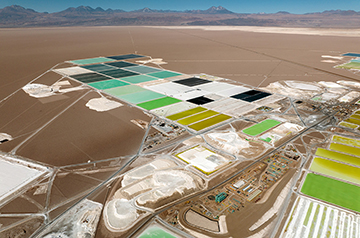
The world has an insatiable demand for lithium, aka “white gold,” a metal critical in electric vehicle batteries, and most of it now comes from giant evaporation ponds in places such as Chile, Argentina, and Bolivia. Companies pump salty, lithium-containing brines from underground aquifers into vast, shallow pools and wait for the Sun to evaporate most of the water, concentrating the lithium ions. Then, they mix in chemicals that cause the lithium to precipitate out as solid lithium carbonate. The approach can be more profitable than mining lithium from rocks, but solar evaporation can take more than a year, and the ponds sprawl across hundreds of square kilometers in fragile deserts and are expensive to build and maintain.
Now, researchers are trying to replace sunlight with electricity. A set of recent laboratory results bolsters the prospect of purifying lithium in facilities with much smaller footprints than evaporation ponds and tapping other kinds of brines with lower lithium concentrations, including wastewater from oil and gas operations and saltwater lakes. “If we can make this faster, more efficient, and use less energy, there will be plenty of lithium for all our needs,” says Lisa Biswal, a chemical engineer at Rice University who is working on one scheme. “A lot of these technologies are at an early stage,” adds Rice chemist Haotian Wang. “But they are beginning to demonstrate their commercial potential.”
The electrical approach typically relies on two chambers, one filled with the source brine and the other with pure water. Each has an electrode, and the chambers are separated by a membrane that only allows certain ions to pass. Current supplied to the electrode in the water chamber splits water molecules, producing hydrogen gas and negatively charged hydroxide ions that attract positively charged lithium ions in the brine, drawing them through the membrane. On the briny side, meanwhile, water loses electrons to the electrode, generating oxygen gas. The steps can be repeated in successive cells until the lithium on the water side is concentrated enough to be precipitated out.
The idea isn’t new, but it has problems. The setup consumes a lot of electricity, much of it going to the oxygen-forming reaction. “The oxygen reaction is very slow,” says Ge Zhang, a chemical engineer at Stanford University. In another drawback, chloride ions from the salt in the briny chamber also slowly react at the electrode to form chlorine gas, a dangerous poison.
Researchers led by Zhang and Yi Cui, a materials scientist at Stanford, reported a twist on the setup that eases those problems in the 6 November issue of Matter. As lithium is drawn into their device’s water chamber, the researchers capture the produced hydrogen gas and pipe it to the briny side, which has been spiked with sodium hydroxide, a cheap compound used in making soaps. The additive releases hydroxide ions, which only need a small voltage difference to react with the injected hydrogen to form water. That reduces the electricity demand of the overall process by 80% and prevents the oxygen from forming in the first place.
The quick reaction also prevents the more sluggish process that forms chlorine gas. “It’s a fruitful avenue to go down,” says Seth Darling, an energy technology chemist at Argonne National Laboratory. But he notes that this initial lab-based demonstration works with a synthetic brine that differs from the chemically complex brines in the real world.
A three-chamber setup, reported by Biswal and her colleagues in the 11 November issue of the Proceedings of the National Academy of Sciences, also dampens chlorine production. They place the briny chamber between two pure water chambers that each contain an electrode and are separated from the brine by a membrane. Biswal explains that when current is applied, lithium ions end up concentrated in one of the water chambers, while the membranes keep chloride ions in the central briny chamber, preventing them from encountering the electrodes in the water chambers and forming chlorine gas.
Cui’s team has tried multiple ways to produce lithium electrically, and another of their schemes, described on 24 October in Nature Water, actually generates rather than consumes electricity. They started with two porous silver electrodes and the traditional two-chamber setup. But before putting the electrodes in place, they dunked one in brine, waiting for chloride ions to infiltrate the pore spaces in the electrode and react to form solid silver chloride. Once chock-full of silver chloride, that electrode was moved to the pure water chamber.
Next, the remaining plain silver electrode was inserted in the briny chamber, and the two were connected by an external wire. On the briny side, chloride ions again moved into and bound to the silver electrode, giving up electrons that flowed to the electrode on the watery side. There they reacted with the silver chloride, liberating negatively charged chloride ions that attracted lithium ions through the membrane. The setup purified lithium at about half the rate of the one in their Matter paper, but it did so while generating electricity—raising the prospect that extracting lithium could one day become a carbon negative process. “It’s a very smart and innovative design,” Wang says.
Researchers led by Zhiping Lai, a chemist at the King Abdullah University of Science and Technology (KAUST), report testing a similar approach on a much larger scale, in the 27 September issue of Science. Instead of using silver electrodes, they use electrodes made from iron phosphate, a common electrode material in lithium batteries. Although their setup doesn’t produce net electricity, they’ve already demonstrated a pilot scale version 100,000 times larger than the typical benchtop device. “It’s a very promising result,” Zhang says.
Lai says the KAUST team is working with the oil giant Saudi Aramco to build a commercial version of its reactor that, starting next year, will purify lithium from wastewater brines recovered from oil wells. If the technology proves viable there, the same chemistry should make it economical to recover lithium for more dilute sources, such as from salt lakes around the globe. “That would be a game changer,” Lai says.
More: https://www.science.org/content/article/scientists-may-have-found-faster-greener-way-mine-white-gold
