


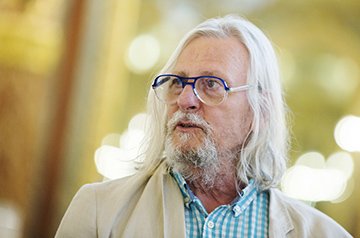
A data sleuth who helped bring to light major research failings at a French infectious diseases institute has unearthed a damning 2022 investigation by the university where it is housed. The findings confirm that clinical studies by its controversial leader and others there violated ethical standards.
The Aix-Marseille University (AMU) investigation began in June 2022 but its final report, dated January 2023, had never been released. The probe examined eight clinical research papers published by microbiologist Didier Raoult and colleagues at the Hospital Institute of Marseille Mediterranean Infection (IHU) that Raoult once led. None of the studies complied with international standards on ethics and most “were not in conformity” with French biomedical law, the report found.
The report adds to the many charges and sanctions leveled against Raoult—who is also a physician and became prominent during the COVID-19 pandemic for touting unproven therapies—and his institute. The French Medical Association last month banned him from practicing medicine for 2 years, his tally of retractions is up to 24, and 243 IHU papers have received expressions of concern. A criminal investigation of research conducted at IHU under Raoult is underway.
Fabrice Frank, an ex-biologist and information technology consultant who began to probe Raoult and IHU in 2020, asked the university for the investigative report under French transparency regulations in January. It only complied in October, months after he asked a French agency that deals with transparency requests to intervene. “They didn’t want the report to go public,” Frank says, “and after we read it, we understood why.”
The report concluded from the papers’ issues that there must be problems both at the university and IHU with training and supervision of research ethics. AMU did not respond to request for comment, nor did Raoult. (The French newspaper L’Express first reported the details of the school’s investigation earlier this week.)
Seven of the eight papers—six co-authored by Raoult—were published in American Society for Microbiology journals that retracted them in January, citing the results of the nonreleased university investigation. Other Raoult-authored papers not noted in the report have also recently been retracted, including five in PLOS ONE. Investigations are underway at PLOS into more than 100 further papers published by Raoult and other IHU researchers, says David Knutson, head of communications at PLOS.
It is surprising that the university only asked its investigators to examine eight papers because Frank and other critics have flagged ethical concerns in hundreds of IHU studies, says Mathieu Molimard, a pharmacologist at the University of Bordeaux and an outspoken critic of the institute’s research. All the papers that flouted ethical standards should be “retracted without any exception,” Molimard says.
Only one of the eight papers has not been retracted: a 2020 study in the International Journal of Infectious Diseases that asked 293 students at AMU to provide bodily samples—including rectal and vaginal swabs—before and after travel outside the country, to see which infectious diseases they brought back. The paper, which included Raoult as an author, stated the research had been reviewed by an ethics committee at IHU and conducted in line with the Declaration of Helsinki, an internationally agreed set of guidelines for ethical clinical research.
But the study was submitted to the ethics committee only after it had already been completed, the university investigation found—a clear violation of the Declaration of Helsinki. And, the report says, having the IHU panel review the study flouted French law on research using human participants. It should have instead been reviewed by one of France’s centralized ethics boards. In a 2021 investigation, the French drug safety agency had already reported that IHU staff had falsified an ethics document related to this work.
The improper ethical review of the study is an “absolute scandal” that should have disqualified the authors from ever conducting more research, Molimard says: “I am extremely shocked that this paper has not been retracted.” Shui-Shan Lee, editor-in-chief of the International Journal of Infectious Diseases, said in an email to Science that the journal had opened an investigation into the paper. He has not received a copy of the university’s report, but has requested it, he says.
The study forms part of a series with two other IHU papers using the same method, both published in the Elsevier journal Travel Medicine and Infectious Disease, neither of which has been retracted. Rebecca Clear, communications director at Elsevier, which also publishes the journal Lee edits, said it has “no further information at this point.”
Frank, who moved from France to Morocco during the pandemic to spend more time surfing, continues his data sleuthing and is happy the investigation report confirms what he and other IHU critics have been saying about its ethical failings: “Now it’s not Fabrice from the beach who’s telling it to you. It’s an official piece of evidence.”
