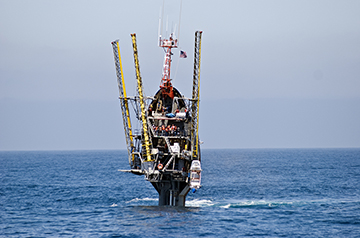
A sinking ship is usually bad news. But not for the Floating Instrument Platform, or R/P FLIP, which sinks its stern and tips 90° to become a vertical platform for ocean research. Faced with prohibitively expensive renovations after more than 60 years of service, FLIP in 2023 was towed to Mexico, where it awaited dismantling—until last month, when a company announced it had purchased the craft and had plans to breathe new life into it.
“It’s not just preserving a historical platform; it is very much answering to a science need,” says Luc Lenain, a physical oceanographer at the Scripps Institution of Oceanography. Scripps had operated the vessel for the U.S. Navy, which commissioned it in 1962 to study the propagation of sonar waves for submarine warfare.
The new owner, U.K.-based DEEP, is developing ocean habitats for research and exploration that could offer paying researchers or tourists sustained undersea experiences. President Sean Wolpert says one of DEEP’s early ideas—a vertical “spar buoy,” tricked out with a 100-meter-deep airlock for divers—took inspiration from FLIP. The 108-meter-long platform floats horizontally when in transit. Filling its ballast tanks with seawater flips it upright, submerging all but 17 meters. The cramped quarters in the remaining top section have equipment that either rotates or is duplicated at 90° angles.
After a flip, “You look at all your bunks and they’re all the other direction, and everything in the kitchen is a different direction,” says Qing Wang, a meteorologist at the Naval Postgraduate School. “You start using this toilet versus the other one—now it’s on the wall!”
Wang led one of FLIP’s most recent research projects, studying how the air and sea exchange gases and aerosols. The observations are important for understanding how radar beams skim across the ocean, as well as how storms form and evolve and how climate change might be altering that process.
FLIP, she explains, enables this research like no other platform. Air and water flow more smoothly around its narrow, cylindrical body than around a standard research vessel, enabling more accurate measurements. Long booms hold sensors away from FLIP to further reduce measurement interference. And with most of its mass floating beneath the waves, FLIP is stable even in stormy weather, offering scientists a stable reference point for measuring waves that would heave most vessels up and down. “The joke that we had on some of our cruises [was] we were drinking coffee outside in windy conditions, looking at another research vessel literally getting beat up,” Lenain says.
With no engine, FLIP relies on tugs to tow it. But this creates another research advantage: The platform is quiet—ideal for studying how sonar bounces off the sea floor and travels through water.
DEEP employees eventually discarded the FLIP-inspired buoy idea, but not their interest in FLIP itself, rushing to save the platform when they learned of its impending destruction. The purchase cost a fraction of the $600,000 needed to build FLIP in 1962, Wolpert says, with the money coming from an unnamed North American tech entrepreneur who acts as DEEP’s primary supporter and sole shareholder.
FLIP will undergo renovations at a shipyard in France until its scheduled relaunch in 2026. Wolpert says DEEP hopes to maintain FLIP’s diverse research capabilities, equipping it to measure air-sea interactions, acoustics, salinity, temperature, and ocean chemistry. The company might refit the platform to carry autonomous undersea vehicles, he adds. DEEP also intends to power FLIP entirely with renewable energy. “We think there’s still a lot of unique research and science that can be conducted on this platform,” Wolpert says.
DEEP says it’s already in contact with research groups interested in paying to access FLIP. Lenain says he would love to reunite with the platform in its new location, after its lifetime in the Pacific Ocean. “I grew up in France,” he says, “so all I can think right now is about … doing some science again from FLIP in the Mediterranean.”