


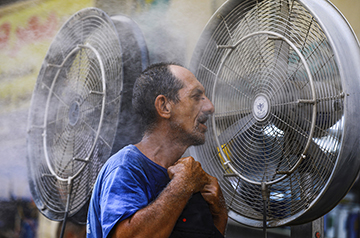
Who knew the simple question of when to use an electric fan could generate so much confusion?
During a heat wave, many people seek relief by sitting in front of a fan. But public health agencies warn that if it’s too hot, the blowing air can actually make things worse by acting like a convection oven—and they differ on that threshold. The U.S. Centers for Disease Control and Prevention (CDC) recommends not using a fan at temperatures above 32.2°C. Others, including the city of Phoenix, give higher thresholds, and the World Health Organization (WHO) puts the limit at 40°C.
New research from two different groups of thermal physiologists favors the higher temperature limits, especially in humid weather. But the groups don’t agree on a single temperature threshold. One study, published on 6 November in The New England Journal of Medicine (NEJM), reports that fans can relieve stress on the heart in elderly people in humid conditions at 38°C. The other, published on 17 October in JAMA, concluded there was little additional benefit from using a fan above 35°C.
“I do see this as unsettled science, or science that’s in the process of being settled,” says David Hondula, an Arizona State University climatologist who also heads Phoenix’s response to heat waves.
As global warming is helping fuel record-setting temperatures, the debate has real-world implications, particularly in parts of the world where costly air conditioning is out of reach for many people.
In the past, many health advisories converged around 35°C as the temperature limit for fans, because that’s the typical temperature of human skin. Above this level, the thinking went, a fan would exacerbate overheating by displacing the layer of air that has cooled to equilibrium with adjacent skin temperature, much like a convection oven that speeds cooking by circulating hot air.
But that threshold wasn’t based on experiments, says Ollie Jay, a thermal physiologist at the University of Sydney and co-author on the new NEJM paper. It also disregards the potential for additional cooling at higher temperatures if a fan helps sweat evaporate more quickly, removing heat from the skin surface.
Over the past decade, Jay has conducted a series of experiments and done computer modeling that suggest the temperature limit might be much higher than 35°C. Jay is a member of the Global Heat Health Information Network, created by WHO and the World Meteorological Organization. His results helped persuade WHO to adopt its 40°C limit in May and informed a Phoenix educational campaign that in 2023 recommended a cutoff between 37°C and 39°C depending on a person’s age and health.
To test these recommendations in high-risk groups, Jay and colleagues recruited people over age 65, some of whom had heart conditions. As people age they perspire less, so they get less cooling from evaporating sweat. And cardiac problems such as heart attacks are one of the biggest dangers of overheating.
The researchers tested 58 people inside special climate-controlled chambers that created two different climates: a humid one resembling places like Mumbai, India, at 38°C and 60% humidity, and a desertlike setting at 45°C and 15% humidity.
When exposed to the moist heat for 3 hours, even older people with coronary artery disease showed a 31% reduction in cardiac stress—based on heart rate and blood pressure—while sitting in front of a fan, compared with a separate test with no fan. When the participants were spritzed with water while in front of a fan they fared even better, with a 55% lower stress level. People without heart disease got even more benefit in all scenarios.
“Under the hot humid heat conditions, we show definitely that fans are protective at a temperature above the threshold used by CDC,” Jay says. That, he says, is because by circulating the air, the fans enabled more moisture on the skin to evaporate than if air close to the body remained stagnant.
By contrast, results in dry conditions starkly illustrated the dangers of misusing fans. The scientists stopped the experiments after testing just 14 people because their cardiac stress went through the roof as the fan blew hot air on them. Nearly half the participants couldn’t stay in the test room for 3 hours. The reason for that dramatic response: The air was so dry that any sweat quickly evaporated, resulting in little additional cooling as the fan bathed participants in extremely hot air, Jay says.
The competing experiment had a similar setup. At a University of Ottawa lab, 72 people over age 65 endured multiple 8-hour sessions in a room that simulated a heat wave, kept at 36°C with 45% humidity. With a fan blowing at a typical speed, participants at the end of the test had core temperatures 0.1°C lower on average than in their trial with no fan. They also had a heart rate five beats per minute lower and reported being more comfortable.
To Loughborough University thermal physiologist George Havenith, who wasn’t involved in either study, the data in the two papers paint a consistent picture. The key point: Above 35°C, humidity matters a lot. In very dry conditions, a fan could be counterproductive, whereas in very humid ones it could continue to help at much higher temperatures.
But the researchers in the Ottawa study say their results don’t justify using fans alone to cool older adults indoors at temperatures above 35°C. “I just don’t see them packing enough punch,” says Robert Meade, a heat physiologist and postdoctoral researcher at Harvard University who helped lead the study.
The dueling conclusions underscore the tricky balance facing public health agencies, says Kristie Ebi, a heat epidemiologist at the University of Washington. “The messaging needs to be simple,” she says—but not too simple.
For now it seems likely to remain confusing. Jay says WHO’s 40°C limit is safe, based on lab experiments, modeling, and historical weather data from around the world. CDC, meanwhile, continues to defend the 32.2°C limit. “We don’t have studies, done in the real world, that show that these higher thresholds are safe for people who are less able to cope with heat,” the agency said in a statement. Studies of physiological responses to fans in the real world—not just in climate-controlled chambers—are “sorely needed to show fans are safe—especially because we know that when temperatures outside are reported as 90°F [32.2°C], temperatures inside can be much, much higher.”
More: https://www.science.org/content/article/when-is-it-too-hot-use-fan
