


Coronaviruses have already caused three major disease outbreaks this century, including the COVID-19 pandemic, and scientists suspect other members of the family lurking in nature threaten humanity. But many of these pathogens are difficult to grow in the lab, making it a challenge to study them and develop countermeasures before they strike.
Now, researchers have devised a strategy to circumvent that problem. Reporting in Nature, scientists say they have equipped human cells with custom-designed receptors that the viruses can bind to and use to sneak inside a cell. The study uses “cutting-edge work at the intersection of virology, immunology, biochemistry, molecular modeling, and cell biology,” says Arturo Casadevall, a microbiologist and immunologist at the Johns Hopkins Bloomberg School of Public Health who was not involved with the work.
A byproduct of the approach, however, could be many more studies of newfound coronaviruses, and therefore a greater risk of accidentally infecting lab workers or even triggering an outbreak, critics say. The authors recognize that concern, says study leader Huan Yan of Wuhan University. “Overall, we believe that the advantages of using [this strategy] outweigh the potential risks associated with these research activities.” The paper’s authors include scientists in the United States and Switzerland, and also Shi Zhengli, whose former lab at the Wuhan Institute of Virology (WIV) has been accused of “leaking” SARS-CoV-2, the virus that caused the COVID-19 pandemic. (Shi is now at the Guangzhou Laboratory.)
Beyond the COVID-19 pandemic, coronaviruses were also behind the 2003 worldwide epidemic of severe acute respiratory syndrome (SARS), triggered by a virus now named SARS-CoV, and Middle East respiratory syndrome, a disease transmitted primarily by camels that burst on the scene in 2012 and still sickens people occasionally. (All three are caused by betacoronaviruses, one of four genera within coronavirus group.)
There are thousands of other coronaviruses in nature, most of them likely living in bats. In most cases, scientists have only detected these viruses’ genomes, or part of them, but they haven’t isolated the actual virus itself. And even if they could, such viruses are challenging to grow in the lab.
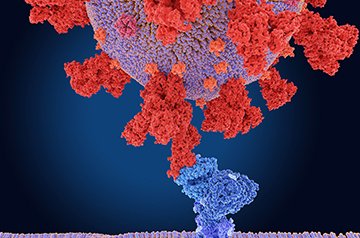
To enter a cell, so-called “spike” proteins on the surface of a coronavirus—which give it the characteristic crownlike appearance—must latch onto a matching receptor on a cell, like a key fits into a lock. Scientists have identified only a handful of coronavirus receptors so far, including angiotensin-converting enzyme 2 (ACE2), the most important receptor for SARS-CoV, SARS-CoV-2, and several other coronaviruses. ACE2 is widely found on lung cells, for example, explaining some of the respiratory symptoms the viruses produce.
When researchers have a coronavirus’ genomic sequence, they can produce its spike protein. Yan, whose group specializes in receptor biology, wondered whether these spike proteins could help him build receptors from scratch, using a variety of building blocks, and stick these artificial receptors into the membranes of human or animal cells.
To do this, the team constructed “scaffolds” from parts of known coronavirus receptors, including ACE2. Then it attached customized “virus-binding domains”—the part of a receptor that matches the spike protein—to the scaffold. The scientists used a variety of techniques to optimize both scaffolds and virus-binding domains. Some of the best functioning receptors, it turned out, were the ones in which the virus-binding domain were so-called nanobodies, smaller versions of regular antibodies, that attached to the spike protein.
The team initially tested how well its receptors worked using so-called pseudoviruses, viral particles that lack most of the coronavirus genome and hence pose no biosafety risk. Together with Shi, the researchers also tested them with real viruses under stricter biosafety conditions.
The first artificial receptors the group tried to make were for SARS-CoV-2; eventually the scientists developed one that worked just as well as ACE2 but had a completely different amino acid sequence. After that proof of principle, they produced custom-built receptors for 12 other coronaviruses from six subgenera. Most were identified only from a genetic sequence and their natural receptor was unknown.
The scientists also showed how, from an anal swab taken from a bat in China, they could isolate and grow a coronavirus named HKU5, using a human cell line with custom-built receptors. The same strategy could be applied to isolate and study other coronaviruses. In the future, Yan says, researchers could create transgenic animals that express the receptors for a new coronavirus and could model how it might infect and sicken people.
Such studies might help develop new antivirals and vaccines, says Yan, who adds that the technique could also provide new insights into viral invasion mechanisms and the precise roles receptors play. His team is exploring whether the strategy can be applied to other kinds of human viruses and has already obtained “some promising results,” he says.
“It’s a really nice paper” that could open up many research avenues, says Vincent Munster, a virologist at the National Institute of Allergy and Infectious Diseases (NIAID). He calls the use of nanobodies to produce receptors “a very creative step.”
The new method creates fresh biosafety concerns, however. Scientists already grow lots of different viruses in cells and animals, but the custom receptor technique could add many more from a group suspected of holding nasty surprises. Yan and colleagues recommend several precautions, such as first performing the experiments with pseudoviruses to assess the biosafety risk before isolating new viruses. When growing viruses in cells, researchers should look for biological changes and mutations that signal adaptations to human cells, the authors also say. Moreover, “We do not recommend isolating a wide/whole range of coronaviruses with unknown risks to humans,” Yan writes in an email.
Ultimately, however, “Whether or not we conduct research on these viruses, they already exist in nature,” he says. “It is beneficial to understand the vulnerabilities of these potential threats before they spill over into human populations.”
Others aren’t so sure. Virologist James Le Duc of the University of Texas Medical Branch says the new paper—along with advances in the prediction of protein structures and other impacts of artificial intelligence in the biological sciences—shows “it is clear that our national and international policies to mitigate risks are failing to keep up with the rapidly advancing technology.” He notes another concern: “With such highly specialized studies, it is difficult to identify qualified independent reviewers able to recognize and suggest steps to mitigate potential risks,” Le Duc says. “Clearly this is a discussion worth pursuing.”
Part of the work described in the paper was done by David Veesler’s lab at the University of Washington, with support from NIAID and other U.S. funders. Veesler did not respond to emailed interview requests.
Casadevall, who takes a strong interest in so-called dual use research—studies whose results can be used for good or ill—gives the new approach the benefit of the doubt. “Like most new biological technologies, this one has dual use potential,” he says. “But I focus on its potential to help humanity confront new viruses, and the possibility that it can lead to novel therapies.”
