


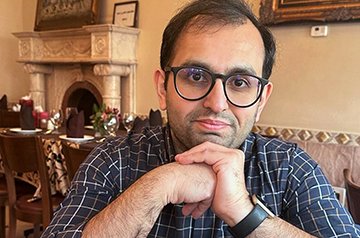
Last month, Shoaib Ahmed Malik, a chemical engineer–turned–theologian, took up a new position at the University of Edinburgh’s School of Divinity, making him one of the few Muslim scholars of religion and science based at a university in Europe or the United States. One of his first projects was moving a trove of classic Islamic texts into his office. Now, he’s ready to use them to inform his studies of the perspective that the faith can bring to contemporary science issues. When it comes to the intersection of science and Islam, Malik says, “I see interesting opportunities and conversation points.”
Born and raised in Kuwait, Malik earned a doctorate in chemical engineering from the University of Nottingham in 2014 and then a second in theology from St. Mary’s University, Twickenham, London in 2023. In 2021, he wrote an award-winning book—Islam and Evolution: Al-Ghazālī and the Modern Evolutionary Paradigm—that explores Islam’s relationship to Charles Darwin’s theory of evolution. Historically, many Muslims have rejected Darwin. But Malik views the issue through the lens of the work of Al-Ghazālī, a prominent Muslim scholar in the 11th century, and argues that Islam allows more accepting interpretations of evolution. He also edited a 2023 book of essays exploring Islamic perspectives on the search for extraterrestrial life. Now, in Edinburgh, Malik is examining the interplay between Islam and artificial intelligence.
