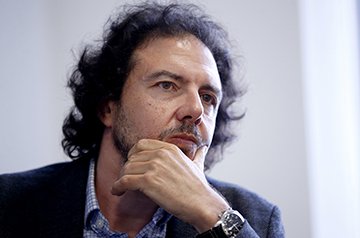
In the latest blow to a once high-flying career, the U.S. Department of Health and Human Services (HHS) is seeking to debar biologist David Sabatini from receiving National Institutes of Health (NIH) grants based on 2021 sexual misconduct findings from an investigation by the Whitehead Institute for Biomedical Research (WIBR). The proposed action comes weeks before Sabatini plans to jump-start his research by opening a lab in Boston as a U.S. branch of his new employer, a Czech research institute.
The WIBR probe found Sabatini breached the institute’s consensual sexual relationships policy and its antiharassment policy when he engaged in a sexual relationship with a scientist then launching a lab at WIBR. It also concluded that Sabatini tried to influence the probe, misleading investigators and attempting to shape interviewees’ testimony.
“I find Dr. Sabatini’s misconduct to be antithetical to [NIH] requirements [of grantees for] fostering a safe and healthful work environment, and I find it to be a cause of so serious and compelling a nature” that it affects his ability to be entrusted with NIH funds, HHS official Katrina Brisbon wrote in a 4 August letter to Sabatini. NIH had earlier asked that Sabatini be debarred from funding for 1 year. However, the length is at Brisbon’s discretion and she wrote she would take into account “any mitigating or aggravating factors that may apply.”
Sabatini’s lawyers challenged the grounds for the proposed debarment in a court filing last week, arguing that the relationship with the scientist was consensual and WIBR’s probe was unfair.
His lawyer, Edward Foye, said in an email today, “We’re confident that the evidence will show that this is a scientist protecting himself against false and defamatory statements. … The HHS proceeding is based on the premise that the ‘investigative report’ was independent. It wasn’t, and it is in material respects false.”
Debarments by HHS, which can also follow financial fraud or research misconduct, are rare. In May, Brisbon initiated debarment proceedings against the EcoHealth Alliance, a nonprofit, over its management of an NIH grant to study bat coronaviruses. (The Wuhan Institute of Virology received a subaward from that grant for work that critics have claimed sparked the COVID-19 pandemic.)
The debarment letter came to light last week in a related Massachusetts lawsuit in which Sabatini is suing WIBR; its director, Ruth Lehmann; and his accuser, Kristin Knouse, a biologist now at the Koch Institute for Integrative Cancer Research and the Massachusetts Institute of Technology (MIT). He is suing for defamation, workplace discrimination, and other charges. Knouse countersued for sexual harassment and retaliation among other things. (Last year, a judge threw out all of the charges against WIBR except for workplace discrimination. Sabatini is appealing that decision, with a key hearing slated for 1 October.)
In a hearing that concluded today, Sabatini asked the court to release privileged documents from the lawsuit for him to file with HHS in support of his argument he should not be debarred. Knouse and WIBR are fighting the release, arguing the documents could then become obtainable by the public under the Freedom of Information Act (FOIA).
Sabatini’s lawyers countered that privacy exemptions to FOIA would prevent the documents from becoming public. They wrote in a 16 September filing that “the vast majority of the impounded evidence consists of text messages between Knouse and her friends about what she intends to do to Sabatini, why she is doing it and how she plans to go about it, which is why it is relevant.” They added: “The evidence that Dr. Sabatini wants to submit … show[s] that the [WIBR] investigation was a sham.” A decision from Judge Hélène Kazanjian of the Suffolk County Superior Court is expected before 7 October.
Sabatini filed the lawsuit in October 2021, shortly after he resigned from WIBR and was fired by the Howard Hughes Medical Institute based on the findings of an investigation conducted for WIBR by an outside law firm. He later resigned from MIT rather than face a battle to keep his tenure after the MIT administration found Sabatini breached its consensual relationships policy by beginning a sexual relationship with Knouse while she was a student in a joint Harvard University–MIT M.D./Ph.D. program.
Access to NIH grants could become much more relevant for Sabatini in the near future: After his near-hiring at New York University was torpedoed by protests in 2022, Sabatini was hired in October 2023 by the Institute of Organic Chemistry and Biochemistry in Prague, which next month plans to officially open a Boston branch housing Sabatini’s new lab.