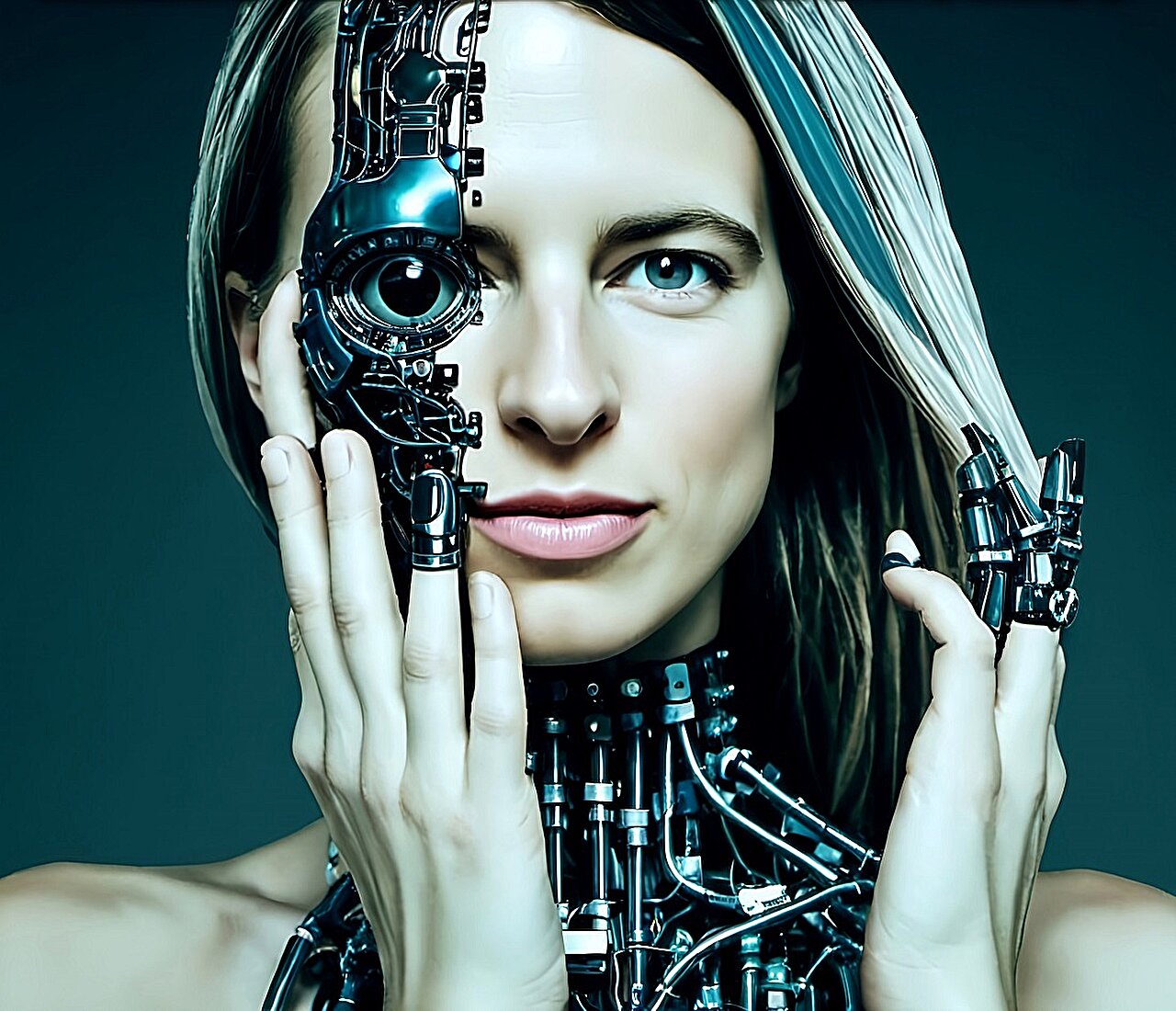
Inga Strümke does not believe artificial intelligence will take over the world with killer robots, but it might kill your spark. This is an area that needs rules, and Europe is about to get them.
Her office isn't necessarily boring, but the cell-like room behind the glass door at NTNU doesn't exactly reveal that this is the base of one of Norway's most renowned researchers, either.
Associate Professor Inga Strümke has become a kind of guru for people who are interested in artificial intelligence in Norway, partly because of her book "Machines That Think," but mainly because she likes to share what she can with the rest of us.
The European Union is now introducing new and stricter rules for the use of artificial intelligence, the so-called AI Act. As an EEA member, Norway will likely adopt the same rules.
"I'm not a fan of regulation for regulation's sake," says Strümke.
However, she sees several reasons why Norway should participate.
"Norway is part of Europe and the world. It is politically important that we continue to work closely with the EU on these issues. But beyond the purely political aspects, the AI Act is important for you and me. We shouldn't have AI that exploits people's weaknesses," she says.
The use of AI that can be dangerous or unfair will be subject to much stricter regulations than uses that appear to be more innocent. Some uses will simply be prohibited in the EEA and EU. You can see a summary in the fact box below.
"The rules will protect consumers. They will ensure that we are safe and can trust the use of AI," says Strümke.
Would it really be such a big deal if these rules were not put in place? Everyone knows that rules can be annoying.
"We could also ignore traffic rules. Everyone could drive as fast as they wanted. For a short time, that is. Until something goes horribly wrong. AI is such a strong commercial force. When Chat GPT was launched, it took just five days before it reached 1 million users," says Strümke.
Chat GPT is currently the most famous chatbot. Numerous pupils and students have already taken shortcuts by using it.
"We are not yet finished dealing with the use of AI in the education sector. You don't really learn that much when you let AI do almost all the work," says Strümke.
However, it is not the case that the rest of the world will necessarily adhere to the same strict regulations as the EU and Norway. For example, what is to stop China or the U.S. from having more relaxed regulations and thereby possibly gaining a competitive advantage?
"Nothing. We cannot prevent other countries from having different rules. But it is a myth that only the EU regulates the use of artificial intelligence. Earlier this year, the United States already had 58 different regulations for the use of artificial intelligence, albeit distributed across various states. But it is not a free-for-all elsewhere either. We have to choose the type of society we want to live in. The EU has had a tendency to set a precedent for others," says Strümke.
Other parts of the world often follow the same path that is taken by the EU. Strümke illustrates this by showing a USB-C cable, the new standard for charging cables in much of the world. It was recently introduced despite a lot of initial protests from technology companies.
This means that we avoid having piles of different charging cables lying around, one type is enough. As an additional benefit, USB-C transfers the most data and power, and the cable can be used in either direction. We can thank the EU for making USB-C the standard.
Similarly, much of the world has followed the EU's General Data Protection Regulation (GDPR), which gives us all greater control and rights over the type of information companies can collect about us.
She believes that the same thing could happen regarding artificial intelligence regulations as well.
Just a couple of years ago, the most advanced AI would probably not have envisioned that an artificial intelligence expert could become a sort of research celebrity. This hasn't, however, led to her having any prima donna tendencies, and that might be part of the secret.
Inga Strümke speaks so clearly that you almost think you understand what her work involves. But just one glance at her computer screen is enough to make you realize that she is not exactly sharing everything she knows with us. It is full of programming language.
She is actually a physicist with a Ph.D. in particle physics, but she has concentrated on artificial intelligence in recent years.
Her specialization is machine learning, which involves training artificial intelligence and explainable artificial intelligence. The latter deals with what artificial intelligence has actually understood and where this knowledge originates from.
More: https://techxplore.com/news/2024-09-danger-ai-good-simply-resist.html