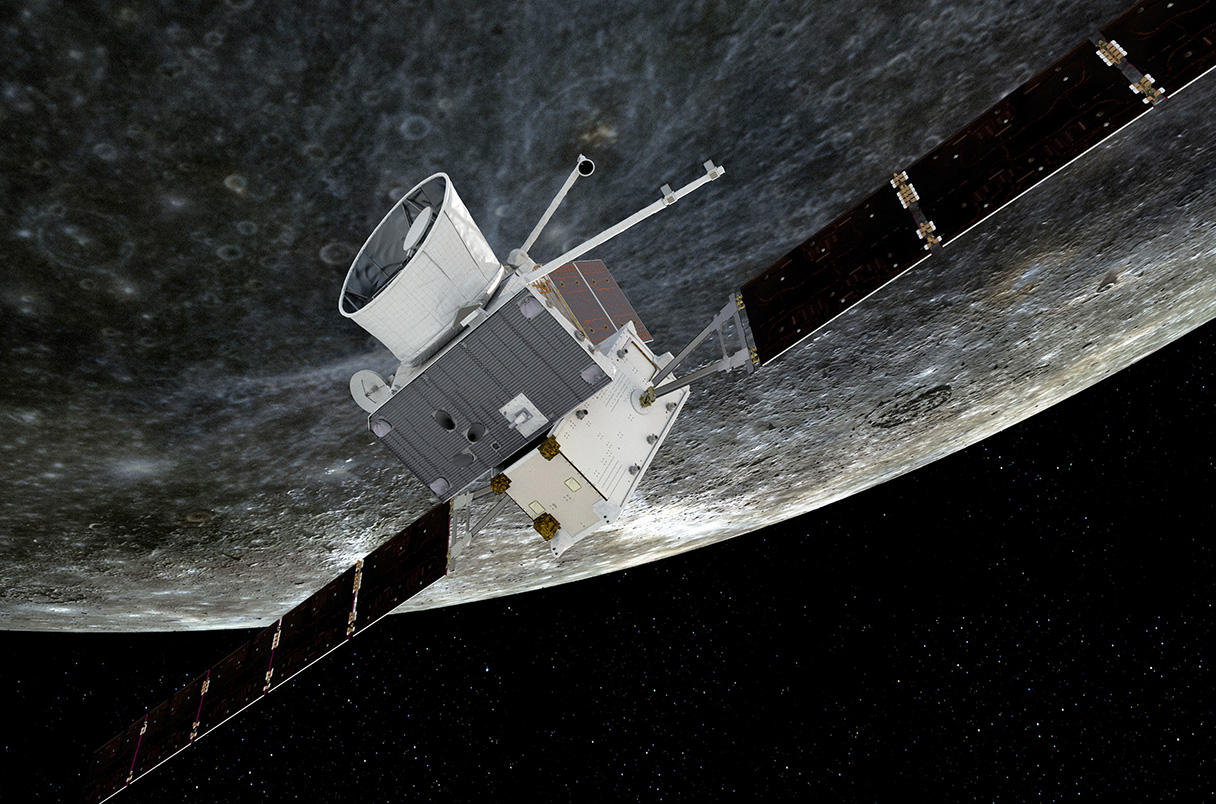
The long and circuitous trip of a spacecraft on its way to study Mercury is getting a bit longer and more circuitous thanks to a glitch in its propulsion system. The BepiColombo mission is now scheduled to arrive at the tiny and little-studied planet in November 2026, 11 months behind schedule.
The European Space Agency (ESA), which developed the $1.8 billion BepiColombo in cooperation with the Japan Aerospace Exploration Agency (JAXA), said in a 2 September statement that the mission's scientific objectives will not be affected by the delay. Meanwhile, the revised trajectory has the craft passing 165 kilometers from Mercury's surface on 4 September during a gravity assist flyby. The encounter, 35 kilometers closer than originally planned, provides an opportunity to test instruments and study the interaction between the solar wind and the planet's magnetic field.
Scientists are planning to make the most of the flyby, starting up 10 of the mission's 16 instruments. “We get to fly our world-class science laboratory through diverse and unexplored parts of Mercury’s environment that we won’t have access to once in orbit," Johannes Benkhoff, BepiColombo’s project scientist, said in a statement.
Launched in October 2018, BepiColombo is carrying two probes, ESA's Mercury Planetary Orbiter, with 11 instruments, and JAXA’s Mercury Magnetosphere Orbiter, with five. The two spacecraft are stacked aboard the mission's transfer module for the trip to our Solar System's smallest planet. Upon arrival, they will detach and enter separate orbits. BepiColombo has so far completed one flyby at Earth, two at Venus, and three at Mercury.
In April, in the run-up to this month’s Mercury flyby, managers found that the craft's ion propulsion thrusters, which rely on electricity provided by the transfer module's solar panels, were not operating at full power. Engineers eventually identified unexpected electric currents flowing between the solar arrays and the equipment that distributes electricity to the rest of the spacecraft, leaving less power for the ion thrusters. ESA's flight dynamics team plotted a revised route that takes into account the reduced thrust.
There will be two more Mercury flybys in December 2024 and January 2025, before the two probes enter the planet's orbit. Once there they will gather data on Mercury's outsized iron core, volatile elements in the crust, and the structure and dynamics of the planet's magnetosphere. Scientific observations are expected to continue for a year with the possibility of extensions.
More: https://www.science.org/content/article/bepicolombo-faces-11-month-delay-journey-mercury