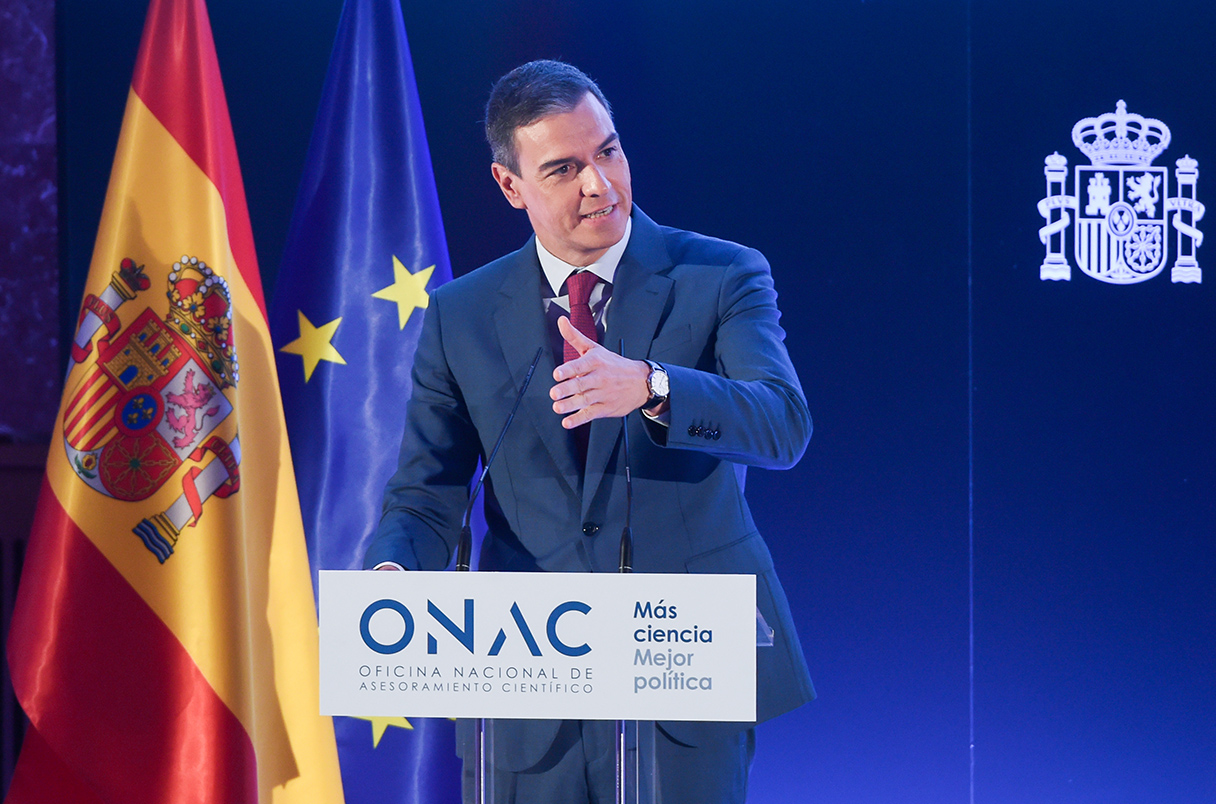
Spanish researchers are hoping science will become more entrenched in government policy, following the launch of a scientific advisory office designed to create new links between scientists and politicians.
The National Office for Scientific Advice (ONAC) will establish a network of science advisers across government departments, according to plans outlined at a 20 June kickoff event. It will also facilitate access to expert advice in times of emergencies and design funding programs for scientists to conduct trials of potential policy interventions.
The office “is excellent news for Spain,” says Eduardo Oliver, a biomedical scientist at the Spanish National Research Council (CSIC), the country’s largest public scientific institution. “We are finally beginning to have a true ecosystem of scientific advice in the country.”
The Spanish government decided to create the new body after finding very few scientists to turn to for advice during the COVID-19 pandemic. In Spain, “There is a ‘valley of death’ … between the research groups that are willing to advise and the policymakers that are willing to listen,” says ONAC’s first director, Josep Lobera, an engineer and social scientist. The new agency aims to bridge that gap. It has been placed within the prime minister’s office to give its mission more political clout, Lobera says, and has received initial funding of €10 million for its activities this year.
A chief priority for the new body is to oversee a network of scientific advisers in each of the country’s 22 ministries who will respond to policymakers’ questions and needs, similar to existing systems in Canada and the United Kingdom. Another 10 scientists with expertise in biomedicine, the environment, digitalization, and other key areas will form a policy unit within CSIC, offering further scientific advice in collaboration with the rest of the scientific community.
ONAC has also been busy devising plans to ensure that multidisciplinary expert teams can offer advice promptly and efficiently during national emergencies, such as disease outbreaks and natural disasters. After the country’s experience during COVID-19, “we are going to try to fix the roof while it’s not raining,” Lobera says. Both the scientific advisers and crisis protocols should be in place by November.
In addition, the office is launching funding programs to test policy interventions in randomized trials. Researchers can already apply for a share of the €2-million-a-year fund to run pilot studies testing the acceptance and impact of new policy measures or delve into government data to find ways to improve existing ones. Starting next year, researchers will also be able to apply for 6- to 8-month fellowships akin to those provided by AAAS, Science’s publisher, to work on policy issues within the government and national public agencies.
ONAC’s creation is a positive step, says J. Ignacio Criado, a political and administration scientist at the Autonomous University of Madrid, because it will allow scientists and politicians to know and understand one another better. But for the initiative to be successful and long-lasting, scientific advisers must be given enough funding to be independent from political powers, he says, and a voice loud enough to be heard.
Oliver, who headed a grassroots initiative that led to the establishment of a parliamentary scientific advisory body in 2021, agrees politicians will need to refrain from using science selectively to push their own ideologies. But likewise, he adds, scientists will have to realize that science is only one factor in the policymaking process. “It is very important that academia actively gets involved and sees it as an opportunity to help address society’s problems,” he says.