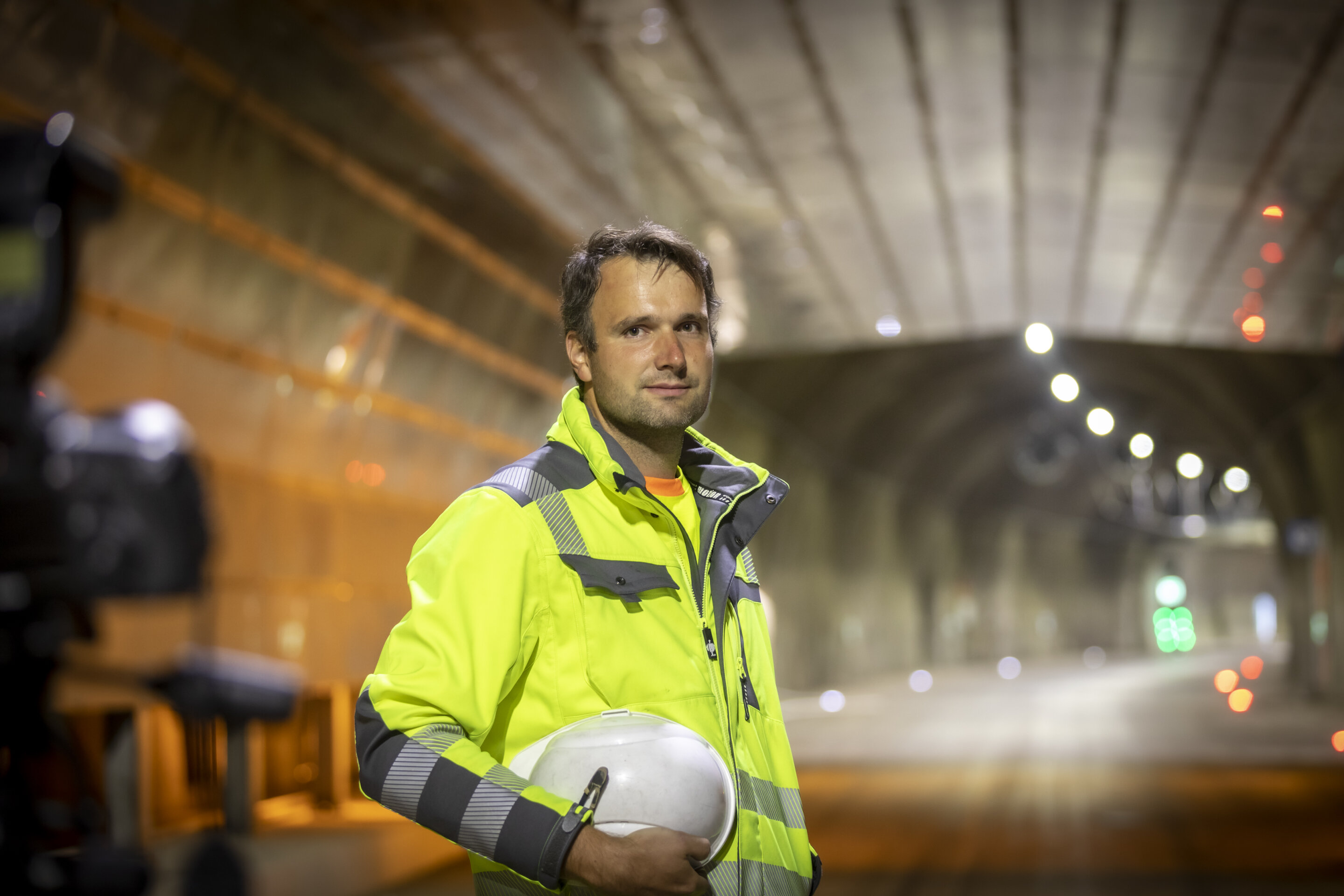
A team from Graz University of Technology has analyzed the risks and damage potential of hydrogen vehicles in tunnels and derived recommendations. Their conclusion? Any damage would be extensive, but its occurrence is unlikely. They presented their findings at the 12th International Conference on Tunnel Safety and Ventilation (TSV 2024), held in Graz from April 16-18.
New Hazards for Tunnels
In addition to electric vehicles, hydrogen-powered vehicles are also seen as an alternative to conventionally powered vehicles. However, an increase in the number of such cars with fuel cells (Fuel Cell Electric Vehicles—FCEVs) would result in completely new hazard scenarios, especially in tunnels.
In the HyTRA project, Graz University of Technology (TU Graz) investigated the types of incidents involving hydrogen-powered vehicles in tunnels that are realistic, the dangers for people and the tunnel structure, and measures to minimize these risks.
Low Probability of Occurrence, High Damage Potential
Due to the low current traffic share of hydrogen vehicles, there is virtually no empirical data on real accidents involving hydrogen-powered vehicles in tunnels. Therefore, only a rough estimate of the probability of occurrence could be made based on experience with gas-powered vehicles, which indicated a low probability.
In comparison, the potential extent of damage was analyzed in great detail using experiments from the EU HyTunnel-CS project, which ended in 2022. Due to the high energy density of hydrogen and the high pressure at which it is stored, FCEVs have a very high damage potential.
According to current standards, hydrogen is stored in cars at a pressure of 700 bar and in lorries and buses at 350 bar. If a tank is damaged, a large amount of energy is quickly released; if hydrogen ignites, it burns at temperatures over 2,000 degrees Celsius. Although tanks are robust and well-protected against mechanical impact, they cannot withstand a rear-end collision with a lorry. This scenario should therefore be avoided as much as possible.
Three Hazard Scenarios
The most likely outcome of an accident involving an FCEV is no significant impact from the hydrogen. However, three different hazard scenarios can occur in serious accidents:
- Thermal Pressure Relief Device (TPRD) Activation: Triggered by a thermal impact (e.g., vehicle fire), releasing hydrogen from the tank in a controlled jet. This prevents tank rupture but if ignited, the flame is directed towards the ground, remaining dangerous yet limited in scope.
- TPRD Failure: The tank can explode, creating a blast wave spreading through the tunnel. This can cause fatal injuries up to 30 meters, serious internal injuries up to 300 meters, and ruptured eardrums further away.
- Unignited Hydrogen Release: Hydrogen rises and collects under the tunnel ceiling, forming a cloud. If ignited by a heat source, a hydrogen cloud explosion occurs, causing a blast wave.
Measures to Minimize Risks - "Our investigations have shown that although the hazard scenarios involving hydrogen vehicles are relatively unlikely, they harbor great potential for damage. Modern hydrogen tanks are built so safely that a lot has to go wrong for the hydrogen to escape," says Daniel Fruhwirt from the Institute of Thermodynamics and Sustainable Propulsion Systems at TU Graz.
"In addition, the transport infrastructure in Austrian tunnels probably fulfills the strictest requirements in Europe. Since we have one operator for all motorway and highway tunnels, the safety level is very homogeneous. There's little risk to the tunnel structure, but accidents would be dangerous for people."
To minimize risks, Fruhwirt and his team recommend several measures: stricter speed limits monitored by section control, precise distance controls that alert drivers when following too closely, and earlier speed limit displays in traffic jams to reduce the speed well before reaching the end of the jam, mitigating rear-end collision damage.
"Since the late 1990s and early 2000s, EU member states have implemented twin-tube tunnels for motorways and highways over 500 meters long, avoiding bi-directional traffic. This considerably reduces risk," explains Fruhwirt.
More: https://techxplore.com/news/2024-05-hydrogen-vehicles-tunnels.html