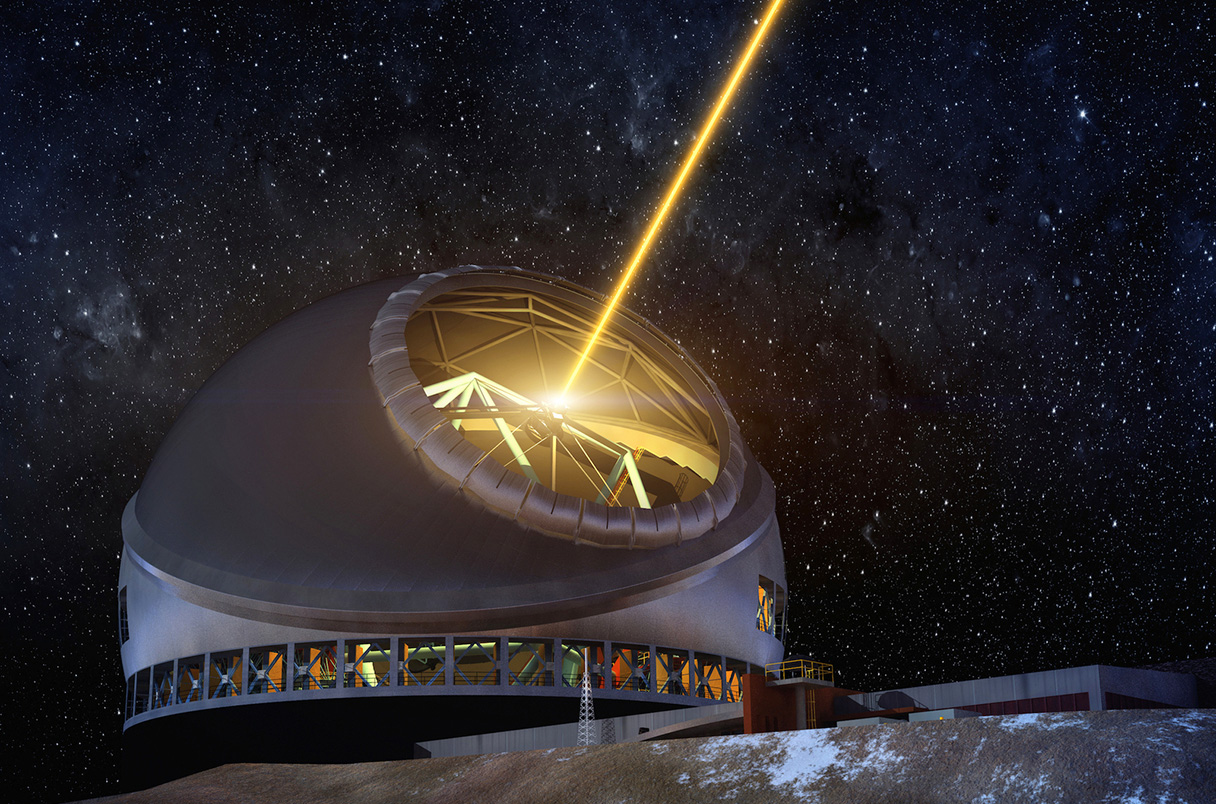
For decades, the National Science Foundation (NSF) has worked closely with U.S. astronomers to choose successive cutting-edge telescopes—and figure out how to pay for them. But that hasn’t happened with the community’s top ground-based priority in the next decade: the Thirty Meter Telescope (TMT) in Hawaii and the Giant Magellan Telescope (GMT) in Chile.
Those efforts to build the largest ever U.S.-led optical telescopes are seeking a record $1.6 billion investment from NSF at a time when the $9 billion agency is strapped for cash. And that’s not the only hitch. Their joint pitch to NSF, called the U.S. Extremely Large Telescope Program (US-ELTP), is out of step with the agency’s approach for selecting big scientific instruments, from accelerators to telescopes.
NSF ordinarily vets projects that are still on the drawing board. Instead, the US-ELTP is essentially offering NSF the chance to buy into two projects that are already well underway. It has forced the agency to tweak its usual approach, spelled out in a 320-page guide, for choosing and building new facilities. “Needing to understand the unique scope of this project has lengthened the decision-making process for NSF,” an agency spokesperson acknowledges.
In the past 18 months both projects have passed a preliminary design review by an external NSF panel and two additional in-house reviews. However, those assessments focused on their scientific merit and the technical soundness of each telescope’s design. They did not resolve whether the US-ELTP’s two-site option is viable and, if it isn’t, which project should go forward.
In February, NSF’s oversight body, the National Science Board (NSB), took steps to speed up the decision. Without expressing a preference, the board approved a $1.6 billion spending ceiling for the US-ELTP and asked NSF Director Sethuraman Panchanathan to come up with a plan for moving forward.
“We recognized that the process was stalled, and that both projects were in limbo,” says Dan Reed, a computer scientist at the University of Utah who stepped down as board chair earlier this month when his 6-year term on the board expired. “This was our attempt to kick-start the system and drive it toward closure.”
This month, Panchanathan unveiled his next step: a new external panel that will assess the strengths and weaknesses of both telescopes. NSF declined to name the panelists it chose, citing the need for confidentiality. But Panchanathan says the group will hear presentations from each project in July and that its report, due in September, will “inform my decision-making on advancing either project to the final design stage.”
Traditionally, private entities have built and operated astronomy’s most powerful telescopes, and that was the plan for these two projects. Toward that goal, a consortium of 14 research institutions led by the Carnegie Institution for Science has amassed $850 million for the GMT, while the California Institute of Technology and the University of California have led an international team of partners that has contributed $2 billion toward building the TMT.
But those sums still leave each project $1.6 billion short of what they need. Meanwhile, construction of a giant European telescope that could see first light as soon as 2029 has forged ahead in Chile. In 2018, the two rival U.S. projects joined hands under the US-ELT banner and turned to NSF to make up the shortfall. In return for a significant investment, NSF would receive a sizable chunk of viewing time, which any U.S. astronomer could compete for.
NSF funds such large instruments through its Major Research Equipment and Facilities Construction (MREFC) account. Created in the 1990s, the account is distinct from NSF’s bread-and-butter research programs, and disciplines typically have agreed to wait their turn for a slot to open up in its annual budget, which has hovered around $250 million. But the US-ELTP, with two similar projects in the same field, has stressed the system.
“I don’t recall any time when there’s been two MREFC candidates from the same subdiscipline simultaneously that have passed the preliminary design stage,” says Diane Souvaine, a computer scientist at Tufts University who was NSB chair when NSF last updated its facilities guide in 2020. Their size sets them apart as well, she says. “We’ve never had a facility that could take as much as 30% of NSF’s annual budget just for construction.”
NSF’s tight budget is a huge obstacle, Reed says. Congress imposed an 8% cut on NSF this year, compounding its failure to deliver on a 2022 promise of sustained annual increases for the agency. Given that fiscal squeeze, Reed notes, it’s hard to imagine the agency funding both telescopes.
The board didn’t say that, he says, because “we did not want to usurp the director’s authority to make a decision.” And its backing of a $1.6 billion investment is an “aspirational” statement, he adds, not a commitment to spend that amount. “We believe in the value of the ELT,” Reed says. “But the truth is, absent new money, NSF can’t afford it.”
The leaders of both the TMT and the GMT say they welcome the board’s February statement and the new review. “We don’t know how this is all going to turn out,” says TMT’s chief executive Robert Kirshner. “But it's better than silence, and it’s better than standing still.” Robert Shelton, who leads the GMT consortium, thinks the panel’s existence will help him sign up more partners. “When I talk to potential [donors], they say, ‘We really love what you’re doing, but we’d sure like to understand what the federal government is going to do.’”
In their public statements, Kirshner and Shelton argue that NSF should fund both telescopes—even though the $1.6 ceiling approved by NSB is only enough to complete one. They cite the scientific importance of operating instruments in both the Northern and Southern hemispheres, as well as their ability to partner with existing NSF-funded telescopes in both Hawaii and Chile.
Both men also believe federal legislators like the idea of building two telescopes. Although Congress hasn’t appropriated any money for the projects, a directive in NSF’s final 2024 budget adopted earlier this year “strongly encourages the NSB to ensure that the US-ELT program includes a two-observatory footprint.”
The new panel is essentially being asked whether the benefits of an NSF investment outweigh the potential risks to its continued support of research and training across many disciplines. During his 2 May presentation to the science board, Panchanathan laid out several criteria he hopes the panel will apply, with project management at the top of the list.
Building one or both ELTs means committing to a lengthy relationship with whatever organization operates them, notes University of Chicago cosmologist Michael Turner, former head of the NSF directorate that funds astronomy and the physical sciences. “This is a 50-year observatory, so choosing the right partner and deciding how the program will be governed is very important,” says Turner, who believes NSF needs to choose one of the two telescopes. “My worry was that science would be the only criteria, but [Panchanathan’s] statement makes it clear that isn’t the case.”
The TMT’s team faces a special challenge. Native Hawaiians have strongly objected to adding an enormous telescope to the many on Manua Kea, the TMT’s preferred site, regarding it as a further desecration of a sacred place. The telescope—if it goes forward—might ultimately have to move to a new site if ongoing reviews of its cultural and environmental impact turn up any showstoppers. In contrast, the Carnegie Institution owns the land on which the GMT is being built.
Although U.S. astronomers are hoping the new panel will recommend that NSF proceed with one or both telescopes, much more would need to happen before first light. NSF would have to request—and Congress would need to approve—increasing sums of money to spend on the project through its completion sometime in the 2030s. NSF’s budget request for 2025, now pending in Congress, hints at how that might work by including MREFC funding for “future priority projects” at a level that starts at $206 million in 2027.
But Panchanathan must first ask the board to approve a recommendation to add the US-ELTP to the MREFC queue. And he can’t do that without approval from White House budget officials, who will be answering to the person elected president in November.
Reed thinks such a deliberate process makes sense when the stakes are so high. “For a $10 billion agency like NSF, a $1 billion facility is a big deal and a real strategic investment,” he says.
More: https://www.science.org/content/article/nsf-wrestles-dilemma-over-dueling-giant-telescopes