


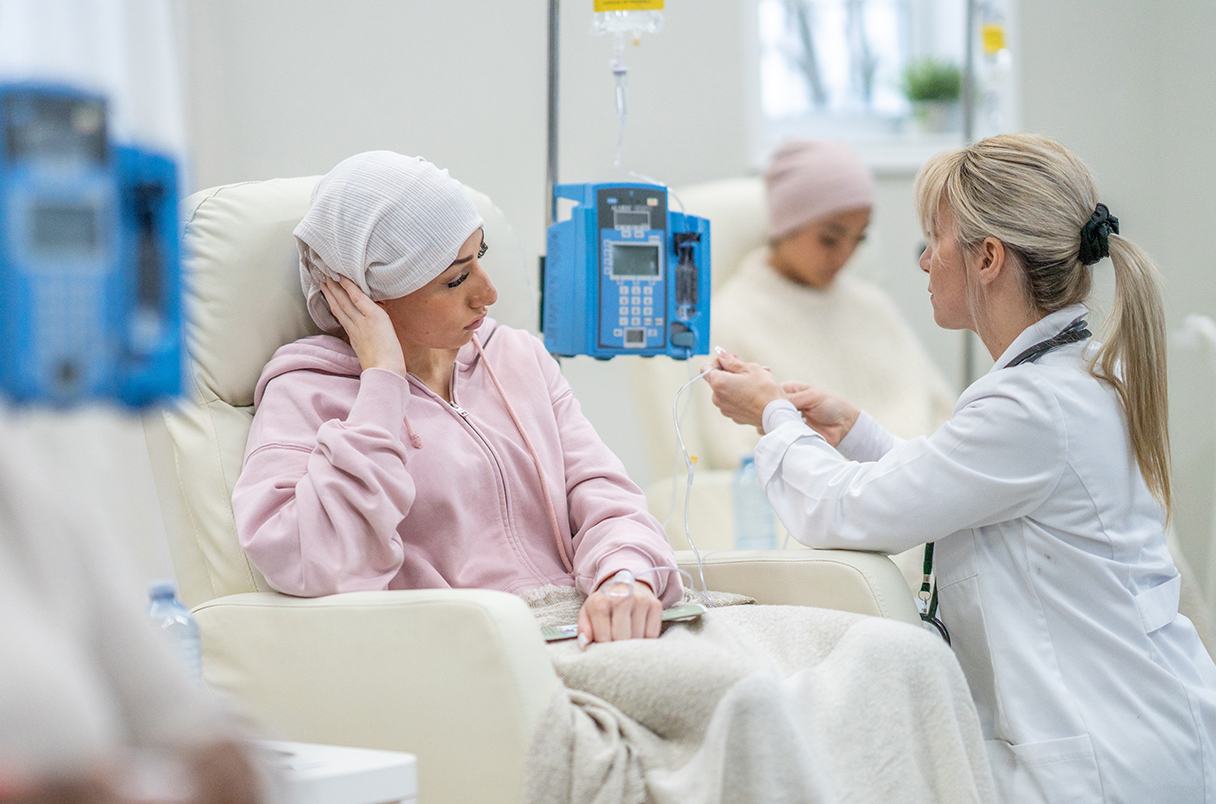
Cancer researchers, doctors, and patients widely view clinical trials as a boon to participants—a chance to advance medicine while potentially gaining access to experimental treatment that could be lifesaving. Even when assigned to the placebo group, patients are told they’ll get rigorous care from top specialists running the study. But how much do they actually benefit from signing on?
A study out this week suggests that although there may be advantages to participating in a trial, improved survival isn’t one of them. Researchers analyzed 39 publications that compared people in cancer trials with patients who were not enrolled and found participants had no advantage when it came to survival. A second study, out last month, suggests cancer trial participants randomized to get the experimental treatment do see a small benefit—but at the cost of more severe side effects.
Those findings run counter to how clinical trials are sometimes promoted, says Jonathan Kimmelman, a bioethicist at McGill University who led the recent studies. Informed consent documents and educational materials for patients “oftentimes describe closer monitoring, greater attention as one of the benefits of trial participation,” he says. But without evidence that these improve outcomes, “I don’t think that language is serving patients well.”
Distilling the benefits of trials for patients “is really complicated,” says Tove Godskesen, a professor of nursing and a bioethicist at Nord and Uppsala universities who led an earlier study that came to similar conclusions.
In an analysis that appeared in JAMA on 20 May, Kimmelman, his Ph.D. student Renata Iskander, and the rest of the team analyzed studies spanning cancer types, including breast cancer, melanoma, and brain cancer; some included multiple comparisons of participants and nonparticipants in different trials. In most of the studies, trial participants and nonparticipants got the same or very similar treatment. For example, one looked at men with prostate cancer treated with radiation either inside or outside a trial. This made it possible for the team to isolate something called the “participation effect”—whether the mere act of being in a trial confers advantages, setting aside any effect of getting the experimental treatment itself.
More than one-third of comparisons suggested trial participants survived longer. But Kimmelman’s team found potential confounding factors that risked muddying those results. For example, a study in which trial participants were younger on average than those in the comparison cohort might show a survival difference that wasn’t from participating in the trial itself. And cancer trials often exclude patients with other serious illnesses, which again could create an apparent survival advantage for participants. After adjusting for these issues, Kimmelman’s team found no survival benefit from the access to top-notch care that trial participants are said to enjoy.
The second study from Kimmelman’s group addressed another key question: Do patients in trials benefit if they get the experimental treatment? That research, published on 30 April in the Annals of Internal Medicine, covered 128 trials of treatments for solid tumors, and found that those randomized to get the experimental strategy did have a small survival edge: about five extra weeks, on average. They also had a higher risk of serious side effects. The survival advantage “is there, and it’s statistically significant,” Kimmelman says. “But that number needs to be considered against the fact that you have elevated risks” with an experimental therapy.
Kimmelman worries potential overselling of trial benefits isn’t limited to cancer. In 2019 his group published a paper about neurological trials, reporting no medical benefit from being assigned to get an experimental treatment versus a placebo. And other studies echo these findings.
Godskesen led a group in Scandinavia that analyzed nine studies comparing cancer trial participants and nonparticipants and in 2020 reported no clear health benefit to being in a trial. And yet when the team interviewed 57 doctors and nurses at two university hospitals in Denmark and Sweden, the health care workers expressed confidence that enrolling in trials was almost always great for patients. “You get better results, whatever study you participate in,” one physician said.
A perspective piece that accompanies the new JAMA paper but doesn’t comment on it cites similar descriptions of trials from the National Comprehensive Cancer Network (NCCN), a nonprofit alliance of U.S. cancer centers. Its guidelines across cancer types state that “NCCN believes that the best management of any patient with cancer is in a clinical trial.” That policy “cannot withstand critical scrutiny,” say the authors of the editorial, David Shalowitz, a gynecologic oncologist and bioethicist at West Michigan Cancer Center, and Franklin Miller, an ethicist at Weill Cornell Medicine.
In a statement to Science, Wui-Jin Koh, NCCN’s chief medical officer, said that in part because the JAMA paper reanalyzes prior studies, “it does not definitively prove that there is no benefit, and certainly does not suggest poorer outcomes with clinical trial participation.” Furthermore, trials offer patients “potential access to novel cutting-edge cancer care, careful standardized monitoring, and the ability to contribute to cancer care.”
Godskesen hopes the recent findings don’t undercut the importance of trials or dampen participation. For years, doctors and researchers have lamented that only about 3% of U.S. adults with cancer join a trial, and they’re especially concerned that nonwhite people and those in rural areas are even less likely to take part. Godskesen notes that trial participants may benefit in ways that are less tangible than longer survival. Her interviews with people in early-stage trials suggest they’re pleased to have a direct telephone number for a research nurse, for example. “They said that the whole family felt taken care of.”
Clinical trials may also improve disparities in care, because “they’re so tightly controlled with regard to how treatment proceeds that there is less room … to treat patients differently,” Shalowitz notes.
But joining a trial, which can be rewarding, also requires effort from participants, Kimmelman says. Patients “give up a fair amount to drive the process of development forward,” he says, and they should have a clear understanding of the potential benefits. When it comes to why a cancer trial would confer a survival benefit over competent care outside a trial, “I guess the question is, ‘Why should it?’”
More: https://www.science.org/content/article/joining-cancer-trial-doesn-t-improve-survival-odds
