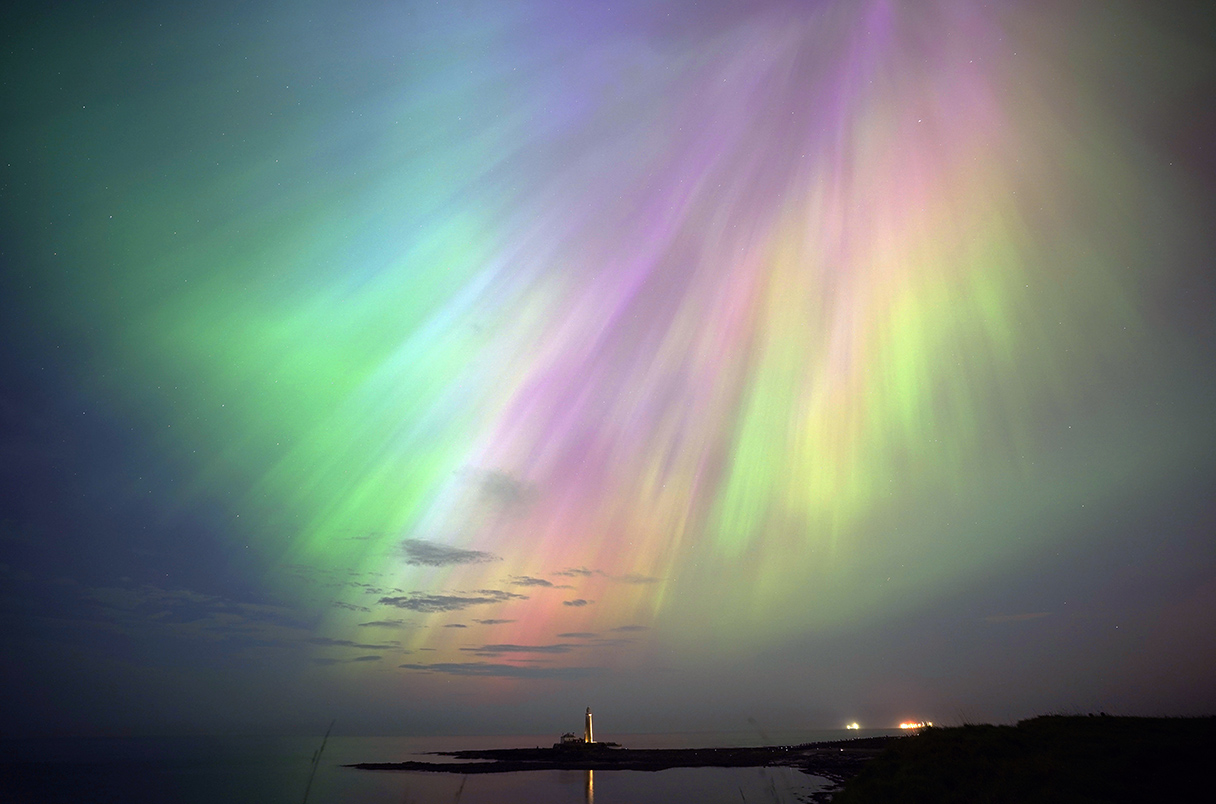
Earth got its bell rung this past weekend, sucker-punched by the Sun itself in the biggest geomagnetic storm in more than 2 decades. The storm—triggered when the magnetic fields in blobs of plasma from the Sun collided with Earth’s magnetic field—not only yielded once-in-a-generation aurorae at latitudes as low as the Florida Keys, but also took scientists’ breath away with its power. “What took us by surprise was the intensity of the storms,” says Mathew Owens, a physicist and space weather forecaster at the University of Reading. “We knew there was something coming. We didn’t quite know what.”
This weekend’s fireworks began with Active Region 3664, a giant cluster of sunspots, more than 15 times wider than Earth, where the Sun’s magnetic field is highly concentrated. The magnetic field lines twisted and eventually snapped, causing the cluster to fling off a series of enormous, billion-ton blobs of plasma toward Earth, each embedded with strong magnetic fields.
The detection of at least five of these expulsions, known as coronal mass ejections (CMEs), caused U.S. forecasters to issue a “severe” G4 watch—its first since 2005—on 9 May, the day before the blobs struck Earth. None of the individual CMEs was especially spectacular on its own, but all of them were directed at Earth. What’s more, as they moved toward Earth, they coalesced into a single complex mass. “We spend all this time looking out for the Big One, and sometimes the Big One is seven little ones in a trench coat,” Owens says. The storm was upgraded to an extreme G5.
When these CMEs smashed into Earth’s magnetic field on Friday, they stripped magnetic layers on the planet’s day side back like an onion and forced its night side to build up to the breaking point. As the field lines snapped back into more stable configurations, huge amounts of energy poured into Earth’s magnetosphere, in a disturbance known as a geomagnetic storm.
How rare are geomagnetic storms?
Geomagnetic storms that approach this weekend’s severity occur about four times per 11-year solar cycle, according to the Space Weather Prediction Center (SWPC) of the National Oceanic and Atmospheric Administration. The last G5 resembling this weekend’s event, the so-called “Halloween storms” of 2003, caused power outages in Sweden and blew out transformers in South Africa. Another G5 storm in 1989 knocked out power for 6 million people in Quebec in Canada.
The 11-year cyclical rise and fall in the Sun’s magnetic activity also affects the chances of a big event. In a 2021 study, researchers including Owens showed that geomagnetic storms tend to occur more often during periods of higher activity, centered around peaks known as solar maxima. Based on the number of sunspots, which increase during periods of high activity, SWPC forecasts that we are approaching a solar maximum now, with a peak expected sometime next summer.
How did the aurorae form?
After the CMEs stir up Earth’s magnetic field, electrons get accelerated along Earth’s magnetic field lines and funneled toward the planet’s poles. These electrons excite the atoms and molecules there and cause them to emit light—yielding the glow that we call an aurora. An aurora’s green and red glow is caused by excited states of atomic oxygen. Purple glows stem from excited nitrogen molecules.
How damaging was this storm?
Powerful solar storms can cause Earth’s magnetic fields to fluctuate, which can induce unexpected electrical currents in long-distance power lines and even oil pipelines. According to SWPC, some power grid irregularities were reported as a result of this weekend’s storm.
The storms can also disrupt GPS signals by forcing those satellites to transmit through a more electron-rich ionosphere, a layer of the upper atmosphere. During this weekend’s storm, some U.S. farmers reportedly paused their planting because of the sudden imprecision of their GPS-enabled tractors.
And just as running current through a wire heats it up, ionospheric currents heat up and expand the upper atmosphere, increasing atmospheric density at high altitudes. This causes satellites to feel more drag and spiral inward into lower orbits.
Although this weekend’s storm didn’t appear to take out any satellites, it may shorten some of their life spans. According to Jonathan McDowell, an astronomer the Harvard-Smithsonian Center for Astrophysics, the Hubble Space Telescope—which orbits roughly 510 kilometers above Earth’s surface—descended roughly 85 meters per day between 11 May to 13 May. That’s about twice the average daily rate over the previous 3 months.
How do forecasters predict geomagnetic storms, and what’s coming next?
CMEs are difficult to predict. So forecasts of geomagnetic storms are limited to 2 or 3 days’ notice, once the CMEs are observed leaving the Sun and heading our way. What’s more, forecasters can’t confirm CMEs’ exact arrival time until they pass by satellites operating between Earth and the Sun.
AR3664 may well throw more at us. Sunspot clusters can last months, and this one has only just rotated out of view; in 2 weeks or so, it will rotate back into view of Earth again, as the Sun moves through its 27-day rotation.
In the meantime, AR3664 still poses another hazard—high-energy particles. If the sunspot were to belch any particles out in the coming days, they would likely follow the Sun’s spiraling magnetic field lines directly to Earth, potentially posing a radiation risk to astronauts on board the International Space Station, Owens says. “The risk of particle radiation is going up, whilst the geomagnetic storm hazard drops.”
More: https://www.science.org/content/article/extreme-solar-storm-generated-auroras-and-surprise