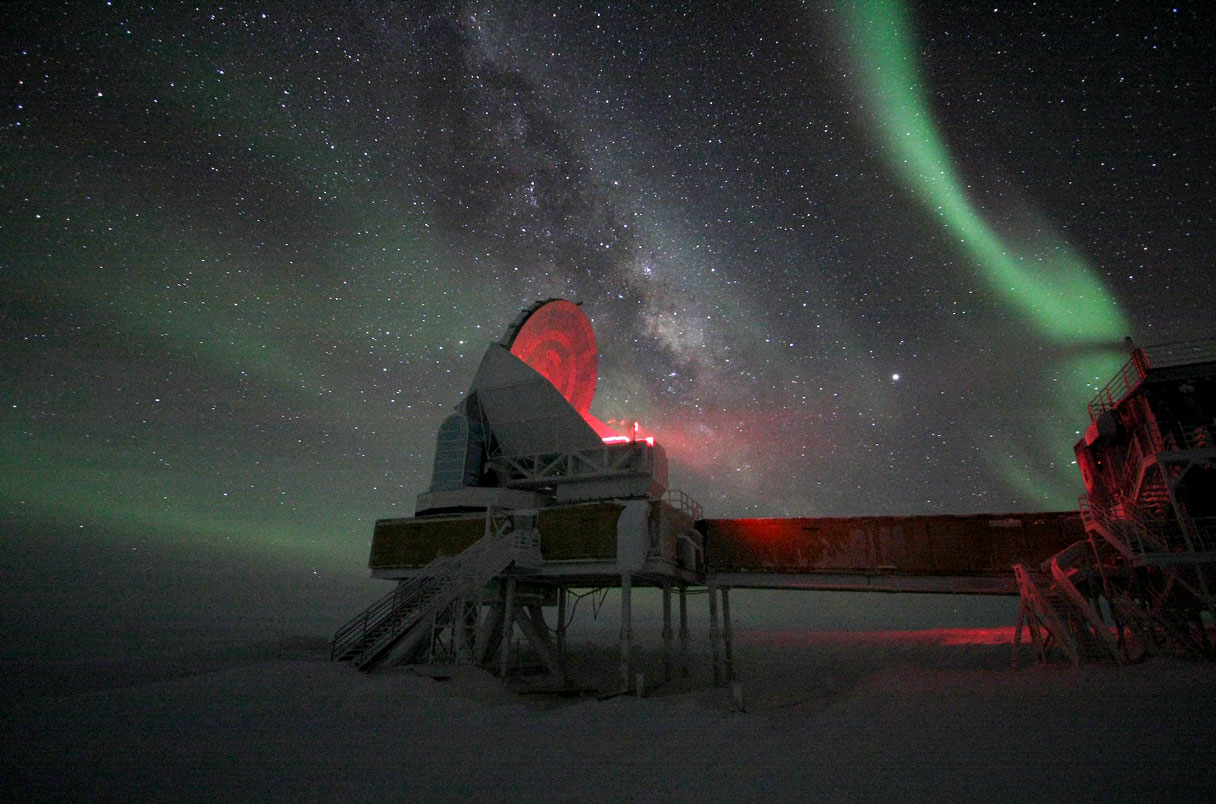
Astronomers working on a roughly $900 million project to definitively map the afterglow of the big bang are in shock after the National Science Foundation (NSF) put the brakes on the effort. Known as CMB-S4, it would study the so-called cosmic microwave background (CMB) radiation with batteries of new microwave telescopes at the South Pole and in the Atacama Desert in Chile. If successful, it could provide proof that the newborn universe underwent a mind-boggling exponential growth spurt called inflation. However, on 7 May an NSF official said the project would not move forward.
The news came unexpectedly at the spring meeting of the National Academies of Sciences, Engineering, and Medicine’s Board on Physics and Astronomy (BPA) in Washington, D.C. R. Chris Smith, interim director of NSF’s astronomical sciences division, told attendees that “in its present form” the project would not move into the design stage. NSF must first refurbish its crumbling polar facilities, he explained. “We have had significant challenges in terms of the infrastructure at the South Pole,” he said. The move effectively sends researchers back to the drawing board, and it bodes ill for plans to expand the gigantic IceCube neutrino detector at the pole.
The decision comes as a blow to the astronomy and physics communities, as both ranked CMB-S4 highly. In November 2021, the project tied for second among new ground-based facilities in astronomers’ latest decadal survey, a periodic wish list that guides federal spending. In December 2023, it ranked first for new facilities in particle physicists’ latest long-range plan as well. Various pieces of evidence, including the near uniformity of the CMB, suggest the nascent universe suddenly ballooned from atomic to galactic scales. Understanding what fundamental force or particle caused such inflation is a central challenge for particle theory. “The science [of CMB-S4] we deemed as absolutely essential,” Karsten Heeger, a physicist at Yale University and deputy chair of the particle physics long-range planning panel, said at the BPA meeting.
CMB-S4 has been in development for more than a decade, and, if successful, could detect a signature of inflation. The process would have generated ripples in space called gravitational waves, and they would have left faint, pinwheel-like patterns about 1° wide in the motley polarization of the CMB. Those so-called primordial B-modes would be much easier to see from the South Pole than from Atacama, says John Carlstrom, a cosmologist at the University of Chicago. At the pole the cold air is even more stable than it is in the bone-dry Atacama Desert, he notes. And from that vantage, telescopes can stare at the same patch of sky indefinitely because it never drops behind the horizon.
Gathering heaps of data at multiple wavelengths will help the CMB-S4 team avoid being confounded by dust in the Milky Way, which emits radiation at wavelengths similar to the CMB. In 2014, a team using a South Pole instrument called BICEP2 claimed to have discovered primordial B modes, but additional analysis showed galactic dust could account for the signal.
NSF’s astronomy program and the high-energy physics program at the Department of Energy (DOE) planned to split the cost of CMB-S4. But the aging Amundsen-Scott South Pole Station has long been a concern. Not only is electrical power limited by the capacity of the station’s generators, but the buildings there are sinking into the ice. Nearly a year ago, NSF warned researchers that because of the need to refurbish facilities at the South Pole, it would be years before any new project could start there.
Nevertheless, the latest news came with little warning, says Carlstrom, who is principal investigator for the NSF portion of the project. He says his team was working with NSF to move the project from the development stage, in which the concept is defined, to the design stage, when researchers develop blueprints for exactly what they will build. Carlstrom says he expected the transition to be a “low hurdle,” as advancing a project to the design stage does not obligate NSF to build anything. “Friday, we were told there was going to be a special meeting called with the project and DOE, and would we be available late Monday?” he says. “And then late Monday, Chris told us about what he was going to say to the BPA Tuesday morning. So, shock.”
CMB-S4 developers had already revised their plans to ensure that the new telescopes could run on essentially the same amount of power as older, less sensitive telescopes already at the pole, Carlstrom says. Nevertheless, he adds, “What NSF has made clear to us is that we need to come up with a plan that has zero footprint at the South Pole.” But Carlstrom warns that any plan that includes telescopes only in Chile is sure to be both more risky and more expensive. To hunt the feeble primordial B-mode signal through less stable atmospheric conditions, telescopes at Atacama would have to be more complex, he explains. And because each telescope would have less sensitivity than it would at the pole, researchers would have to build more of them.