


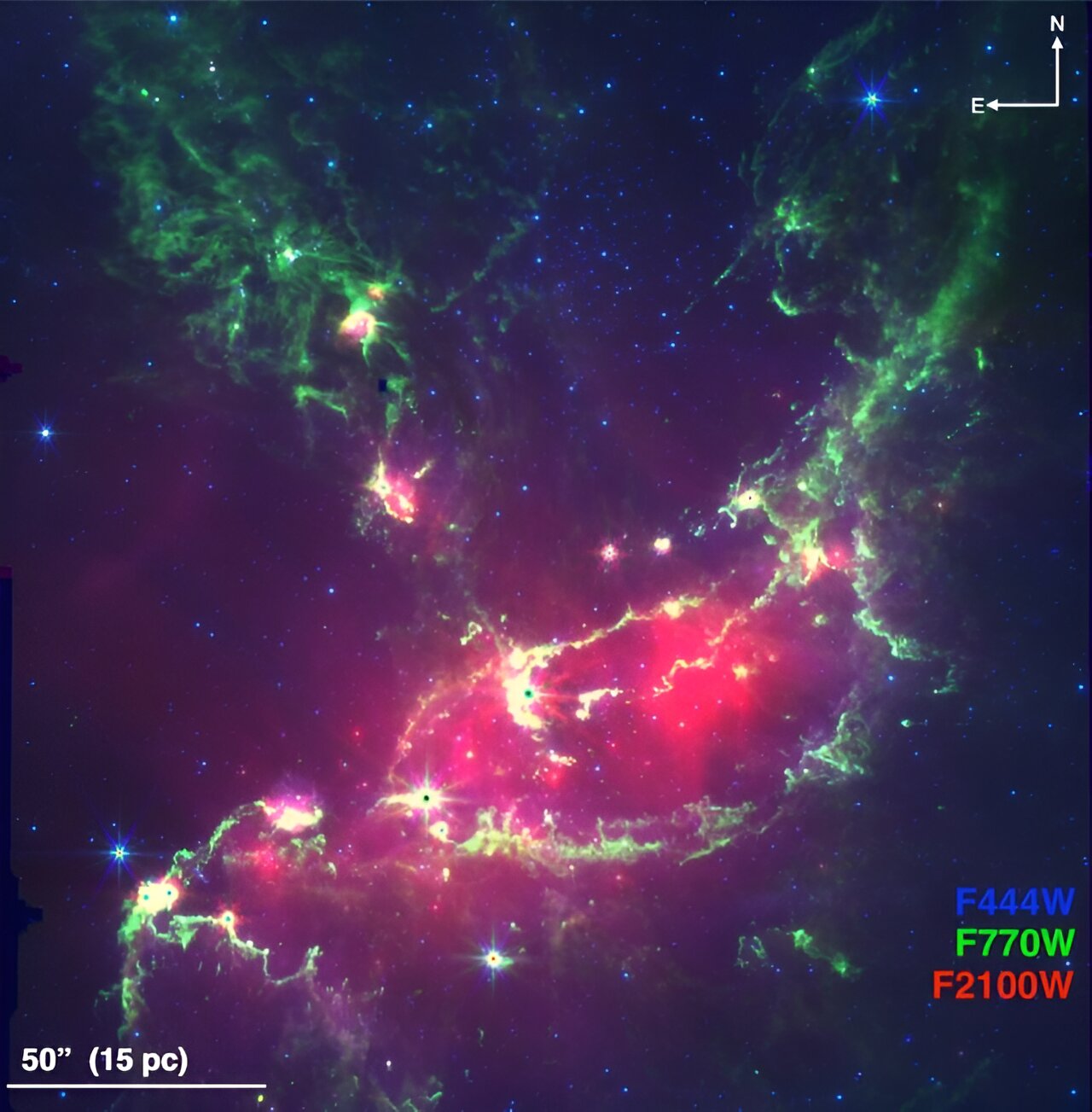
An international team of astronomers has delved into the population of young stellar objects (YSOs) within the NGC 346 open cluster using observations from the James Webb Space Telescope (JWST). Their study, recently published on the preprint server arXiv, sheds light on the characteristics of YSOs within this cluster.
YSOs represent stars in their early developmental stages, including protostars and pre-main sequence (PMS) stars. Typically found in dense molecular clusters abundant with molecular gas and interstellar particles, these objects offer insights into the star formation process.
NGC 346, located approximately 202,000 light years away in the Small Magellanic Cloud (SMC), serves as a young open cluster and the brightest star-forming region in the SMC. With a diverse star formation history ranging from massive, evolved stars to low-mass YSOs, NGC 346 presents a unique opportunity for studying stellar evolution.
Led by Nolan Habel from NASA's Jet Propulsion Laboratory (JPL), the team utilized JWST's Near Infrared Camera (NIRCam) and MidInfrared Instrument (MIRI) to investigate the stellar populations within NGC 346. Their analysis involved imaging data spanning wavelengths from 1.15 to 25.0 µm.
The study initially identified a total of 196 YSOs and PMS stars within NGC 346, offering a valuable sample for further spectroscopic analysis. Additionally, the astronomers identified a population of 833 objects exhibiting significant mid-infrared excess, suggesting their association with YSOs.
Further analysis, including spectral energy distribution (SED) fitting, revealed crucial insights into the properties of the identified YSOs. These objects exhibited a wide range of sizes, with radii spanning from 0.14 to 82.32 solar radii, and masses ranging from 0.95 to 4.15 solar masses. Bolometric temperatures of the YSOs varied from 2,051 to 17,930 K.
Of particular note is CN202153, identified as the least massive extragalactic YSO to date, underscoring the significance of NGC 346 in advancing our understanding of stellar evolution beyond our galaxy.
The authors emphasize the importance of future near-infrared spectroscopic studies using JWST to further elucidate the nature and properties of the identified YSOs within NGC 346, contributing to our broader understanding of star formation processes in diverse environments.
More: https://phys.org/news/2024-05-astronomers-population-young-stellar-cluster.html
