


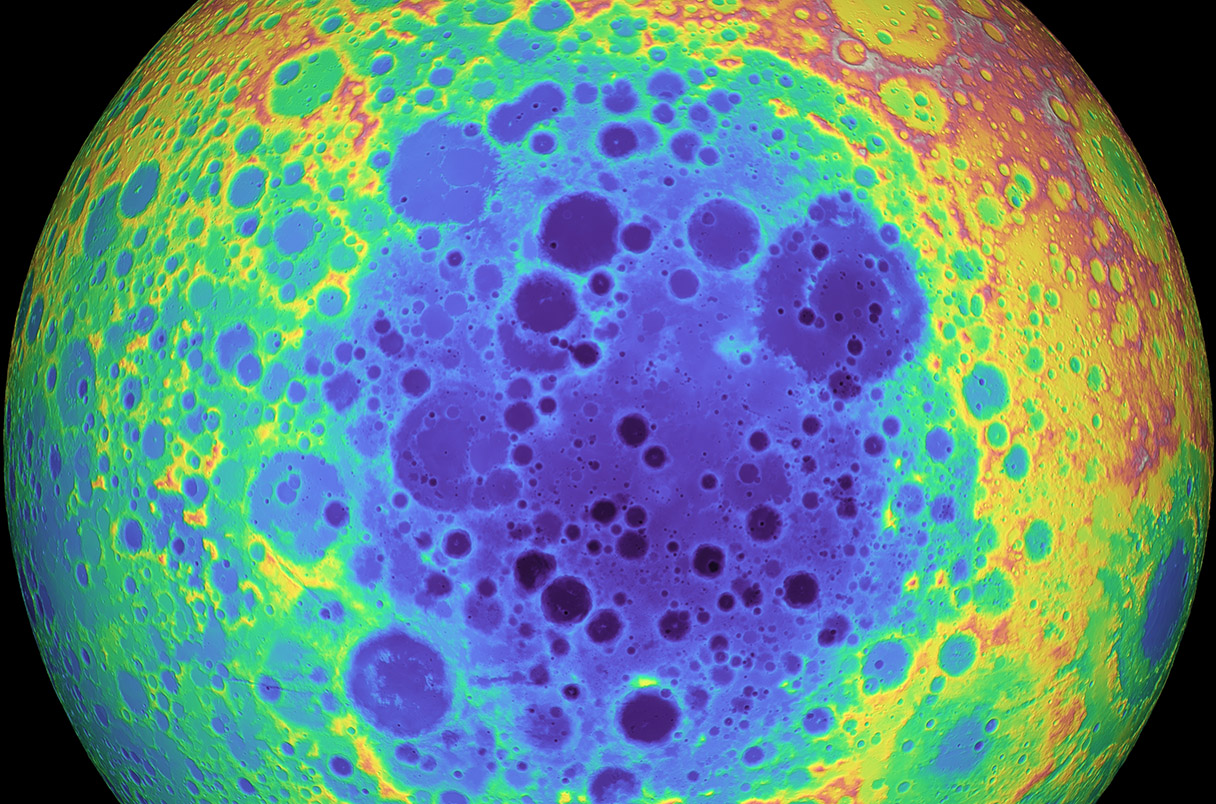
There’s a giant hole on the backside of the Moon. The South Pole–Aitken (SPA) Basin, the Moon’s largest and oldest impact crater, is more than 2500 kilometers wide and 8 kilometers deep—nearly big enough to swallow two Indias and hide the Himalayas. Now, China plans to land in it.
The basin may have been blasted out during a barrage of asteroids that pummeled Earth and other inner Solar System bodies billions of years ago, and scientists have long wanted to get their hands on SPA rocks to test the idea. The China National Space Administration (CNSA) aims to provide them with the Chang’e-6 mission, which scientists close to the program say could launch as early as 3 May. “The community is excited about any lunar samples being returned from anywhere in the SPA basin,” says planetary geologist Carolyn van der Bogert of the University of Münster. “There is an impressive amount of science that can be done.”
Chang’e-6, the latest in a series of missions named after a mythical Moon goddess, follows Chang’e-5, which returned the first Moon rocks since NASA’s Apollo missions. Like its predecessor, the Chang’e-6 orbiter will drop a lander that will drill and scoop up 2 kilograms of soil and rock. An ascender module will ferry the samples back to the orbiter for the trip home and a final plunge by parachute in a return capsule, 53 days after launch.
CNSA is expected to share Chang’e-6 samples internationally, just as it is now doing with Chang’e-5’s rocks. Scientists hope they will yield clues to the timing of the SPA impact, which “remains a topic of debate,” says Kentaro Terada, a cosmochemist at Osaka University. Some researchers believe the basin was carved out 4.3 billion years ago, but others think the impact occurred hundreds of millions of years later, part of a hypothetical “late heavy bombardment” of the inner Solar System about 3.9 billion years ago that’s indicated by an apparent cluster of other large lunar impact basins around that time.
The bombardment would have had profound consequences for Earth’s newborn continents and nascent life. But it’s unclear what could have thrown so many large asteroids toward the inner Solar System. One possible mechanism was a sudden shift in the orbits of Jupiter and the other giant planets, but the timing doesn’t seem right. Recent research suggests the shift occurred too early—just tens of millions of years after the Solar System’s birth 4.56 billion years ago.
Dating material melted by the SPA event itself could help “settle the question of whether or not the Moon and the inner Solar System underwent the late heavy bombardment,” van der Bogert says. But Chang’e-6 will need luck: Most rocks at the expected sampling sites are basalts—lavas from later volcanic eruptions. Another lucky break would be finding a fragment of the lunar mantle, gouged from a depth of tens of kilometers. But remote sensing data suggest “the possibility of finding mantle material is low,” says Xiao Long, a planetary scientist at the China University of Geosciences.
Returned samples may also help explain why the Moon’s two faces are so different. The near side is paved by “maria”—smooth, sealike lava flows—and its crust is estimated to be 30 to 40 kilometers thick. The far side is pocked with impact craters and its crust is twice as thick. Even the compositions of the two sides differ. Some models suggest the dichotomy goes back to the Moon’s formation by a giant impact on Earth, which flung chunks of molten rock into orbit. Facing a blazingly hot Earth still recovering from the impact, the newborn Moon’s near side remained molten while the far side cooled and crystallized. Learning when rocks on the far side crystallized and comparing the dates with those for near-side rocks “would help support or reject some of the models,” says Miki Nakajima, a planetary scientist at the University of Rochester.
Chang’e-6 is carrying payloads from France, Italy, Sweden, and Pakistan, evidence that China continues to internationalize its space program. For 48 hours, a French instrument mounted on the lander will study the origin and dynamics of the lunar exosphere, a wispy layer of gases that hugs the surface. One goal is to explain sharp variations seen in the exosphere’s density by time and location. “We don’t really understand the reason for these variations,” says Pierre-Yves Meslin, a planetary scientist at the Research Institute in Astrophysics and Planetology.
If Chang’e-6 returns samples, it will cap a run of six successful Chinese lunar missions. Terada notes that Moon probes from India, Israel, Japan, and Russia have all crashed recently. “I think it’s a remarkable achievement that the Chang’e program has not had a failure.”
More: https://www.science.org/content/article/china-set-fetch-first-rocks-mysterious-far-side-moon
