In March 2022, when the pandemic was still raging, the messenger RNA (mRNA) company Moderna announced it would build a $500 million plant in Kenya to manufacture half a billion doses of its COVID-19 vaccine annually. “This is major,” Kenyan President William Ruto said at the time. The plant would help reduce Africa’s dependence on vaccines produced elsewhere, Ruto said—a situation that had turned disastrous during the pandemic—and bring economic benefits as well.
But Moderna may never break ground on the Kenya factory. On 11 April, the company said it had “paused its efforts” because not a single African country had ordered its COVID-19 vaccine since 2022, leading to $1 billion in losses and write-offs. The move triggered a bitter reaction from the Africa Centres for Disease Control and Prevention (Africa CDC), which said, “Moderna is abandoning a commitment to build highly needed and relevant vaccine manufacturing capabilities in Africa.”
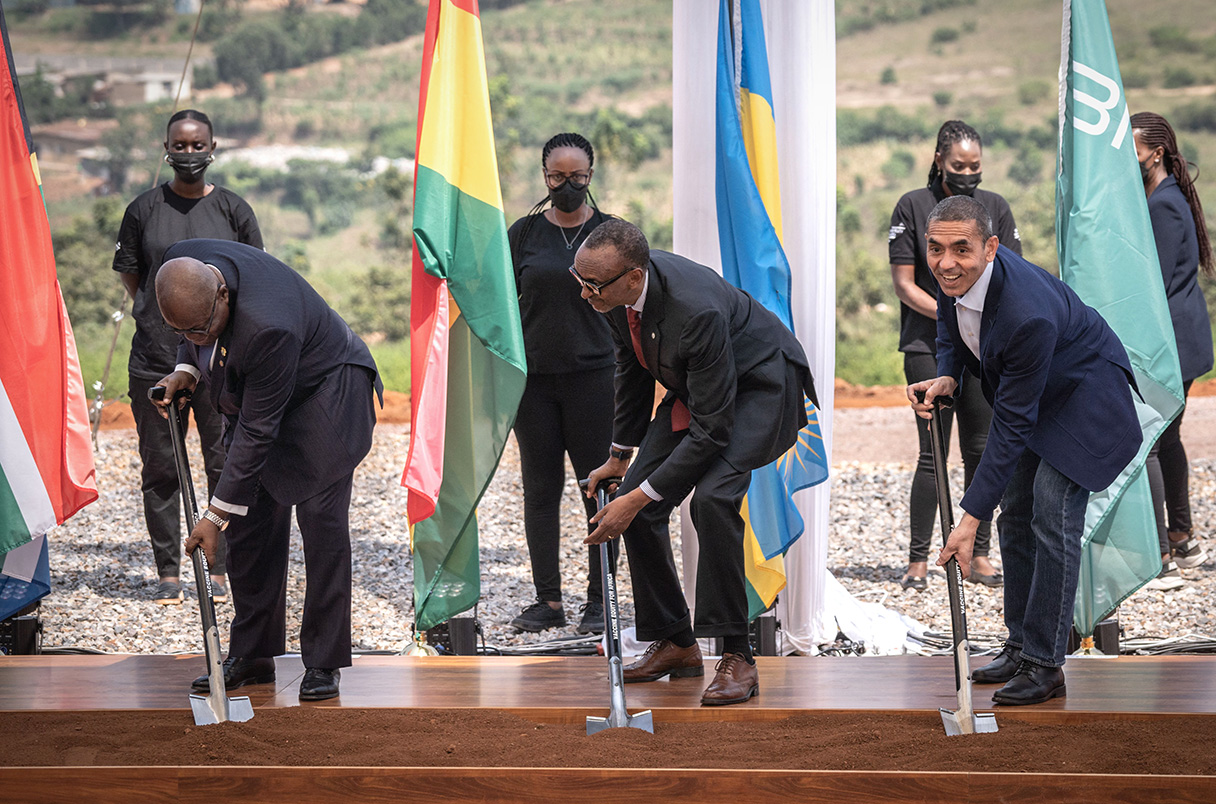
Moderna’s decision is a reality check of sorts for other schemes to increase vaccine production on the continent. Many are underway, including facilities in Rwanda, Senegal, and South Africa by the other big mRNA vaccine company, BioNTech, and an up to $1 billion investment by Gavi, the Vaccine Alliance. But there is no longer much demand for COVID-19 vaccines in Africa, and shots for many other diseases prevalent there are already produced cheaply and in large volumes elsewhere, making it hard to establish a market for local manufacturers. The continent also faces a lack of trained workers and weak regulatory systems for medical products.
Producing more vaccines in Africa “is a moral imperative, and it’s economically difficult,” says Martin Friede, head of vaccine research at the World Health Organization (WHO). “So we are struck between a rock and a hard place.”
The COVID-19 pandemic exposed the harsh inequities in vaccine access like never before. Rich countries purchased far more doses than they needed, whereas India, home of the largest producers of shots meant for developing countries, blocked their export in March 2021 to deal with its own COVID-19 surge. By the end of 2021, when wealthy countries had fully vaccinated most of their populations, fewer than 20% of Africans had received at least one dose.
Establishing vaccine manufacturing plants in Africa—which currently imports 99% of all of the vaccines it uses—could help prevent this from happening again. The facilities could produce vaccines against measles, malaria, hepatitis, and other diseases during normal years and—hopefully—churn out whatever specific product is needed when the next pandemic hits. In addition to Gavi’s pledge, governments, philanthropies, and multilateral organizations have promised at least $3.5 billion to help realize this goal, according to a recent analysis by the Clinton Health Access Initiative (CHAI).
One early effort was an mRNA “techno-logy transfer hub” in South Africa, led by Friede. Over the past 3 years, the hub has trained scientists from 15 countries, including six in Africa, to produce mRNA vaccines themselves. Today, “Each of these countries is facing the situation of, ‘OK, we requested mRNA technology, thank you, we appreciate it. Now, what do we do with it?’” Friede says. “If you are not producing a product that is being procured on a day-to-day basis, after a couple of years, you will go bankrupt.” Friede says he understands Moderna’s decision to halt its Kenya plans.
Several other programs have launched. In 2021, the African Union and Africa CDC launched the Partnership for African Vaccine Manufacturing (PAVM), whose goal is to have 60% of the continent’s vaccine doses produced there by 2040. That bold ambition has “galvanized the continent,” says John Nkengasong, a Cameroon-born virologist who led Africa CDC at the time and now heads the U.S. President’s Emergency Plan for AIDS Relief.
PAVM will coordinate fundraising for the effort and wants to see seven vaccine technologies pursued, including mRNA, traditional inactivated and weakened viruses, and harmless viral vectors that carry genes from dangerous pathogens. Some 30 projects, including the three BioNTech facilities, are underway, says virologist Nicaise Ndembi, who heads PAVM.
Another major initiative came in December 2023 from Gavi, which currently purchases about half the vaccine doses used in Africa. Gavi’s $1 billion commitment is for the African Vaccine Manufacturing Accelerator, a plan to speed production of shots to protect against 11 diseases. The money will be doled out to local companies in a complicated scheme that rewards them if their products pass muster with WHO’s strict quality standards and awards extra bonuses for those who sell to Gavi or the world’s other major vaccine purchaser, UNICEF. The funding aims to help at least four African vaccinemakers together produce 800 million doses annually within a decade.
Yet these plans face significant obstacles, according to a recent analysis by Africa CDC, CHAI, and PATH, another U.S. nonprofit. Few African companies have the capacity to produce antigens, the pathogen components that trigger immune responses and are the core ingredient of any vaccine, the groups said. For that, the firms need foreign companies to transfer technologies, but few such deals exist, and securing them is difficult in part because African governments have not committed to buying African-made vaccines. African countries also need to strengthen their workforce and their ability to evaluate and approve vaccines, the report says.
Any African vaccine manufacturer will face stiff competition from vaccines produced elsewhere. The Serum Institute of India, which produces more vaccine doses than any other company, is already a major supplier to Gavi. If a string of smaller rivals arise on the African continent, “you’re not going to have volume, and they won’t be competitive on the global marketplace,” predicts Seth Berkley, who headed Gavi for 12 years until retiring in August 2023. That same year, South Africa’s government purchased a pneumococcal vaccine made in India because it cost less than one produced at home.
To avoid fragmentation of Africa’s budding market, the Regionalized Vaccine Manufacturing Collaborative, announced in January, aims to streamline and coordinate efforts. Ideally, countries in a region will pool resources, make bulk purchases of supplies, and evaluate demand together. Nkengasong says Africa may best be served by two or three vaccine manufacturing networks. “You can have glass produced in Zimbabwe and lipids produced in Kenya, and they can assemble the vaccine somewhere else,” he says. “Use the African Union platform to bring everybody together so that you can share information in real time and let them realize, ‘Oh, I don’t want to go do this all by myself.’”
If in the end African-produced vaccines can’t compete on cost, one solution would be to simply pay more for them. A November 2022 report from Gavi noted that the alliance does not generally shell out extra money for doses “in the name of geographical diversity and supply security,” but suggested it should consider doing so. Ndembi predicts that with the lessons from the pandemic in mind, African governments will be willing to pay a bonus for local products as well. “This is a health security issue,” he says
More: https://www.science.org/content/article/plans-expand-african-vaccine-production-face-steep-hurdles