


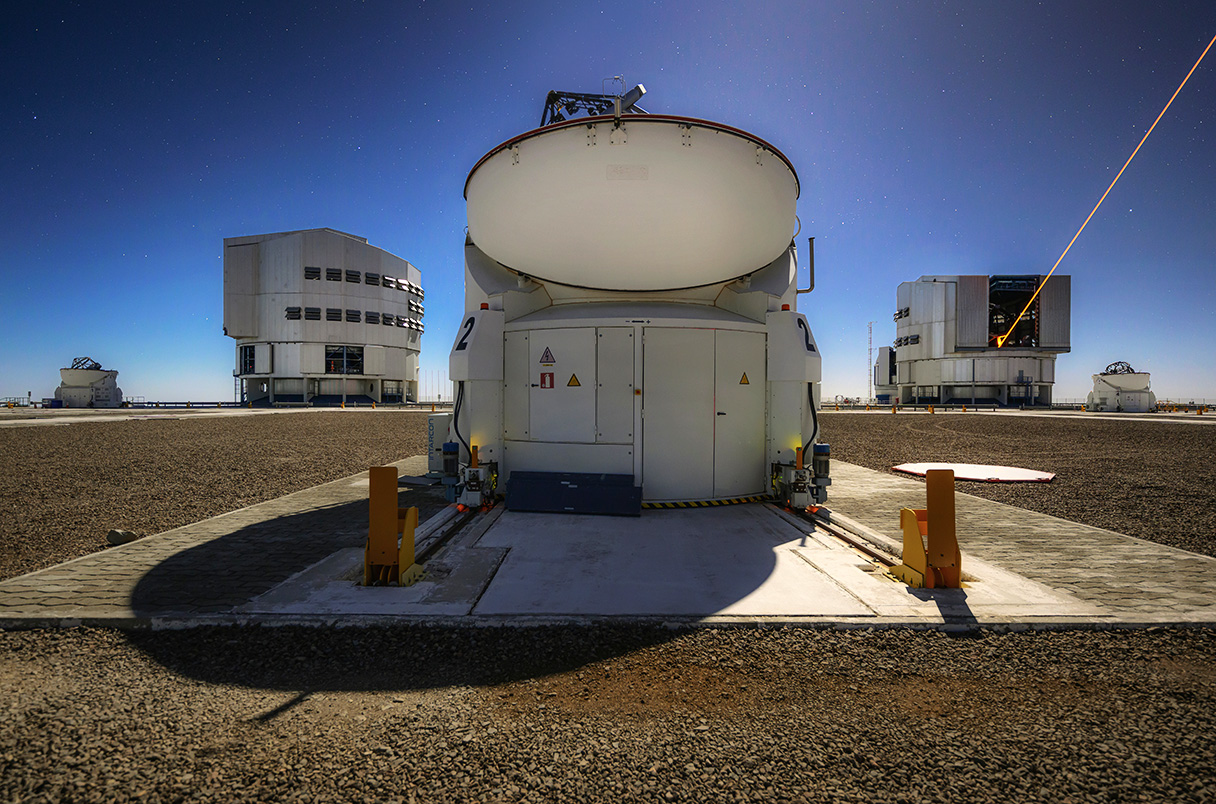
In the pursuit of sharper celestial vision, astronomers are turning to quantum technologies to revolutionize the capabilities of telescopes. With the impending completion of the Extremely Large Telescope in Chile, boasting a 39-meter mirror, the astronomical community faces the challenge of extracting detailed information from distant celestial bodies.
At a recent gathering organized by NOIRLab, researchers explored a novel approach: harnessing quantum technologies to combine the light captured by multiple telescopes. Rather than relying solely on the power of a single behemoth telescope, this strategy involves integrating signals from dispersed telescopes through quantum methods. If successful, this approach could enable telescopes hundreds of kilometers apart to collectively achieve a level of resolution capable of unveiling surface features on exoplanets and the swirling matter around supermassive black holes.
The technique, known as interferometry, has long been employed in radio astronomy, where signals from arrays of telescopes are merged to produce detailed images. However, the challenge lies in adapting this method to optical telescopes, given the shorter wavelengths of visible light.
To overcome this hurdle, astronomers aim to leverage advancements in quantum technologies. One promising avenue is quantum memory, which can store the exact state of a photon—including its phase information—for extended periods. While current quantum memory devices are limited in capacity and fragility, researchers are exploring ways to enhance their capabilities for astronomical applications.
Another approach involves transmitting photons' quantum states over optical fiber networks, enabling real-time interference. Although experimental, this method holds promise for extending the reach of interferometry across vast distances.
Furthermore, quantum mechanics' phenomenon of entanglement offers a tantalizing possibility for long-distance connections between telescopes. By generating entangled photon states, astronomers can establish phase references for interference, paving the way for groundbreaking observations.
While these quantum solutions remain in the experimental stage, astronomers and quantum technologists are collaborating to bridge the gap between theory and practical application. With the goal of conducting small-scale demonstrations in the near future, the astronomical community aims to propel quantum-assisted telescopes into the forefront of observational astronomy by the 2030s. This ambitious endeavor represents a convergence of cutting-edge technology and astronomical exploration, promising to unveil the mysteries of the cosmos with unprecedented clarity.
More: https://www.science.org/content/article/can-quantum-tech-give-telescopes-sharper-vision
