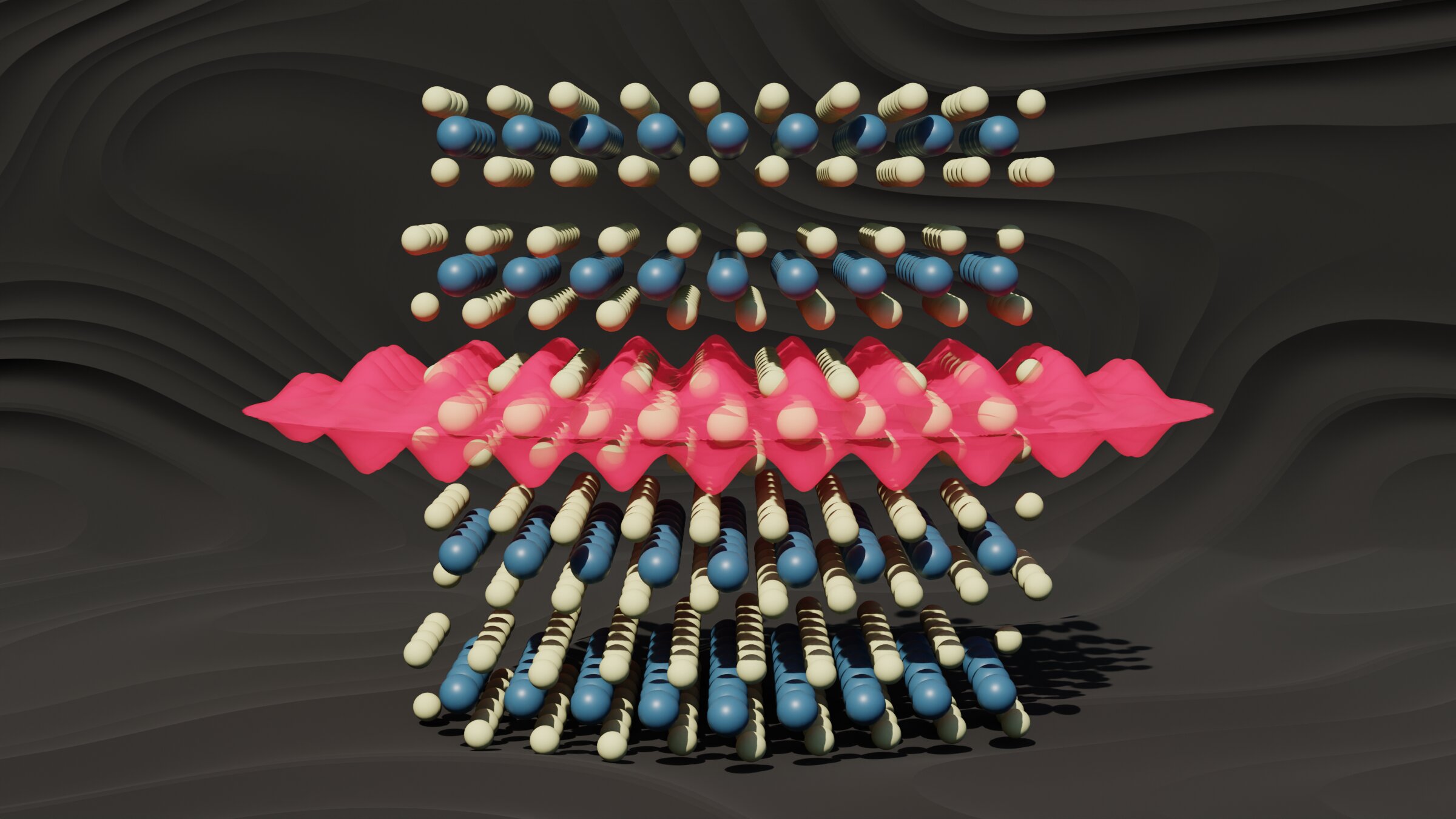
In a groundbreaking development, researchers at the University of Michigan have uncovered a novel class of 2D materials capable of exhibiting a stable charge density wave at room temperature, offering unprecedented potential for quantum computing applications. The findings, detailed in a paper published in Nature Communications, mark a significant milestone in the field of quantum materials.
Quantum materials, despite their immense promise for computing applications, have long struggled with fragility, particularly in maintaining non-trivial quantum properties like superconductivity or magnetic spin. Traditionally, these materials only manifest exotic phenomena at extremely low temperatures due to disruptions caused by thermal disorder.
Led by Associate Professor Robert Hovden, the research team devised a unique approach to induce and stabilize a charge density wave within a 2D material framework. Unlike conventional methods of exfoliation, where individual atomic layers are peeled off, the team grew the 2D material within another matrix, a technique they termed "endotaxial" synthesis.
The researchers focused on tantalum disulfide (TaS2), a metallic crystal, and observed how electrons within the sandwiched 2D TaS2 crystal layer spontaneously formed a charge crystal or charge density wave—a phenomenon where electrons clump together in a repeating pattern. Remarkably, this transformation altered the material's conductivity, converting it from a conductor to an insulator without altering its chemical composition.
According to first author Suk Hyun Sung, the stability of the charge crystal at room temperature opens up new possibilities for transistor applications in both classical and quantum computing, offering precise control over voltage flow.
Moreover, the researchers observed the charge crystal's resilience even at elevated temperatures, further underscoring its potential for practical applications. As Associate Professor Hovden notes, this discovery lays the foundation for exploring new quantum materials and paves the way for stabilizing quantum properties at temperatures conducive to real-world applications.
With quantum materials poised to revolutionize both classical and quantum computing realms, this research represents a crucial step forward in unlocking their full potential. As researchers continue to explore the possibilities offered by endotaxial synthesis, the future of quantum computing appears increasingly promising.
More: https://phys.org/news/2024-03-class-2d-material-displays-stable.html