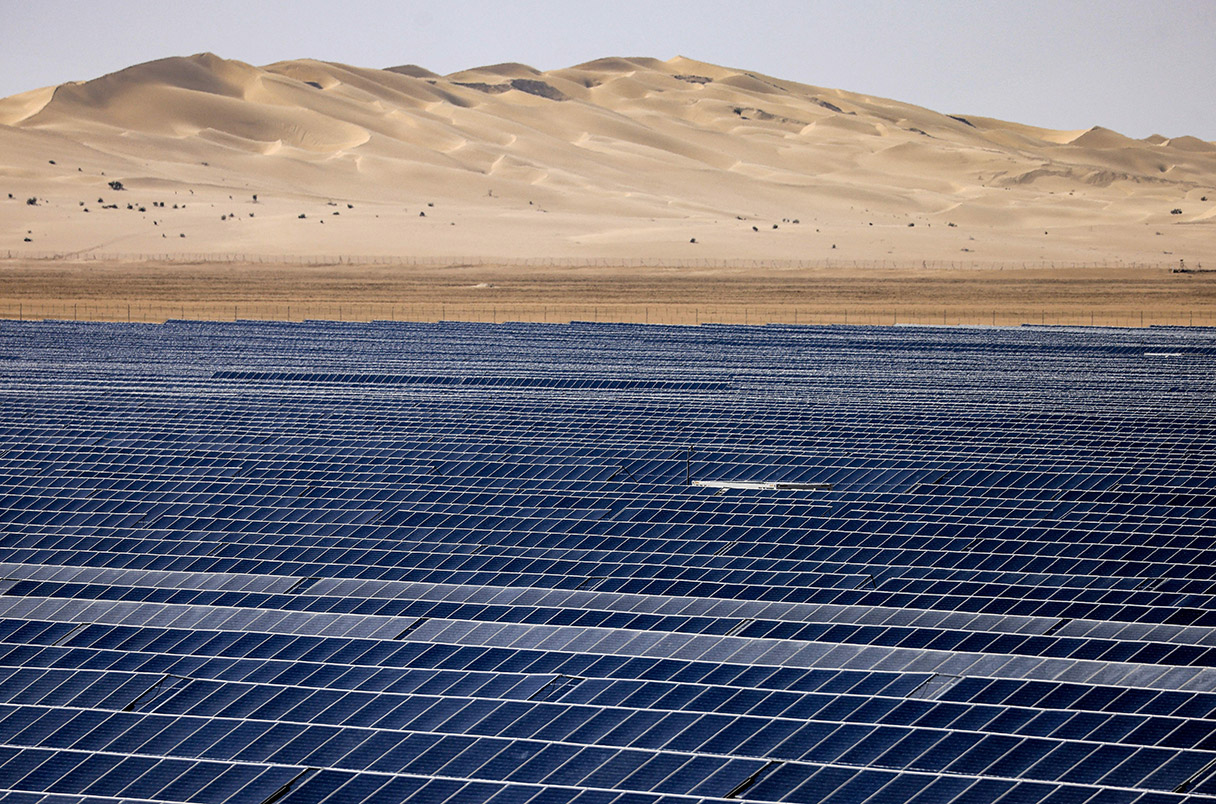
In the arid landscapes of regions like the United Arab Emirates (UAE), water scarcity poses a significant challenge, often outweighing the value of oil. To address this pressing issue, the UAE has relied on costly desalination plants and cloud seeding initiatives. However, a recent modeling study suggests an innovative approach to stimulate rainfall: utilizing city-sized solar farms capable of generating their own weather patterns.
Led by climate scientist Oliver Branch from the University of Hohenheim, the study, published in the journal Earth System Dynamics, explores the potential of solar farms to induce rainstorms. Branch's research delves into the emerging field of how renewable energy initiatives, crucial for combating climate change, can influence regional weather patterns.
Previous studies hinted at the possibility of large-scale solar farms in desert regions like the Sahara enhancing local rainfall and vegetation growth. Branch's team aimed to ascertain whether more realistic solar farm sizes could have a similar effect. Using advanced weather modeling, they demonstrated that solar farms exceeding 15 square kilometers could significantly enhance convection processes, vital for cloud formation.
However, effective rainmaking also relies on a source of atmospheric moisture. The model identified moist, high-altitude winds from the Persian Gulf as a potential moisture source. Under favorable conditions, a 20-square-kilometer solar field could increase rainfall by substantial amounts, offering water resources to support thousands of people annually.
While the study presents a promising solution to water scarcity, some experts express reservations about the realism of the simulated solar panels, which were darker than typical commercial panels. Nonetheless, Branch remains optimistic about the feasibility of testing the concept in real-world scenarios, particularly in countries like China where large-scale solar farms are becoming increasingly common.
Although the UAE remains committed to its existing cloud seeding program, Alya Al Mazrouei, director of the UAE's Research Program for Rain Enhancement Science, acknowledges the potential of alternative strategies like optimizing convection.
Branch and his team continue to explore potential implementation sites for solar farm rainmaking, including regions like Namibia and Mexico's Baja Peninsula. Their ongoing efforts to refine modeling techniques aim to provide further evidence of the rainmaking capabilities of solar farms, potentially spurring increased investment in renewable energy infrastructure.
As the world seeks innovative solutions to combat water scarcity and climate change, the prospect of solar farms as rainmakers offers a glimpse of a sustainable future powered by renewable energy.
More: https://www.science.org/content/article/massive-solar-farms-could-provoke-rainclouds-desert