


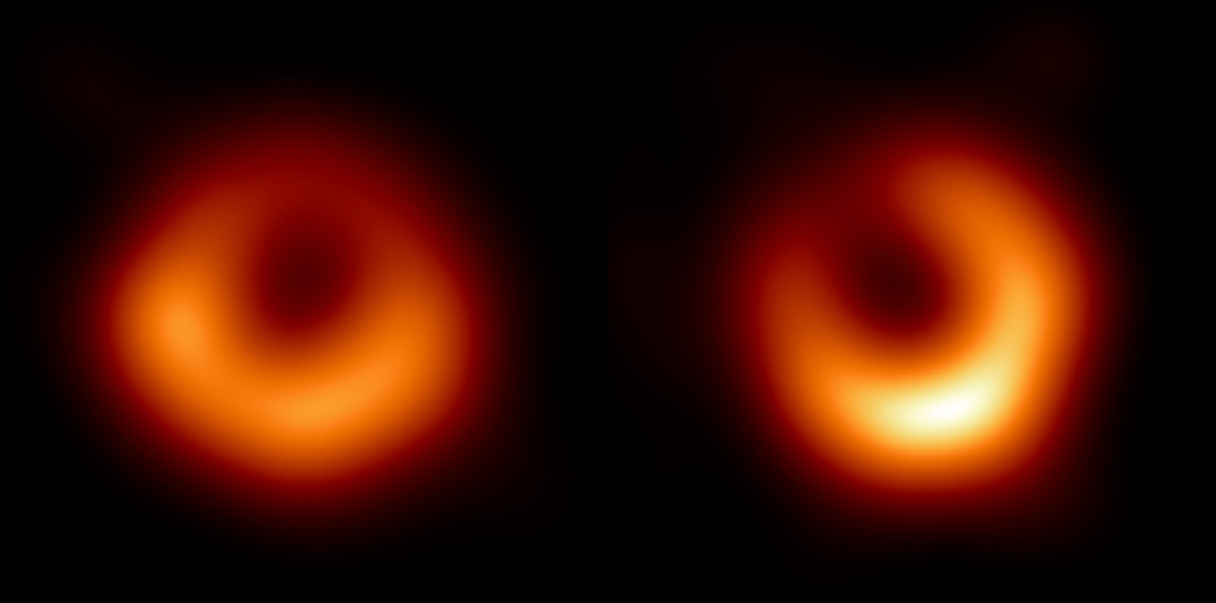
In a significant breakthrough, astronomers have unveiled a fresh image of the heart of the nearby galaxy M87, confirming the existence of a colossal black hole 6.5 billion times the mass of the Sun. Published in Astronomy & Astrophysics, the new image, captured by the Event Horizon Telescope (EHT), not only affirms the presence of the gravitational sinkhole but also reveals a subtle shift in the bright ring surrounding the black hole.
The image, obtained 1 year after the historic first-ever picture of a black hole in 2019, showcases a dark center identical in size to the original image, solidifying its authenticity. The confirmation eliminates the possibility of the initial image being a fluke, providing evidence that the black hole's size is solely determined by its mass.
The most intriguing aspect of the new image is the counterclockwise shift of about 30° in the brightest part of the ring encircling the black hole. This shift, observed by researchers, could be attributed to random churning in the disk of material surrounding the black hole's equator or fluctuations in one of the jets emanating from the black hole's poles. If the latter is true, it suggests that the jet doesn't align with the black hole's spin axis but precesses around it like a wobbling top.
Astronomers express excitement over this discovery, emphasizing the need for continued observation to understand the dynamics at play. The success of the EHT, a network of radio dishes creating an Earth-size dish, has sparked plans for its expansion. The proposed next-generation EHT (ngEHT) seeks a $73 million investment to build 9-meter radio dishes in four locations globally, enhancing image sharpness and enabling the observation of black holes in more distant galaxies.
The ngEHT project not only aims to improve image resolution but also to speed up data processing, potentially enabling "black hole cinema." This advancement will aid researchers in unraveling the mysteries of a black hole's spin, magnetic field, and the swirling disk of material influencing the launch of powerful jets of particles into space.
To further enhance observational capabilities, a mission proposal named Black Hole Explorer, led by Michael Johnson from the Center for Astrophysics | Harvard & Smithsonian, is set to be submitted to NASA in 2025. The proposal envisions a spacecraft equipped with a 4-meter dish in geosynchronous orbit, expanding the observational baseline of ngEHT to about 35,000 kilometers. This development could enable the imaging of photon rings, providing critical insights into a black hole's mass, spin, and disk inclination.
The ngEHT, along with its proposed orbiting outrigger, holds the potential to test Albert Einstein's theory of gravity, general relativity, in extreme conditions. The mission promises to bring humanity closer to the edge of a black hole event horizon, offering unprecedented opportunities for scientific exploration.
More: https://www.science.org/content/article/nearby-galaxy-s-giant-black-hole-real-shadow-image-confirms
