


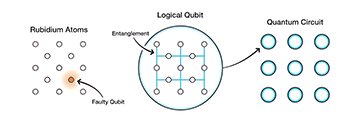
A team of researchers led by Mikhail Lukin at Harvard has achieved a significant milestone in quantum computing by creating the first programmable, logical quantum processor. The processor is capable of encoding up to 48 logical qubits and executing hundreds of logical gate operations, representing a notable improvement over previous efforts. The breakthrough is considered a key step toward stable and scalable quantum computing, offering potential applications in fields such as medicine, science, and finance.
The work, published in Nature, demonstrates large-scale algorithm execution on an error-corrected quantum computer, signaling progress toward early fault-tolerant quantum computation. Lukin compared the achievement to an inflection point similar to the early days of artificial intelligence, indicating that ideas of quantum error correction and fault tolerance are starting to bear fruit.
The research was conducted in collaboration with Markus Greiner, MIT colleagues, and QuEra Computing, a Boston-based company founded on technology from Harvard labs. The logical quantum processor uses neutral atoms as physical qubits and leverages parallel, multiplexed control of logical qubits, making the system more efficient and scalable.
While challenges remain, the researchers believe this advance will accelerate progress toward large-scale, useful quantum computers. The breakthrough is seen as a significant contribution to the development of quantum information processing and sets the stage for transformative benefits in various domains.
Denise Caldwell of the National Science Foundation described the achievement as a "tour de force of quantum engineering and design," acknowledging its potential impact on science and society. The researchers plan to continue their work to demonstrate more types of operations on the logical qubits and configure the system for continuous operation.
More: https://techxplore.com/news/2023-12-programmable-logical-quantum-processor.html