


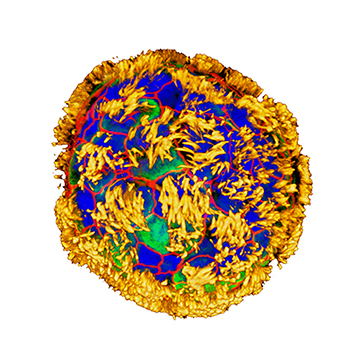
In a groundbreaking development, scientists are exploring the potential of miniature 'anthrobots' constructed from human cells to revolutionize medical treatments. Envisioned as molecular physicians of the future, these living devices, created from a patient's own cells, could play a crucial role in detecting cancer, repairing injured tissue, and eliminating plaque from blood vessels.
Published in Advanced Science, the research led by Michael Levin, a developmental biologist at Tufts University, introduces a remarkable breakthrough. The team coaxed tracheal cells to form organoids, termed 'anthrobots,' capable of self-propulsion using tiny appendages. When introduced to wounded neurons in the laboratory, these anthrobots demonstrated the ability to assist in neuronal repair.
Xi "Charlie" Ren, a tissue engineer at Carnegie Mellon University, praises the work as "amazing and groundbreaking," emphasizing its potential to pave the way for personalized medicine.
The initial "living robots" created four years ago involved stitching together embryonic heart and skin cells from the African clawed frog. However, considering potential immune rejection in humans, the recent study focuses on utilizing tracheal cells from the adult human trachea. Gizem Gumuskaya, Levin's graduate student, employed a 3D scaffolding made from rat tissue, mimicking the human tracheal environment. The resulting organoids, showcasing diverse shapes and sizes, were engineered to move with cilia acting as miniature oars.
The study explores the interaction of these anthrobots with human tissue, demonstrating their ability to contribute to nerve tissue healing. Astonishingly, clusters of anthrobots facilitated the formation of a nerve tissue bridge, promoting the healing of scratches. This response was notably absent when nonliving substances were tested.
Partially funded by biotech startup Astonishing Labs, the research aims to harness anthrobots' potential in treating neurological diseases and injuries to nerves and spinal cords. Thomas Cirrito, the managing partner of Astonishing Labs, envisions applications in burn healing.
Experts see additional potential applications, including using anthrobots as screening tools for pollutants, new drugs, and carcinogens. The ability to monitor the vitality of organoids based on their movement opens avenues for high-throughput screening in various studies.
Salvatore Simmini, a stem biologist at STEMCELL Technologies Ltd., sees promise in using anthrobots to test the effects of viral infections and evaluate the efficacy of potential antiviral drugs.
Researchers speculate on further enhancing anthroids by modifying their genomes for specific functions, such as drug delivery. Levin suggests that anthrobot delivery vehicles may offer lower toxicity and reduced risk of immune system aggravation compared to existing drugs and implantable devices. The prospect of harnessing anthrobots' sensing and memory capabilities for monitoring the body's health status opens up a realm of possibilities. Cirrito concludes, "Biology can do a lot more than you would expect."
More: https://www.science.org/content/article/tiny-anthrobots-built-human-cells-could-help-heal-body
